.png)

Loreen: [00:00:03] I'm in charge of my own destiny, that I'm actually taking what patients have taught me. I mean, university taught me a lot in seven years, but the best education I ever received was from every conversation that I ever had with a patient.
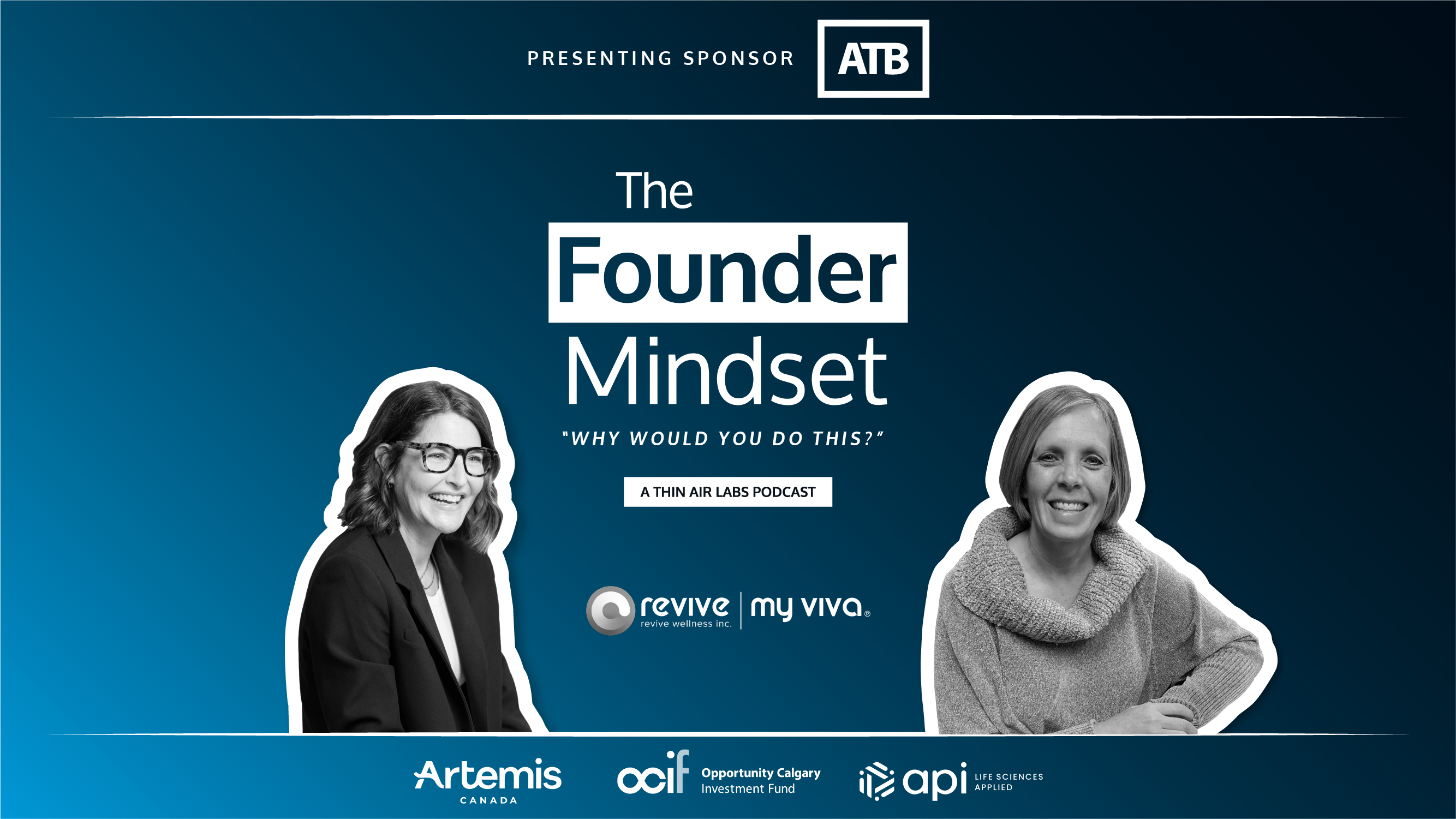
Leah: [00:00:22] Hello and welcome to Season Three of The Founder Mindset, brought to you by ATB. I'm your host, Loreen Sarich, and I'm delighted to be back for another season of talking to Founders about what it's really like to build a company from that first big idea. If you've listened to previous episodes you know I was a journalist for over 20 years, so I'm more curious about why anyone would ever want to become an entrepreneur. Not so much about the business model, product market fit, and so on. I want to understand why entrepreneurs keep going, why they think they're the ones to solve a massive problem, why they want to make a real impact in the world. And if you're here, I bet you want to know why too. Let's find out. Joining me today in studio is Loreen Wales, Founder and CEO of My Viva, a lifestyle management platform that helps patients manage chronic diseases like obesity, diabetes and heart disease with personalized, evidence based treatment plans. Loreen, thank you so much for being here.
Loreen: [00:01:21] Well, it's my pleasure, Leah.
Leah: [00:01:25] I'm so grateful that you made the drive from Edmonton to come and hang out with us in the studio, because it's just way more fun. Absolutely.
Loreen: [00:01:29] Absolutely. And it was a beautiful sunrise, as I said to you earlier. Just a gorgeous, gorgeous day.
Leah: [00:01:34] It's so pretty out there right now. It is, I love it. Well, as we do with every conversation in this room for this podcast, we go back in time. So I know you're a dietitian by trade, but I'm really curious about how you went from dietitian to entrepreneur.
Loreen: [00:01:50] Well, if you want to know the honest answer, I had zero intention of going from dietitian to entrepreneur. But I guess going back 28 years, when I started as a dietitian, I also had done a psychology degree and and decided that I wanted to work in the area of nephrology, so kidney disease area. Started my career at the University of Alberta, and in the course of the ten years that I was there, I think from the onset, I believe it was the first week that I learned the stats on why most… why over 70% of the population that had kidney disease had kidney disease. They had it not just naturally because they just only had kidney disease. They had it due to another comorbidity. 40% of them had kidney disease due to diabetes. And of that subset, 95% were type two diabetes, which we can do something about. Another 30% had kidney disease because of uncontrolled high blood pressure. So from the very onset of my career, I kept thinking, seriously? It's the 20th century. Are you kidding me? We can do something about this. And dialysis and living with kidney disease. There's no quality of life there whatsoever, right? And so, fast forward ten years, I realized that I wanted to help prevent people from ending up on dialysis, ending up with kidney disease. And I scoured the globe to just see what was going on out there. And it didn't really seem like there was a big urgency in trying to solve this problem. Don't get me wrong, there's a lot of people working on things, but nothing transformational. And I was looking for something transformational. And so I took a leap of faith and jumped off of the cliff to start a bricks and mortar clinic, Revive Wellness, which in 2006, interestingly enough, was the first private practice group of dietitians in not just Canada, in North America. And at that moment I went w.t.f. Are you kidding me? I went to the US to multiple conferences. I went to the dietitian associations in the US trying to find private practices, and there weren't any groups of dietitians in private practice together. And I thought, okay, I really don't want to be a pioneer here. Like, give me a break.
Leah: [00:04:33] Right, right. I don’t want to do this. Right. Yeah.
Loreen: [00:04:35] But then I was so passionate about the problems that I saw in tertiary care that I thought, well, somebody has to be brave enough to do this. So I opened our, what we call our bricks and mortar clinic, Revive Wellness in 2006. And so that was the start of the entrepreneur journey.
Leah: [00:04:52] Wow. Okay. So you've got the bricks and mortar building, but then you realized we actually need to take this a step further. We need to create a platform for these patients. So tell me a little bit about your thinking there and how that came about.
Loreen: [00:05:06] Well, when it comes to patient care, we as healthcare professionals, all we have ever had, believe it or not, to give patients to manage their health at home are our verbal recommendations or some general handouts. We give advice.
Leah: [00:05:22] Yeah, right. Yeah.
Loreen: [00:05:23] I, as a dietitian, I can actually build people very personalized meal plans and stuff. But no payer system wants to pay me to do it because it's… it takes a long time to actually build it. And when you compound that with multiple health conditions, it becomes even more complex. So that started to percolate in my brain and realizing, I mean, you get tired in clinic constantly saying the same thing over and over again to patients. And there's this lovely word, or I guess it's a… it's technically two words that healthcare professionals love to use when it comes to chronic disease management, which is noncompliance.
Leah: [00:06:08] Right. They're not doing what we told them to do. Yeah.
Loreen: [00:06:12] My goodness. If it was just that easy. Seriously. I mean come on Loreen, you need to exercise. You need to eat better. You need to manage your stress and get enough sleep. And, oh, congratulations, Leah, you deserve to be paid whatever you get to be paid as a healthcare professional because you did your job. You told Loreen what to do, right? That's insane. Sorry. It's insane.
Leah: [00:06:35] Yeah, and I'm not going to do it because I'm not… I'm not incentivized. I forget. My life intervenes. Et cetera. Et cetera.
Loreen: [00:06:42] Exactly. Yeah. So that. But that's all that we've had at our disposal. And technology has come along the way. I mean, if you think about glucometers to measure blood sugar levels, blood pressure cuffs to measure blood pressure at home. You know, spirometers, that people living with asthma can use to assess their breathing and stuff. So there's… and I picked those three because those are the three areas that technology has been studied the most in looking at how it can help with behaviour change and supporting patients at home.
Leah: [00:07:16] Okay.
Loreen: [00:07:17] And so looking at that literature, looking at just this concept of okay, so all I have at my disposal to give people to manage their health at home are our general, my general recommendations, some general handouts, and some general websites that I send them to. I thought, oh, this is terrible. We need to do better. We can do better. And I had this aha moment that well, hang on a second. I have built clinical algorithms. If/then logic decision trees to help standardize patient care, to drive efficiency within the clinic setting. And all of us in healthcare have memorized many of those and built many of those. And I thought, well, wait a second, we could actually digitalize that. We could build this lifestyle medicine program that brings everything that the patient needs under one roof, that is evidence-based, that's clinical grade. And I say clinical grade. And when I say those two words to you, what does that mean, Loreen?
Leah: [00:08:20] It means like it's really sciencey and less wellness-y, maybe.
Loreen: [00:08:26] And evidence, right? Very sciencey, very like bullet. It's tested. It's tried. It's researched, right? And then add the layer of privacy and security on top of that to make sure that we protect personal health information that we're doing. We're doing it with thought, intention and purpose for the good of individuals to improve their health. Not just sitting in our mom's basement, building an app and thinking that we go put it out there to the world and don't have to follow all of these other rules and regulations and stuff.
Leah: [00:09:03] Right, right, right.
Loreen: [00:09:04] So we built this clinical grade beast, I want to call it, because it didn't… I mean, and I've had people I had one VC person say to me who, interestingly enough had gone into med school, but he quit. But he said to me, oh, I could have built what you built for $50,000. And I smiled and said, well, thank you for that comment. But that wouldn't even pay for my third-party testing, penetration testing, that I have to do on an annual basis. But thank you for that comment. I appreciate that, right?
Leah: [00:09:40] Thanks very much. It's got to be infuriating. Yes, yes. Yeah. So here we are. Here we are. And this is the start of My Viva.
Loreen: [00:09:49] It was. And that epiphany came in 2013.
Leah: [00:09:52] Wow. Okay, amazing. So let's do a little one on one, if you will, on My Viva and where it's at today. So when did you launch?
Loreen: [00:09:59] I had the idea in 2013. I then bootstrapped it, played around with it for four years trying to think, oh, you know, is this something? Do I believe in this? Is this going to work? And somebody said to me, do you… how much do you believe in this? And I said, well, I would bet my children's lives on this. And he said, okay, so if you have that much conviction in it, because that's a pretty bold statement.
Leah: [00:10:36] That’s huge. Yes.
Loreen: [00:10:37] And he said, why are you so convinced that this is going to work? And I said, Because I've been living and breathing it my entire career.
Leah: [00:10:46] Right. We talk about domain expertise.
Loreen: [00:10:48] Yeah. I know patient care when it comes to chronic disease management with these cardiometabolic health conditions. I know it well. And so, he said to me, okay, well, kid… It's another entrepreneur. He said, if you really want to see your vision come to fruition, you're going to need to go and raise some capital, because otherwise your idea is dead in the water, because you've bootstrapped it for the four years and you're at the end of your road. And so that was another pivotal moment for me, because if my mom was still alive, she'd say to you that I had this fierce independence of never wanting to be a burden on people, on them, my mom and dad, or anybody else. And so it wasn't about arrogance that I didn't want to take money from somebody else. It was about a harsh reality that I know within my own soul is that if I take a penny from somebody else, I need to be 100% confident that I am going to see that through and to take that vision to fruition and don't stop until I make it happen. And so I had to do a gut check. And a few, spend a few sleepless nights trying… really saying, okay, if you're going to actually jump off this cliff, you know, the road that you have in front of you.
Leah: [00:12:12] Wow, that's a huge leap. It's a huge leap. Okay, out of curiosity, how many employees do you have right now?
Loreen: [00:12:19] With our dev, we're at 40, I believe.
Leah: [00:12:22] Wow. That's exciting. Do you want to talk about how much money you've raised? You don't have to.
Loreen: [00:12:27] Yeah, no, I'm… Sure. I mean, here's the thing. It's… people look at it, like I said, I've had people say, oh my gosh, I could have built that for $50,000. Like, do you, have you ever done type two?
Leah: [00:12:40] Right?
Loreen: [00:12:40] I mean, seriously. Yeah. That’s laughable right there. Yeah, totally. So it's… so we've… I've raised 14 million to date since 2017, and I didn't take that 14 million all at once. I took 2 million at the beginning. I somehow, I got a really good piece of advice to go raise smart capital.
Leah: [00:13:03] Hmm. What does that mean to you?
Loreen: [00:13:06] Well, that's just it.
Leah: [00:13:07] Yeah.
Loreen: [00:13:08] Today it means, don't ask me how I was able to pull this off, because at the time... I mean, seriously, I'm a healthcare professional. I spent seven years going to university, focused and worked in the healthcare industry to then be an entrepreneur and having to learn everything when you're, like, living it, right? There's no, oh, okay, go study this, do a project on it, write an exam, and become more knowledgeable. No, this is real world. Just, off you go.
Leah: [00:13:38] Yeah. Good luck.
Loreen: [00:13:39] Go figure it out. And so I was told to go get smart money, and somehow I did. And so the approach that I took with it was, well, what is it that I don't know, I don't know. I've never built a business. I've never IPOed a business. If that's something that I want to do. I've never done a merger/acquisition. I've never scaled a company internationally. Right? I've never grown from one employee up to 10,000 employees. There's a lot that I don't know. And so I went out and met and talked and clearly convinced some very amazing humans to be a part of my journey. And none of them had a background in health, interestingly. And so when I took that first 2 million, we came up with the plan of what we were going to do. And every step that I took, they… it's… the other fascinating part about the story is that they all have non-voting shares. And yet I've treated them as if they have voting shares and I've kept them up to date. They've all been mentors to me. Every single one of them. I have learned so much from them on this journey. And so we've done these small raises bit by bit, because I only ever wanted to take what I thought I needed, and then we would get together as a group, evaluate, figure out, okay, well, what do we do next? Are we all satisfied with where we're at? Do we keep going? What do we do? I technically never asked for money. That was the interesting thing along this journey because I couldn't. I didn't feel I could. My job was to go and tell the story and to then do the evaluation and give them the facts of saying, okay, here is, here's what I've done so far. What do we do next? Here's what I think we can do if we go forward. Is everybody in, is, like, what? You guys have to be the ones to decide. And so that's been the journey to date.
Leah: [00:15:40] Wow. That's amazing. I love the relentlessness that you're describing, you know, and yet very strategic and honest about what you know and what you don't know. And I do, I mean, working for a VC, obviously, that's the kind of thing that I know that our capital team likes to hear. You know, people that are realistic about what they know and what they don't know. That's great. And they communicate that effectively.
Loreen: [00:16:03] Well, it's… that's part of the reason why humble confidence is part of one of our six core values. And the other one is tenacity because.
Leah: [00:16:13] Oh, yeah.
Loreen: [00:16:13] You sprinkle it on everything that we eat and drink. It's in the water.
Leah: [00:16:14] For sure. It is with you. Absolutely. Okay. But we know when it comes to building these companies, there's always a moment when it's like, wow, this is a do or die moment. This is a real pivotal time. What are we going to do? I don't know if this is going to work. So I ask every Founder that sits in this chair, this question. Give some thought as to a moment for you when you had that do or die kind of moment. And what happened?
Loreen: [00:16:42] Well, I think I've had many. I think I was always, right? When your runway is getting close to the end and you really aren't sure what the next steps are. I've had that conversation many times over in my head. And here's the weird… It's so this is this. I say this out loud and I just in my brain think people really are going to think my cheese is off my cracker because it's bizarre. As stressed as I have been in those moments, the belief has never wavered, Never, The conviction of what… The journey that I'm on. Not that. That isn't the part that has ever wavered. Because patient care has to be transformed. It is non-negotiable. The cost of health care these days is through the roof. No health system can afford it. Non-communicable diseases like obesity, type two diabetes, heart disease they're plaguing every nation around the globe, and so do I have conviction about this? 100%. Live it. Breathe it, believe it. There's no wavering on that. So in those scary times when the runway has been close to the end, it's been… Yeah, but it's not negotiable that we stop like you. We can't stop. That's insanity if we stop. So we have to figure out a way. And so the… So all I've ever done in each of those moments is to take a deep breath. And yes, there's been a few times where… there's the Kelly Clarkson song, what doesn't kill you makes you stronger. Yeah. And I mean, I get the song, really, the lyrics have nothing to do necessarily with what I'm going through in business, but the lyrics of the course absolutely do. What doesn't kill you makes you stronger. That is called resilience. And there are always going to be ups and downs on every single journey. But I said out of my mouth to one of my first investors that I would, I bet my children's lives on this, and I didn't say that flippantly. I said that with the passion and conviction that I, as a human, have, and the belief that we how much I believe that patient care needs to be transformed. And so I am not stopping until I see this through.
Leah: [00:19:22] Shivers. Just got shivers right there. Wow. The Founder Mindset is brought to you by ATB Financial. In the fast paced world of tech, your banking needs evolve as quickly as your industry. Whether you're just starting out or aiming to reach new heights, ATB Financial is dedicated to supporting tech companies every step of the way. Partner with ATB Financial for a banking solution that grows with your business. You actually told me once that it defies logic, the way you think about building My Viva. So I want to talk a little bit about that. But what I want, I'm curious about, is how this level of conviction affects the rest of your life. I mean, the impact on, you know, your family, your relationships, things like that. What does that look like for you?
Loreen: [00:20:11] Well, when I started this. So let's see. Our daughter is 22. Our son is 20. So… And I've been at this since, so 12 years. So they were, what, eight and ten at the time? And for a few years when I started, they straight out told me how much they hated it.
Leah: [00:20:35] Oh, really?
Loreen: [00:20:36] Yeah, they did not like my company.
Leah: [00:20:39] Why is that?
Loreen: [00:20:40] Because it consumed a lot of my time. And when they look back on it now, and neither of them feel that way now, they're really proud of me. But when they look back, I've asked them that question. I thought I was an active participant in their life and an active mom, and that I… And both of them genuinely said to me, you 100% were because I put them first. Right? I did. And when they would go to bed at night, I was working into the evening and in the night. Right? I mean, on the phone, with, as you're releasing your next version, you're testing in the middle of the night. You're fixing glitches and stuff before 6 a.m.. I mean, it just is the way that it is, right?
Leah: [00:21:31] Yeah.
Loreen: [00:21:31] So, yeah. So my kids are good. My husband, he traveled a lot for work. His own work. I mean, he is a civil engineer. And so both of us, I mean, he did his masters in engineering. And he… I've said to him, you need to pursue what fills your bucket, right? Because, yes, family matters. But when you spend that much time in university, those professional goals, that professional drive, that there's also a whole lot of personal satisfaction that comes from executing on those. And so I never wanted to stand in the way of him. And so he traveled a ton for work as the kids were growing up. I was a single mom, married, running a business, like doing all the juggling and stuff. And I don't know, you just… you make it work because it mattered to me that he was happy. It mattered to me that the kids were happy, and it mattered to me that I was a good wife and that I was a good mom, and that I was a good friend. And sure, I don't have a friend group that I have thousands of friends that I have the time to go spend time with. But I have a core group of friends that I've been... Some of them I've been friends with for over 30 years. And they still are my people. And so, I've made an effort to make sure that that is center in my life, because if it wasn't, Leah, seriously, I've built a technology to help people manage their health at home. I need to practice what I preach, right?
Leah: [00:23:08] Absolutely. But, you know, I mean, and I ask every entrepreneur this not just the women, to be very clear, but I do say that when when your family pushes back or says, you know, I hate this company, I hate what you're doing, or, you know, I'm worried about you. You're working too hard. When you hear that from the people that you love some... What's that feel like for you?
Loreen: [00:23:25] Well, with the kids, it made me sad because they saw their dad travel all the time for work. And he was gone all the time. And we never got… I mean, we got sure Miss Daddy, but never got I hate his job, right? But with mom, it was I hate yeah, I hate what you're doing. And I think maybe because I was that constant, I was always the one there. Until the pandemic. And then my husband stopped traveling for work, and, and we, for the first time as a family, were together. So I know there's a lot of negative things that people say about the pandemic, but there were also some pretty amazing things that it allowed us to do, and that was to actually be a family unit for several years. And we just never had that before. So there are a lot of precious moments in time with that. And I think through that, my kids and my husband, we all gained a richer appreciation for what one another want to do with their lives. And so… and my husband, I mean, he… Yeah, he's my, he's one of my biggest cheerleaders.
Leah: [00:24:33] Yay. I love hearing that. Okay, so you did talk about this a little bit about how you have to practice what you preach. But I do want to know, as you do all of this work, to build this company relentlessly, as you've described, how do you stay well and healthy and productive in your own way?
Loreen: [00:24:52] Well, so with the travel these days, it's been a bit chaotic. And again, I mean, I've been that type of healthcare professional my whole career. I have to practice what I preach. So I have a routine. I work out on a regular basis. I… with travel I finally found and here's a plug to Orangetheory, was the one gym that I found was in the cities that I was going to. So I bought a membership. Go every day that I'm out of town, have a routine when I'm home at the gym and working out. I always, as a dietitian, I've always found so much power in fueling your body properly. So that's just ingrained in me. So I don't have to really think about it, because I've just believed that. And then managing stress. I would say, I mean, exercise is my mental therapy. I mean, as we all have, we all have journeys in life. We all have terrible things that happen to us and stuff because it's called life. I've just pushed myself to have to deal with it. I mean, I lost my mom to pancreatic cancer when I was 36. She never really… she got to meet my children, but they were two and three. And so we were just talking about that at Thanksgiving, that my kids never got to know her, right? And so but I mean, everybody has horrific stories, right? And so it is what it is. What doesn't kill you makes you stronger. And you have to find that balance, and you have to find how to work through them, as opposed to burying your head in the sand. Because trust me, I'm a human. I sometimes would rather bury my head in the sand than deal with things, but I know that that's not an option because I am, I refuse to be a hypocrite.
Leah: [00:26:44] Mhm. Yeah. And also you're the leader of your organization.
Loreen: [00:26:48] Mhm.
Leah: [00:26:48] And you need to model this for the people that are there. Yeah. Yeah. I get it. I love that. So we've talked about some of this stuff that can be challenging as an entrepreneur. But I'm also extremely curious about what you love about this work.
Loreen: [00:27:02] That I'm in charge of my own destiny, that I'm actually taking what patients have taught me. I mean, university taught me a lot in seven years, but the best education I ever received was from every conversation that I ever had with a patient. And so working through to figure out how to solve problems and help give patients meaningful, effective tools to help them build their self-confidence to manage their health at home. That is, I mean, it literally puts a smile on my face every time I get a text message or a phone call or talk to a patient to say, do you have any idea how much you've changed my life?
Leah: [00:27:51] Wow.
Loreen: [00:27:51] Do you have any… No. Really, Loreen. Do you have any idea? I… when I first met you thought that maybe you were some voodoo witch doctor. Because how could just spending two minutes a day doing some reflections and answering questions that don't necessarily… They're just collecting some data… Really help me change my behaviours and fast forward. Oh my gosh. How impactful this is and how yeah, it's wow, Loreen. And so that's what excites me is that we're affecting change at the individual level for patients, but then also for healthcare professionals to reduce the cognitive load to improve the efficiency and stuff. So those are the things that get me excited because we're really, genuinely transforming care.
Leah: [00:28:45] Wow. It's life changing. Oh, that's so exciting. I love it. You mentioned this briefly, but I want to dig into it a little bit more because impact is really important to us at Thin Air and to me. And so I'd love to understand how you think about creating meaningful human impact with what you're building.
Loreen: [00:29:02] Well, that is front and center. That's our why: transforming patient care. So regardless of where you live on the planet, regardless of who you are as a human, every human, I believe, deserves to have the tools to help them take control of managing their health. And that is what really does fuel my… it's not. And people say, oh, you're building a business to actually have a $1 billion valuation and a huge exit. Okay, well that's secondary, but it's seriously not what's driving it. Because if it was money that was just driving this, I would have quit a long time ago. It doesn't… that's kind of like a “so what?” Because money doesn't build happiness at all. It never has and it never will. We get one shot at this life on this planet. And to me, I want to be able to give people the tools for them to be able to take control of their health and live their most optimal life that they can for themselves. That's the greatest gift, in my mind, that any of us should be able to receive.
Leah: [00:30:25] Wow. I love this. You're so fun to talk to. I'm just going to say that right now. So when you start thinking about My Viva and writing the story for your company, how do you want that story to go?
Loreen: [00:30:38] Of course. You're asking me this when I got up at 3 a.m. today and was doing some work and stuff. So there's always, when you get a few less hours of sleep that there might be a little bit of emotion on there. But I guess the story for me is thinking, and I think I said this to you before, that on my deathbed, people have often said, well, nobody's going to care what you did. It's the people that are standing, looking down at your coffin to say, oh, I wish I had more time with Mom. But I actually believe that my kids and they've said this to me recently, how proud they are of the sacrifices that I've made, the commitment, the tenacity, the resilience and the drive to effect change at a global level. To be a part of something bigger than me. Because it isn't about me. I mean, sure, maybe I started, I jumped off the cliff and had this idea and it started to evolve. But I've collected, I've created, started to create a community internationally of people that have this same vision, that want the same thing. And so to be a part of that community, to be able to effect change at that level, that just feels like an incredible honour that if this is my last day on this planet, for whatever reason, I know that I will have done everything to be a part of that change.
Leah: [00:32:20] Oh, I love it. And then finally, Loreen, you know you're doing this. This is on you. How do you hope your own story goes as a Founder?
Loreen: [00:32:31] My daughter said to me, she responded to a LinkedIn post. I was the recipient of an alumni award from the University of Alberta last year. And I'm embarrassed to say that I really didn't understand the significance of that award when I got told that I received it. So when I put it out there on LinkedIn that I had received this award, my daughter responded and she just had said how proud she is of me and that I was a mentor to her. And so giving back, showing other women, showing young women how if you believe, if you have the conviction of anything in your life, don't waste it. Don't waste it. Take it and run with it. Because living with regret is the worst prison that we all, as humans, put ourselves in. And we, just so we're clear, we're the ones that put ourselves there. If we're living with guilt, that is on us, right? So don't live with the guilt. So what? I mean, do you think that I'm sitting here and that this has been a cakewalk? That's laughable, because, congratulations, it's been a ten year overnight success, and we're still nowhere near done, right? This is the hardest thing that I've ever done in my life. Hard. Hard, hard, hard. But if you believe strongly in what it is that you're doing, go for it. So that's what I want my story to be, is somebody that people can look at and say, you know what? She actually took an idea. And she not only built a technology, but she built a business. She actually, over, no matter how many doors got slammed in her face because trust me, there are many, and those door slams are still coming on this journey. But no matter what, she didn't stop. And that's what it takes to have success. Is that conviction that you believe so deeply in something that it doesn't matter what storm comes your way. And I told one of my staff this week that after every storm, guess what? There's one guarantee. There's always a rainbow. Yeah.
Leah: [00:34:52] You're gonna make me cry, Loreen. Thank you so much for this conversation.
Loreen: [00:34:57] Oh, it's a pleasure. And you know, it's funny, Leah, because you said come and talk about my story. I mean, I don't think my story is anything special, right? Because it's just, it's the way I live and breathe my life. And I'm just an average person, you know, some one of my other staff this week said to me, you're actually a CEO, but you are a CEO that if the bathroom floor needs to be washed, you're down there on the floor washing it. If the toilet needs to be scrubbed, you're the one scrubbing it. If the garbage needs to be taken out, you're the one doing it. And I said, well, of course, because, that's… I'm a part of the team. I hated having to use the CEO title. I actually refused for a few years to use it, I did. I don't want to be… I'm part of a team. I couldn't do this by myself. So? So, yeah. So I'm just a little little girl from Edmonton, Alberta that is just very tenacious about wanting to effect change. But instead of just in Alberta, I want to do it globally.
Leah: [00:36:05] I love it. And I look forward to seeing what this looks like. Loreen, thank you so much.
Loreen: [00:36:10] Oh well, it's a pleasure. Thank you for having me, Leah.
Leah: [00:36:22] If you're building a tech company in Canada, you've probably heard of Artemis. They're the recruiters Founders trust to find the leaders and key teammates who will shape the future of their business. I know them personally. They're thoughtful, genuinely caring, and deeply connected in tech. The Artemis Candida team treats every search like the future depends on it, because it does.
Ready to accelerate innovation? The Opportunity Calgary Investment Fund is driving our economy forward by investing in opportunities that build a diversified and resilient future. Discover how OSIF is shaping Calgary's tomorrow at OpportunityCalgary.com.
API is helping innovators accelerate from idea to impact. Whether it's pharmaceuticals, medical devices and diagnostics, health technologies, or natural health products, API supports the full journey, from early research to clinical and commercial manufacturing. API bridges the gap between academia and industry right here in Canada.



In this episode of The Founder Mindset
Dietitian-turned-Founder Loreen Wales never planned to become an entrepreneur. But after years of watching patients struggle with preventable chronic diseases, she knew something had to change. That conviction led her to build My Viva, a clinical-grade lifestyle platform designed to transform the way people manage their health. In this episode, Loreen shares how she turned frustration into innovation, how she learned to raise capital with confidence, and why her belief in better patient care has never wavered.
She also opens up about the personal cost and the courage it takes to build something that truly matters. From sleepless nights and family sacrifices to the lessons she’s learned about leadership, resilience, and self trust, Loreen’s story is a powerful reminder that transformation starts with conviction, and that the hardest journeys often lead to the most meaningful impact.
About Loreen Wales
Loreen Wales is the Founder and CEO of My Viva, a clinical grade lifestyle platform helping people manage and prevent chronic disease through personalized, evidence based care. A registered dietitian and lifelong advocate for better patient outcomes, Loreen spent years in the healthcare system watching preventable illnesses take too many lives. Determined to make a change, she turned her frustration into action and built a platform designed to transform how people take charge of their health.
Known for her humble confidence, tenacity, and deep empathy, Loreen leads with conviction and care. She’s as passionate about empowering patients as she is about supporting her team, her family, and the growing community of innovators reimagining what healthcare can be.
Resources discussed in this episode:
The Founder Mindset is Sponsored By:
Contact Information
Contact Thin Air Labs:
Contact Loreen Wales:
Dietitian-turned-Founder Loreen Wales never planned to become an entrepreneur. But after seeing too many patients struggle with preventable chronic diseases, she knew something had to change. In this episode, she shares how that conviction led her to build My Viva, a clinical-grade lifestyle platform transforming patient care, and how resilience, humble confidence, and self trust have shaped her journey.