.png)

Brian: [00:00:01] We’re willing to try stuff. We're willing to go out of our way. That's a huge difference in other communities. But the big difference is you’ve got to be here. If you're here and you're a good person, the community will help support you and grow because everybody here wants the community to grow together. It's not just the individuals. It's not like that anywhere else. And you can get handshake deals done here. That means something. So I think that's part of the entire advantage, let alone the corporate stuff and everything else that adds to the opportunity. But I just think it's the mindset that shifted. And now Calgary is starting to believe in itself, too. The last two weeks alone, we've had $11 billion worth of deals done in our city.
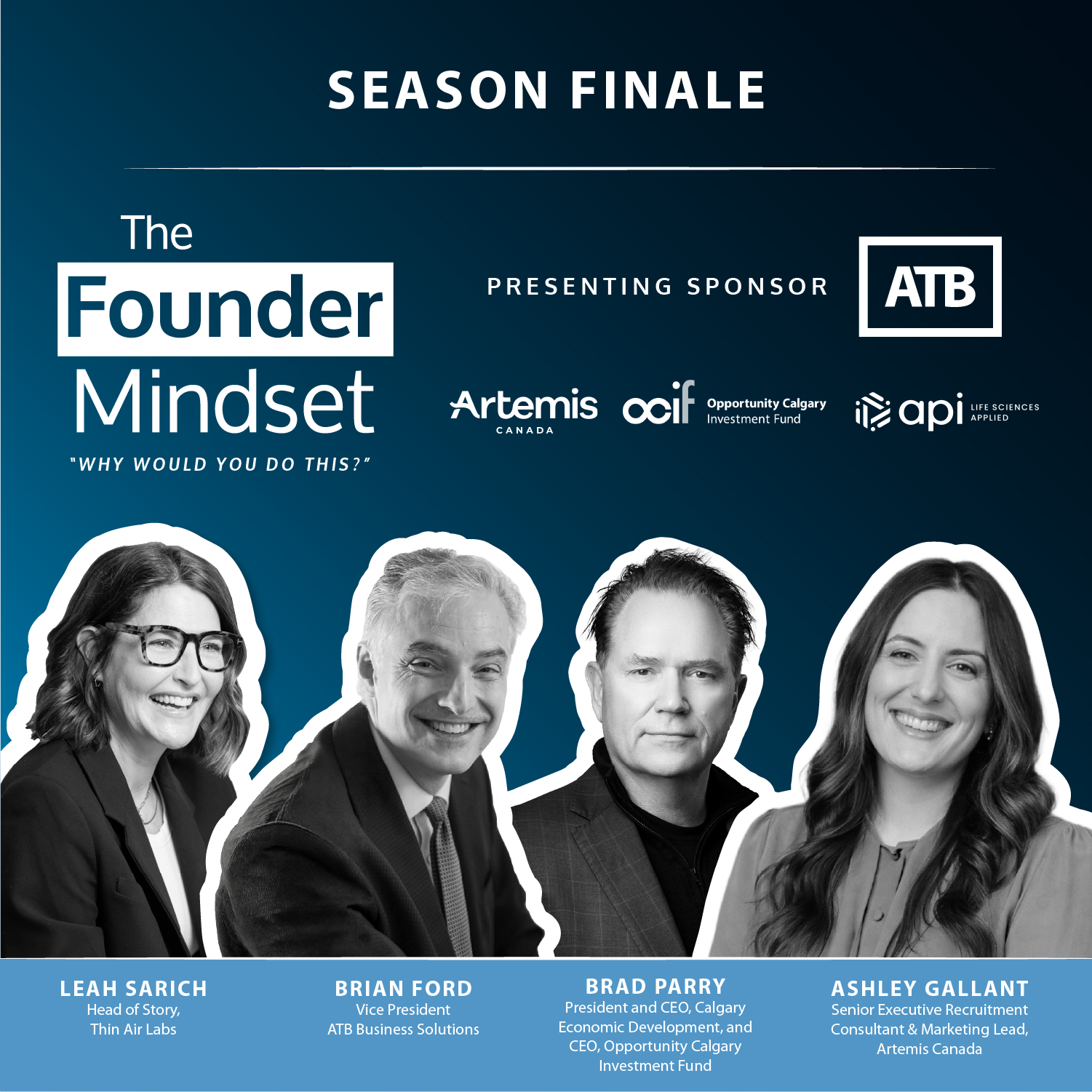
Leah: [00:00:44] Hi everyone. Thank you so much for being here for this live recording of The Founder Mindset. Thank you so much for braving the spring storm and the snow. So thank you so much for being here. Special shout out to the podcast production team, Astronomic Audio, who drove in from Edmonton during the storm. So thank you guys so much for being here today and for your support all season long. Thank you so much. I'm the host of The Founder Mindset. My name is Leah Sarich. We love ATB, our presenting sponsor. So thank you ATB for this season of the podcast. And really, the podcast is about exploring the human experience of being a Founder. So what does it feel like to do this wild work where you build a company from nothing? What does it feel like late in the middle of the night when you're like, oh my God, how much runway do I have left? And we talk through all of that in the podcast studio and online, and it's amazing. And I'm so honoured to talk to Founders all season long. But what also came out in these conversations is that, you know, Founders can't do it alone. So they have a team, they have other Founders, they have Co-Founders, and they have an innovation ecosystem that supports them. And so we thought for this final episode of season three (woo!) We wanted to bring together the folks that support these Founders as they grow and scale. So with me today, we have Brian, Ashley, and Brad, and I'll let you introduce yourselves and maybe your organizations. And we can start with a little bit about why you want to support the foundation of the innovation ecosystem in the first place.
Brian: [00:02:12] Thank you so much. My name is Brian Forde. I'm with ATB Financial. We use the term business solutions as a group. I also use the term transactional banking, but it's a bunch of lines of business that I have. And it's everything from what, I would call it the plumbing of banking that clients need and companies need. So that could come payments that could include like receivables financing, supplier financing, all your kind of deposits, investments that you would have as a business with the bank all sits under my space. But what's kind of interesting as well is I manage a group that really focuses around tech companies, fintechs, and, in particular, around crypto. So you're going to hear a lot of crypto from me today because I think there's a great crypto tech community in Calgary, in particular. So I'll talk a lot about that. And I've been with the bank for about eight years, and before that, I actually worked in Korea. I was in South Korea for about five years, and before that I was in Toronto. But I've always sort of been in the space of banking. Commercial, corporate banking and supporting technology firms. So pleasure to be here and meet everyone. As a bank, why would we want to be in this space? It's huge. Right? If you think about the banking industry, for us, we want to be able to support you at the beginning of your journey because ideally, in a perfect world, you're going to become bigger, you're going to be successful. We want to be there for you. We want to grow with you as you scale. We want to be able to support you as you grow and scale your business. And I'm going to talk a little bit about that today, about what does that mean? And how do we actually support clients as they do grow and scale? And I will also share some examples of clients that we started with when they were a startup to where they sit today. Some really fascinating companies that I will actually share some of those stories as well. So that's myself, and I will pass it over here.
Ashley: [00:03:58] All right. I'm Ashley, I'm an executive recruitment consultant at Artemis, Canada. At Artemis, we partner with tech companies and generally speaking, Founders, to hire their executives or really strategic hires. And I think we all know that great companies are powered by great people. And so we like to make those connections. We work really closely with Founders to make sure they're building the teams that are the right fit for their domain, their size, their scale. We tend to come in at inflection points. So that could look like, you know, maybe a solo Founder taking off a hat when it's time and making sure it goes, you know, to the right person. It could be an inflection point of maybe a Series A where your leadership team needs to change to get you to that next level. And whatever goal it is that you're looking for. It could be correcting a mis-hire and doing a confidential search. So there's a variety of areas across the tech ecosystem that we come in and support Founders with their people.
Brad: [00:04:51] Hi, I'm Brad Perry. I'm the president and CEO of Calgary Economic Development and the CEO of the Opportunity Calgary Investment Fund. Our job is to help diversify the economy, right? So when you think about what CED is responsible for is, is really helping position Calgary for long term economic success. And the way we do that is through attraction, retention, and expansion of companies, capital, and talent. And the fund itself, which I can get into a little bit afterwards. But that is really a tool for economic development. It's a tool to help us diversify the economy. And so for us, it's about looking for diversification. It's looking for those other sectors. So we're not just a one-trick pony, right? So how do we invest in the ecosystem? How do we get the innovations to really start to make sure that we have a whole bunch of other sectors that will grow and thrive and become as robust and reliable? So we're not going through this sort of cyclical economy again. So that's the job that we do. And so we've got teams on the investment side, and we have teams on the trade and investment side to help drive those companies growth. So what we do is we also help companies expand globally. So we have accelerator programs. We have trade programs, which as you get into the market, as you start to build your PMF and you get your TAMs done, we can help you go into international marketplaces to look for new clients for products and services. And I can talk about those in a bit too.
Leah: [00:05:58] We’ll totally get into that. Thanks so much, Brad. Brian, I'm looking at you as ATB and I want to understand, you know, if you're a Founder listening to this, what do they need to be thinking about? If they're looking about attracting and working with a banking partner, how should they be thinking about that?
Brian: [00:06:14] You always want to pick a banking partner that's there to provide you, not just support, but advice, right? So I think the advisory side is really important. And it'd be no different than how you might treat your accounting partner or your legal. But the bank is also an advisor. And sometimes people or Founders or startups don't think of the bank as a place for advice. And we're there for that. And that's one of our purposes. So I think that's just something always to think about. Also, make sure that the organization, the bank you're working with that they can scale with you, right? So what I always be careful of is a bank that maybe is trying to fit you into solutions, that is maybe for their commercial clients or their corporate clients. It's not what you want, right? You want a solution that fits your business. And it might actually have to be a little bespoke. It might have to be a little customized. And it's okay to ask a bank for that. The other comment I would always say to is ask your bank for support. I work with a lot of startups.
Brian: [00:07:07] I don't mind if a startup comes to me and says, are you interested in capital? Do you look at seed funding? We might not say yes, but we should hear you out. I also work with a lot of startups that will come and say, well, will you partner with us? Will you look at our technology? Will you actually bring your IT group in to take a look at what we're offering? A bank should say yes to that. They shouldn't say no. It doesn't mean they'll do it, but they should be open to the conversation. And that's what you want for your bank. You want your bank to be a partner, and a partner is going to listen to you. They're going to talk about investments, they're going to talk about capital, and they're going to talk about partnerships. And we do have startups that literally are in the startup stage, where we end up partnering with them at some point in their journey. And I think that's an important piece of what the bank should offer you. And you shouldn't be afraid to ask the bank for that.
Leah: [00:07:54] Thanks for that, Brian. So, Ashley, when it comes to Artemis Canada, how do you guys think about supporting startups specifically? Is it sort of case by case basis?
Ashley: [00:08:04] That's a great question. I think, you know, we are ideally your talent partner. We partner with you very closely. And I think it comes back to your true partnership, what you've described. You know, the ideal one is where we start off our relationship really understanding your business. It's not just, I need to hire a VP marketing and me turning around and finding one nearby. It's really understanding your story, you as a Founder, what you are, you know, your goals are. I'm trying to 3X in the next three years. Okay, then how do we find someone who has done that, who can do that? Who's done it in, you know, the right space for you? It is a case by case basis because every Founder is different, every company is different, every leader is different. And so, you know, when you really shrink down the pools of the things that you're looking for, it tends to be quite small, especially at the leadership level. And so we aim to really understand your needs so much so that maybe even before you anticipate them. Like I think an ideal partnership has been, you know, one where I'm so plugged into the C-suite that I can say, this person's on the market, you need to talk to them. And, you know, I have an instance of that where that happened. And now there's, you know, an office opening in Calgary and hiring 50 engineers because of just that connection, that suggestion, that understanding where their business is and where they want that to go. Like that to me is the true partnership. It has to be both sides, though. There's a lot of trust involved. There's a lot of, you know, communication, there's some hard conversations that need to happen to get to that. So not everything is going to be an ideal partnership. But, you know, similarly, you want one that grows with you, that's nimble, that will scale with you. And that's what we aim to do with all of our partnerships. And that's how we're most successful, I would say.
Leah: [00:09:40] For sure. Absolutely. I loved your comment about trust. And you guys can start thinking about this, but I want to ask you specific examples of what that looks like in practice. But Brad, before we do that, tell me a little bit about what you're looking for when you are thinking about making an investment through OSIF.
Brad: [00:09:55] So I guess some background on OSIF. So the opportunity Calgary Investment Fund was set up in 2017, back when there was a big challenge, there was a whole bunch of office spaces that were going down, the oil prices were getting killed. People thought it was going to come back. It didn't come back. And so the city decided to put some money aside. So they put $100 million aside. But it's interesting. It's not unlike any other startup. We sort of went in with the right idea, but then really learned that we had to fix the program and how we did that, you know, and Angie was one of the first people on the team. And I think when we launched the program, it was like an intake portal, right? And so we didn't get a chance to define what it was. And so we put it out there and we had like 287 applications in the first three months. And because it's a city fund. So just so you know, so Calgary Economic Development and OSIF are wholly owned subs of the city. So we're not part of administration. We're not part... We report to a board of directors and I report to council itself. So we're not part of the bureaucracy. We're not actually in the city. We just have one shareholder. And so when we launched it, it was a mad dash.
Brad: [00:10:52] So people were applying. Like somebody, you know, wanted to expand their bar patio. Somebody had an app in their parents basement that was going to be the best thing. We had multinationals come in. So we didn't really get a chance to define what it is we wanted. And so the board was really trying to figure it out. And so not like any other startup, you’ve got your feet under you for the first couple of years. You're actually realizing what the hell's going on. And so because the team was put on its back foot, because the way we were set up. So remember, this was set up and this is Chatham House rules, right? We were set up by accountants, lawyers, and city administration. And so you've got a shareholder who's not just risk averse, they’re risk negative. And so the collars we had to put into our deals were ridiculous. And it put us on the back foot because one of the things, we had to actually do due diligence on anybody who applied. So whether it was a brutal idea or not, we literally had to put them through an evaluation cycle. So that put the team behind. And then Covid hit and we made some initial investments. And so we didn't want them to fail. We didn't want to say you can't get funding.
Brad: [00:11:49] So we had to go back and renegotiate all of our amendments. We had like 15 amendments to do during the Covid period, at least, I think, Ang? And so that was going back and wanting to work with the Founders, wanting to work with these companies and try to get them back on track. So we literally lost like 3 or 4 years. And then once we got through the backlog, we said, what the hell are we supposed to do? Right? And I think my position, our view is that, look, governments shouldn't invest directly into companies. That's not our job. That's what the market. What we have to do is help create the environment where innovation and innovators can flourish. And so we changed our thesis. And so now it's really about finding, fueling, and fostering. So our job is to go and find the right kind of opportunities to build because we're an opportunity fund, not a venture fund. So we're not necessarily looking for dollar returns. It's great to do that. But the intent was never to be a regenerative fund. It was meant to create an ecosystem, get job creation, you know, fill up some office space. And so that's the finding part. So we became curational. So we had to look for the kinds of deals versus just taking the deals in. Fueling is what it is.
Brad: [00:12:48] We had to put capital in, but we refer to it as combustible capital because we are a grant-based program. We don't take equity. We don't do any of that stuff. We don't dilute. It's literally milestone-based grants. You get a check when you do that. And the last part for us is fostering. So how do we make sure the investments that we're doing are helping grow the community and the investments? And how do we make sure that we're building that diversification in our economy? So what we're doing is not just looking in the rear view mirror. We're looking five, seven, ten, 15 years out and saying, where do we need to start to think about investing for those kinds of things or putting money into like an innovation node, which we can talk about in a bit. How do we build that ecosystem to help our innovators go in there and flourish and provide that environment for them to build a company, to start to grow, and then have seed come in and help them scale, as I mentioned, our trade program. So when we look for investments, it's less about direct company investment, but more so about how do we build an ecosystem that's going to make us better in the long term in those core sectors that we think we can win in?
Leah: [00:13:44] I love that. Thanks, Brad. I do want to take a moment to talk a little bit about specific examples. I think that helps people understand what it is that you guys do for the innovation ecosystem. So Brian, I'm looking at you. I know ATB has partnered with a lot of startups here in Calgary. I know one of ours, Quickly, you've been a great partner. So maybe you can just talk a little bit about some real life examples of this work.
Brian: [00:14:04] Indeed. The other thing I was thinking too, like, again, when you look at a bank, yeah, you want a bank that's innovative too, right? I think that's really important. A bank that actually embraces technology. Okay, maybe it embraces your technology, but they embrace technology, I think is important. And I would say ATB, we're pretty tech-forward in what we do. We're different than the big five banks. You know, our core banking systems, our payment engines, they're not like the core five. They're not legacy. They're much more tech-forward. And I think, I'll use really good example quickly in a moment, but I'm actually going to go back. So we actually nine years ago as a bank decided to support the crypto industry. We're the only player in Canada that decided that we would actually support crypto when everyone else said no to it. We put in a regulatory framework. We put in a risk framework, which we've now developed. We would bank today 75% of the regulated crypto industry in Canada. It's quite an achievement for us as a bank. It's become its own business line. It sits under myself, Jonathan, and the crowd there. It manages risk for me and it's actually become a very, very successful business for us. But I'll tell you, that's where you start startups because every one of those clients was a startup, every one of those clients, and I'll give you some examples. And I've talked to the clients and they're fine with names. So I'll use Shakepay. I don't know if everyone's heard of Shakepay before, but they are a crypto exchange out of Montreal.
Brian: [00:15:26] And I love the Shakepay because the Founder will say, I've had the Founder come out and speak to our board. His quote is, if it wasn't for ATB, we wouldn't exist. Like he wouldn't exist. Today they have 1.6 million clients. They're actually becoming a direct, clear, they're becoming a financial institution themselves. So think of a Wealthsimple or Neo Financial. Neo would be another great example. We actually were the backbone of Neo Financial's credit card. We stood that up for them, and then they became so big and so successful that they went on their own issuance. They actually became bigger than our credit card, which is great. I love it. Like it's a great story. So when I look at the Shakepays and Neos, but we started with those names when they were actually startups. And what's kind of interesting about some of those names, and I'll quickly into the same boat and quickly as a receivables payables. They help small companies get paid faster. Great technology, great ownership. Those three companies started in our, what we call Entrepreneurial Centre. Like are literally our. Our branch as an account as a startup. And today all three of those clients sit in our capital markets business, which is the largest of the corporate. We have 500 capital market clients. So they went from startup and we're talking 2018, 2019. I think we both put capital right at the beginning. And the other thing that we have done with and again, with a Neo, with a Shakepay with, a Quickly.
Brian: [00:16:53] It's not only in many cases, we'll put capital into them, but we also give them credit. And if you think about your world, if you've ever gone to the bank and asked for credit, it's hard in a technology and it is really difficult. But the fact that we've invested and we have technology teams that sort of have an ability to understand the risk associated with the tech company that's different than the risk with oil and gas or with real estate. You know, your big sectors: agriculture, oil, gas, energy, real estate. Easy stuff, tangible, right? Real estate is the easiest thing to lend to, right? You’ve got land, you’ve got buildings. It's easy. It's hard in tech because you got a bunch of receivables that really, how do you actually grab those receivables and bank? You can't. So I actually am very proud of ATB and what we have done in the tech industry in all of Alberta, but it's not just Alberta. So I just came back from Toronto. I've been in Toronto. I think I've been Toronto, New York, and Montreal more in the last three months than probably Calgary, because we have clients in the tech industry and ecosystem that we support in all those cities. So there's just some really good examples of what. And that's what your bank should do for you. And if your bank doesn't do that for you, then you should think about a different bank.
Leah: [00:18:04] So Ashley, same thing for you when it comes to Artemis. Give me some really good examples of big wins in the startup space.
Ashley: [00:18:10] Yeah for sure. And specific to Alberta, I can give some really tangible ones and ones that really relate to this room. I think Phil called me last summer and said, Neo needs a bunch of developers. Can you help them? And I said, okay. And I took a call with Chris Reed on Saturday morning and said, hey, nice to meet you. How can I help? And he said, I need ten engineers in the next month. And I said, okay, that's going to be tough, but I'll try. I'll see my best. Let's see how it goes. And it went really well. We did that and then we did a lot more and that was great. So thanks, Phil, I really appreciate you on that one. And so obviously Neo, that is one of, like a great story. And I think that also creates a talent flywheel, which I think is a thing that's really interesting. You know, a lot of tech hubs get a talent flywheel when there's maybe an IPO or a sale. Also, when there's a layoff, there's opportunity there where folks say, hey, maybe I'll like take a minute and start something. But then also some talent moves on. And I also work with Questrade really closely. I will caveat, I am not allowed to take from Neo and put them in Questrade. That would be like very bad business. But I was helping the Questrade team in Toronto predominantly over the last year across, you know, the entire org.
Ashley: [00:19:20] They want to 3X their growth and they're on their way, which is fantastic. And they said to me, we've noticed there's a big talent pool in Calgary. Like tell us more about that, and particularly fintech. And so then we look back and if we look at the ecosystem, many of them worked at Neo. And so, you know, I've placed some talent who have moved on from Neo and not directly from. And so you have Ralph, who was employee six. He's now one of the first employees of Quest Bank, which is a net new initiative, one of the first Canadian fintechs to become a bank and one of the few people in Canada who you can really say was on the ground floor of starting a bank that isn't one of the big six. And so that's like an excellent flywheel story. That's a very excellent Alberta story. And so I think that's like a great example of that. And I think now more and more people and companies are coming to Alberta because of that talent flywheel. And I think it will only continue and hit other industries. Yeah, I would say those are like the biggest wins within the last year. But those types of themes are what we get really excited about.
Leah: [00:20:17] No kidding. I can see why. I think we get really excited about them, too. Yeah. So Brad, same thing to you when you're thinking about the Opportunity Calgary Investment Fund, what are your some big wins and opportunities that you're very excited about?
Brad: [00:20:30] Going back for a second, talking about how we learn and grow. I mean, that was one of the things when we took, you know, had a chance to catch our breath was like, how do we do this? And we heard a lot of feedback from the community, a lot of negative feedback, which was fine, because we learned. So you don't lose, you learn. But it wasn't misplaced. Like we deserved the stuff because we didn't do a good job of communicating and stuff. But when we took a step back and said, look, we're not a venture fund, so we don't have the capacity or the team structure to actually be able to put money into the community, because that was the big thing. It was, you know, the corporate slush fund was a big headline that kept coming back at us in the first sort of couple of years, but it was the furthest thing from the truth. We took a step back and said, okay, how do we do this? Because we don't have the capacity. How do we help the ecosystem? So we actually consciously went out and did an RFP to bring incubators and accelerators into the community itself, right? Because we knew we had some great startup ideas. We never had a startup problem. We just had that growth and scale problem. So how do we help our local companies? So we actually put $10 million aside and worked with a number of global incubators and accelerators. As a matter of fact, we're one of the only cities in North America that has all the big guys headquartered here. So you think of Endeavor, Thrive.
Brad: [00:21:35] All of those things are here, helping our local companies go through learning how to not just grow a company and build a company, but access global markets, access capital. The second thing we did was we heard loud and clear that we weren't getting money into the hands of startups, you know, because we were trying to find the bigger deals and there was a bunch of other stuff. And so we consciously went out and did a fund of funds. So we said, let's go back, and we did an RFP and did a whole bunch of work around that. But the idea was, how do we leverage the expertise in the marketplace, and how do we put our money to work more quickly and more effectively with people who are doing this on a day to day basis? So we did with Thin Air Labs and Sandstone. So James is here with Sharon, and so we put some money in with them. They matched that money. So then we had this pre-seed fund that was going in. We did the same thing with AEC and Yaletown for them. And what we did was they made sure they had to have the money invested in Calgary. And that's the hard part, right? So you’ve got to go find the deal flow. So if you think about the funnel, we invested at the front of the funnel to get companies that were going through incubators that could get funded, which was the key. And the way we structured those deals was we'll give you a sweetener if your company can graduate your program and raise capital. And we put like a floor of $1 million.
Brad: [00:22:43] So if your company can raise $1 million, which should buy you at least 18 to 20 months of runway, maybe hire 2 or 3 people. And even if it fails, that's okay. Because now we've got people who have the bug who want to start companies who want to do things. And so for us was, if you can put companies that can raise capital coming out of your program, we'll give you more money to keep doing that. So we put the sweetener in behind that. But again, we couldn't do the direct investing. We just didn't have the team or capacity. So that's why we did Yaletown and AEC as well. So at the end of the day, we ended up with like a $25 million pre-seed that was focused just on local Calgary companies. And I'm thrilled to say that James and the team have done a great job of getting that money out the door. He's done a great job. So we're that's how we put money back into the ecosystem to help drive it. And it was sector agnostic. It was just more, let's get the money out the door and make sure it's working in complement to the work that we're doing on these innovation nodes, which is how do we then create the environment that allows those companies that are graduating and getting capital to get around like minded companies, to build IP, build new things, have the collisions to start to drive that ecosystem development on nodes? I'll get into it after, but very specific sectors where we think Calgary has an immense right to, to be successful.
Leah: [00:23:50] I love it, I love it. The Founder Mindset is brought to you by ATB Financial. In the fast-paced world of tech, your banking needs evolve as quickly as your industry. Whether you're just starting out or aiming to reach new heights, ATB Financial is dedicated to supporting tech companies every step of the way. Partner with ATB Financial for a banking solution that grows with your business. Before we get into the future thinking and all the fun things that everybody's got planned, I do want to talk a little bit about Calgary and Alberta specifically, and what is special here, because I know certainly at Thin Air, we hear it all the time how it's such a collaborative ecosystem, and it's something that's really special about this ecosystem. And so from your perspectives, I would love to understand how you're thinking about what is unique to Alberta and what's special about it.
Brian: [00:24:44] It's interesting, I was in Toronto last night at this time speaking on, to a primarily crypto audience around crypto and a little bit around investments and very, I was very, I was the only Albertan speaking on the panel. It was all Torontonians and I was very pro-Alberta. And I was talking a little bit about just Alberta's created an ecosystem for tech. I think everyone knows Edmonton, like a lot of AI, it's always been an AI-leading center. I worked in Calgary eight years ago. Before that I was in Korea. When I worked in Korea, Koreans knew about Edmonton's AI sector. Like that's, and I'm going back 15 years ago. Like that's amazing actually, that they were, it was so well known. But I actually think Calgary has become a bigger tech centre now than Edmonton is. And I think Calgary has become quite a significant tech sector. And a lot of companies that we deal with, especially companies that are out east, they're actually looking at relocating to Calgary. And a lot of it is there's talent here, it's a young city, it has a great demographic, has a beautiful standard of living in comparison to Toronto or Vancouver. It's become. But one of the reasons.
Brian: [00:25:52] And again, I'll go back to my… The crypto world is that here the regulator, the British Securities Commission, has actually made it crypto-friendly. So they allow crypto companies to come. They have sandboxes that you can play in that you can not get penalized, right? You can play in the sandboxes, see whereas there's nowhere else in Canada that offers that. You have a government that actually supports tech innovation, jobs and a government that supports crypto. I always use an example. I think last year at Stampede, I usually do 1 or 2 events per day. So let's call it 20 client events in ten days. I would have seen Danielle Smith at probably 12 of those events out there talking to everybody, right? I guarantee you other premiers don't do that. And it's not just Danielle Smith, it's her ministers. It's the entire cabinet. And I just think they have created an environment here that encourages companies to come invest here. And companies here have reacted by having the right people and the skill set and a very educated workforce. So that's, in my view, why Alberta has really succeeded around tech innovation, and Calgary in particular.
Ashley: [00:27:02] Yeah. I'll piggyback on that slightly. I'm from Waterloo, born and raised. You know, your neighbours are Founders. Your, you know, everyone you know, works in tech there and worked at BlackBerry and then didn't work at BlackBerry. And so you, you really are just kind of all around it all the time. And so I started my career in Waterloo, Toronto Corridor, which is fantastic. And then I moved here and I did notice some differences. And I now live in Vancouver. So when I'm speaking now, it's kind of referencing all of those experiences. But I think that is the strong culture of collaboration for sure. I think there's so many more collision points here. I think the fact that you can rely on a tech event every Thursday, like you don't have that in other ecosystems. So Phil, good job. You know, I'm a recruiter and I work across Canada, and I think this city has the most in-person work requirements. And that naturally will foster connection, collaboration, collision. In Toronto, you know, it's mostly remote and maybe hybrid. Same goes for Vancouver. Montreal also has quite a bit of that in-person connection. But, you know, when we look at the talent mapping, and I think this is like broadly after Covid, the back to work and back to office has really differed across the country and in those cities.
Ashley: [00:28:13] And so I think that will be really interesting to understand how does that impact innovation? If someone can study that, I'm sure. But I think that that's really, really neat and unique. I think there's also a really unique to Calgary is a lot of kind of cross-industry talent. So companies are more welcoming of those who maybe haven't worked in tech, but maybe they're a really excellent, you know, operator in a different type of business. I think similarly, the private to public, I think the playbook for a lot of other companies in another area is let's just find someone who's done it before, which is great. That is like so trustworthy and that's fantastic. And that tends to be successful. To me, I mean, I do that all the time, but I also find true innovation comes from someone who's never done it before, someone who's going to look at it differently, do it differently. Like to me, that lights me up. That gets me excited. But I also know like it's kind of a riskier play. But I do think that Calgary has more openness from what I've seen to bring folks in from other industries and to collaborate. So I think that yeah, are the unique points.
Leah: [00:29:13] That's definitely special indeed. What are you seeing, Brad?
Brad: [00:29:16] Okay. I got a long walk on this one. But first of all, Brian, if you have companies that want to come here, I have a company that actually helps with that. So by all means, send the leads over man. We will help, help take care of that. That's what our team does, right? You know, if you rewind seven years ago, even longer than that, I mean, Calgary wasn't this way, right? I mean, I left Calgary because you couldn't get the capital, you couldn't find the clients, you didn't have the talent. But then you fast forward to 2019, 2020, and then you see people not having to leave the market anymore, right? Because before you had to leave to get the talent, you had to leave to get the capital. I mean, I had a public company and I tried to raise capital in Calgary, and it was just… I remember going and talking to people and saying, yeah, technology, this and that. And they're like, I don't understand technology. I'm like, well, you have a remote control for your TV? Yeah. You have a smartphone? Yeah. You have a computer? Yeah. You use technology every day. Yeah, but I just don't get it. I said, so when was the last time you put your head in an open pit mine? Like I just, I could not get my head around this.
Brad: [00:30:09] And so it was a flyover that we just wouldn't bother trying to raise capital here. But you start to see that change, right? You had people who did successfully exit from other markets, who went down to the Valley, who went to Toronto, and decided to come back because of the quality of life that we had here. And you start to see that start to build out now. And so now you start to see the applications start to happen and people are going, hey, you know what? I'm going to invest in this community because I guarantee you there are stories that you guys don't even know about in the technology space that are happening right now and amazing companies that are doing global scale stuff. We're trying to keep up. We can't even keep up to that. But we now have the talent. We now have the capital. We're still short on clients and it's getting better. I think we need to still unlock the corporate stuff, but that's the big opportunity for us here. So the other thing that is an advantage for us, I think if you look at Edmonton and Calgary, and I remember when I first came here, it was always this chirping between Edmonton and Calgary. And I was like, as soon as I said, no, we’ve got to stop that. We're a province of, what, 5.5 million people.
Brad: [00:31:03] I mean, we're too small to compete. We've got to collaborate. And so when we talk to companies and stuff, we have Edmonton, which is a theoretical centre. Like we look at that, they've got all those amazing things that are happening here. But we think Calgary is the applied center. People will come to Calgary because they can actually work on projects. They can actually work on real world problems. And that's the one advantage I think we have is we have such an open opportunity with the data standpoint, and our pitch is always, look, we have the most head offices per capita than anywhere else in Canada. And people go, who gives a rat's ass? Well, we have the decision makers here. They go again, that's nice, but who gives a rat's ass? Well, the decision makers have access to the data, and the data is what's going to help us solve some of these global challenges. And that's where the difference is here, is people are willing to open themselves up to share the data. As a matter of fact, the city, its open data source at the city of Calgary is the best in North America, guaranteed. You can access a whole bunch of stuff. If you want to try to solve a problem, they will work with you. They will give you that data and you can access some of that data.
Brad: [00:32:00] So I think that's been the change. And now you're seeing people go, yeah, I want to work some cool shit. You know what I mean? We always talk about that. No offense to Waterloo, but sure, you can graduate and then you can go work for Uber or Meta or whoever, and you can sit in a cubicle farm and you'll never got to talk to your boss or your boss's boss or your boss's boss's boss. And you work in a sandbox environment for like two years and never see your product get light of day. Whereas you come here, you get shit done right away, and you get to work on stuff that's going to go and get implemented right away. And so I think that's part of it. But it's also the business community, right? I mean, you know, we talk about the blue sky thinking. That doesn't get in our way. We don't stop, right? We're willing to try stuff. We're willing to go out of our way. And that's a huge difference in other communities. But the big difference is you got to be here, right? That's the one thing in Calgary, if you're here and you're a good person, the community will help support you and grow because everybody here wants the community to grow together. It's not just the individuals. And I've done work in Boston, New York.
Brad: [00:32:55] It's not like that anywhere else. And you can get handshake deals done here. That means something. So I think that's part of the entire advantage, let alone the corporate stuff and everything else that adds to the opportunity. But I just think it's the mindset that shifted. And now Calgary is starting to believe in itself too, because I know when I came back in 2020, man, this city was not high on itself. It did not like itself. It did not believe in itself. It was the trough, as we like to say. And that's now changing because we're seeing all these amazing things. I mean, the last two weeks alone, we've had $11 billion worth of deals done in our city. I mean, that's crazy. Nobody would have thought about that seven, eight years ago. So it just takes that one thing to move. And I think now we're seeing that everybody wants to be part of something that's special. And I think we're definitely in a great spot. And I can tell you when we talk to people from across the country, there's a lot of Calgary envy. Like there's a lot of people in Toronto and Vancouver, Montreal going, holy shit, what are you guys doing in Calgary? I can't stop hearing about you guys. So that's what I think is the difference for us.
Leah: [00:33:51] That's a nice story. It's a good story. The one thing we know about innovation, of course, is that it's always changing, right? Stuff's always moving, always shifting, always changing. And this is a good thing. So when it comes to ATB, Brian, and you're thinking of this year, what are you focusing on? What are you excited about when it comes to innovation?
Brian: [00:34:07] Yeah, for sure. So,, one of the well, again, back a little bit to crypto, blockchain DeFi theme, right? Because we've been so focused on this industry, uh, we're really trying to look at how do we actually bring blockchain or DeFi technology or what I would call distributed ledger technology, DLT, into the bank, right? So continuing on to say, well, how do we actually bring this to life for our clients? But how do we bring this into the organization, right, to create efficiency? So there's a lot of work that we're doing around DLT. In general, we're looking at the whole use, I'll use the term programmable money. Right? So smart contracts. So like just the whole kind of concept that you receive your product and you automatically get a payment made right away. Use the term atomic payment. It's instantaneous. It's immediate. Just that whole concept. So we’ve got a bunch of POCs that we're looking at around that to say, well, how do we actually bring this to life within ATB? And then we're looking at partnerships with other banks. So we're talking to the big five banks to say, well, what are you doing? So I think everyone's probably heard there's lots of stablecoin initiatives. Another great tech story, Tetra Trust is a, not a lot of people have heard of them, they're a custody provider of digital asset custody. We invested in them. They just launched a stablecoin a couple of weeks back. And we look at stablecoin as is going to transform payments, going to transform how you pay money, how you collect money, how you move money around the world.
Brian: [00:35:33] We see it as a huge opportunity. So again, a lot of doubling down around stablecoins and all the banks are looking at this. And then the final one that we'd be looking at, I wouldn't say nothing that's going to be necessarily scaled this year, but is just tokenization. So I've had conversations in the last couple of weeks for a couple months, I should say, with a large agricultural client that's tokenizing $1 billion worth of farmland. He actually did tokenize it. So he put it on the blockchain and he sold that farmland around the world. Now he did relatively large chunks. And then we're in discussions with an office tower right now in Calgary that is trying to sell. They, they just, it's… they can't sell it. It's, the pension funds don't want to put that much money into the Calgary market. So he's looking at tokenization, to tokenize his office tower, again, about $1 billion worth of tokenization, sell it on the blockchain around the world. This is going to be led out of Calgary. There's no tokenization happening, there's none of this happening in Toronto and Montreal. Right? It's happening here. So that would be another area of focus for us is how do we actually drive that industry forward and be the leader in that industry for Canada with and with partnering with other banks as well?
Ashley: [00:36:54] Yeah. I mean, similarly, it's pushing industries forward through the work that we do. And so I would say we've had a steady stream of, you'll guess it, AI companies that we've been working with, but then also fintech has been a big one. So really helping those Founders accelerate their growth, have the right people to do the things that they need to be doing and hitting those goals. And how we do that is we're small. There's ten of us. We stay nimble. We try to experiment with tools. I think everyone is doing that across the board of what tools are the right ones for us right now? Also, staying on top of like market mapping, compensation, knowing what the talent is expecting and why. Really like keeping tabs on the innovation ecosystem across Canada so that we can be, you know, the talent expert that Founders lean on to push those things forward because, you know, one excellent hire can really change a company and then change an industry overall. And that's the goal with the work that we do. And so that's how we kind of plug into the ecosystem and try to help them innovate.
Leah: [00:37:51] I love it. Brad, what are you guys thinking about over at Opportunity Calgary Investment Fund and you're excited about for 2026?
Brad: [00:37:58] I just want to go back for a second. So when we sort of looked at this back in 2020, it was like, you know, well, we got to do something. What about innovation? And we said, well, you know, we want to be like Silicon Valley. We want to be like… And I was like, no, we don't. We need to be Calgary. Right? And so we did a ton of work around that. We brought people in who had done ecosystem development mapping around the world. And they, all of them came back to us and said, you know what? You guys have all the right pieces. You just haven't put it together yet. Like you just haven't got it connected. And so we did a bunch of research. I spent some time in Tel Aviv, in Austin, in Silicon Valley, around the world, just to understand, Sweden, just to understand what are these innovation centres doing? What's the right thing? And I can tell you, one thing that we took away from that was I met with all these guys, what they were doing, and I asked them, so if you go back ten years, what would you change? And to an exact, every single one said we would be more focused, because we went out to be too broad and we weren't focused enough. And so we started looking at this and started talking to the ecosystem and realized they really need to think about this, not only like a deep neural network, which is kind of what the innovation strategy is modeled after, which is let's try to put these hubs or these nodes together that are very focused on sectors that we think we have a chance to do well in.
Brad: [00:39:05] So we've invested in a bunch of those like Life Sciences Innovation Hub. We have the Aviation Innovation hub, we have Defense and Dual-use Commercialization Hub. We have an Ag Innovation hub. We just announced the energy transition innovation piece. We announced a transportation logistics. So we have all these nodes that are really focused on that specific sector. Now that paradigm inside the sector is broad, but now you bring people who are working on the same types of issues together, and you start to see this collision start to happen. These ideas, this new IP start to form, new companies start to form. But that's not good enough because I think the myth in all these other markets is they're not connecting those nodes together. And that's what we're doing right now. Part of the fostering piece is how do we look at life sciences into the Ag space? How does the energy stuff work in logistics? And that's where we really want to take it. So how do we start? The first part for us is let's set it up to make sure we have programming.
Brad: [00:39:57] We have opportunities. We have the capital for wayfinding. Again, you guys know there is no venture fund that has a general thesis anymore. They all have very specific thesis. So if somebody comes in on the venture side and wants to do something in Ag, we point them to the innovation hub there. And that's where you can start to see that deal flow start to happen. As we move that forward, we want to start to bring the scale markers in, because I think that's one of the challenges. We need to start to see more companies scale. And that's what we're excited about now, is how do we invest in those markers to really, truly help us move the needle on scaling to bring that in? And I think, again, you know, and this is not popular a lot, but I think we have to quit being so hung up about not failing. I think we spread the peanut butter so thin and we've given ribbons out to everybody. We have to fail. That's the thing. And the market. That's why when I talk about us not investing directly in companies, it's the market should dictate who the winners and losers are. Our job is to create the environment for that to happen. And the example I'll talk about is like China.
Brad: [00:40:53] 20 years ago, China said we want to win the EV space. They didn't say, BYD, you are the winner. They said, go figure it out. And they put the money out there. There was 196 companies that were developed within five years. There's still 96 companies that do EV work in China. But BYD was the winner. So the government got behind them and said, you, the market says you're winning. You're going to create jobs and drive GDP. Then we're going to get behind you and support you. That's the whole idea. How do we build that ecosystem for us? And that's what we're excited. And Brian's talking about sandboxes. That's exactly what's going to happen in these nodes for us, is how do we think about building a different way to de-risk innovation? Because right now, we have a huge challenge in our country where we punish innovators, we punish risk takers. Right? Anybody here knows, I mean, the personal guarantee stuff that you have to do, the stuff… If you fail, you fail for six years. I mean, it is not an environment from a government standpoint that's helping us build that innovation, that that try and fail, and we need to get ourselves over that. But I think we're excited because we see that mentality start to happen now, and there's more risk appetite for us in the community itself.
Leah: [00:41:54] Oh, I like that thinking. That's exciting, Brad. The other thing I want to ask you about is impact. At Thin Air Labs, we like to work with companies and support companies that are creating meaningful human impact in the world. It's something that's really important to us. And so I posed this to you. You know, you're in this innovation ecosystem at ATB. Brian, how are you thinking about impact?
Brian: [00:42:15] Yeah, there's a lot. So one, we do a lot around mental wellness. And that's a big thing. That's always been a big thing with ATB and supporting not just, obviously staff, but clients, right? So there's a lot that we do around mental wellness for clients. And I think in a startup space that can sometimes be a challenge, right? It's a stressful space to be in. And I think having that or knowing that, that that exists, or maybe your banker or the person you're dealing with at a branch, that they have that kind of background in them, I think that's important. The other thing that we also try to do is we try to look at sectors. So for any women entrepreneurs, we have our W by ATB brand. It's a huge brand. We do amazing seminars, right? So whether they're seminars, whether they're podcasts, in-person events, where we bring together women entrepreneurs in Calgary and Edmonton, all through Alberta. And it's quite a powerful brand. And I always encourage if you haven't and you’re not part of it, just get on our W by ATB website, participate and get your name on the list of the various events. And we bring amazing speakers. We do the same for Indigenous, right? Because again, there's technology within Indigenous. We also do the same for agriculture, for real estate, for energy, right? All these particular we’ll called sectors will have a technology team embedded in the sector. So when you as an entrepreneur, if you happen to be in technology and energy, you know that you're speaking to a group of bankers that understand energy and understand technology. Same goes for fintech. Same goes for the financial services space, the crypto space. So that's a lot of what we've tried to create that environment within the Alberta market. And I think that helps tech entrepreneurs because you're able then to relate to someone that actually knows your industry.
Leah: [00:44:05] Ashley at Artemis Canada, how are you guys thinking about creating impact in the world?
Ashley: [00:44:10] All that we think about is the human impact. Like, what can this one person do to change the trajectory of this company, of this product, of this industry, of the ecosystem overall? So it's kind of, we're obsessed with it a little bit because like, we take it very seriously. I'm on the line if this is a mis-hire, or I guess my pay is on the line, but in many ways it is a reflection of who we are. And so, you know, there's a ripple effect for every hire that you make. If you think about someone you work with, like, yes, you work with them and you get that done, but they also become a friend. You know, maybe they, you know, I've heard things like, oh, you introduced me to this person. You know, I brought someone from India and then he moved here. And then they remained friends and their families went on vacation together. And that all started with a LinkedIn message. And I know that that's very woo woo and like, okay, but human impact beyond even just the tech that we're building is something that's super, you know, top of mind for us. And then how they, you know, impact technology and the future of innovation within the country. So yeah, we think about it a lot and in a very personal way. And so I think that's why, you know, AI recruiting feels really scary and replacing that, like replacing that human element of recruitment where we, we really should know your motivations and what drives you and your values. And Founders really want that too, like their company is their baby and they want the right people along for that ride. And so we really try to, you know, vet for that humanness and making sure it's the right fit. Is this who you want to work alongside for the next however many years to reach your goals? So, yeah, we're obsessed with the human impact there.
Leah: [00:45:43] I love it. Obsessed with impact. That's amazing. Brad, how are you thinking about creating impact?
Brad: [00:45:48] I mean, for us, again, we think, try to think long term. We also have to connect a lot of dots, right? And so we've gotten some criticism before on some of the investments we've made. But if you think about, how do we make sure that we have corporates here, right? So it's one thing to have the startups, which we need that, but you also need to have clients. You need to be close to the big guys. Plus, we need to be able to funnel in some of the talent that's graduating from our ecosystem. So if I look at, you know, a deal that we did with Lufthansa Technik, it was Lufthansa Technik, it was the airport authority, it was the Government of Alberta. And the methodology was, okay, if we can put a bit of money in to make sure that we're competing against other marketplaces to bring them here. So we put in just under $3 million into this deal. That turned into $120, $150 million of capital investment into the community. It's like, okay, well, what does that mean? Well, we were able to convince them to actually bring their test facility here, their test cell facility. So there's new engines called Leap-1 engines. There's only five licenses in the world that you can work on those engines.
Brad: [00:46:43] And those are the engines that actually WestJet bought. So WestJet was part of this deal as well. So bringing LHT here to set that test cell up is great. It creates jobs. But more importantly, it's now a funnel for employment. So if you think of somebody graduating from SIAT or from the U of C who has an engineering degree, they can go into LHT, spend two years to become a certified aerospace engineer, making 150 grand a year. And so for us, that's the kind of impact we're thinking about. How do you link these pieces up to make sure that we're building the community for the long term? Because we want the startup ecosystem to go, but if you don't have clients to sell to, if you don't have somebody there, that's the mothership like de Havilland or WestJet or LHT, then then we're not doing ourselves a service. So for us, that's the impact that we look at in different kinds of deals that we do. Like the one, the CAE deal that we worked on. So CAE does all the flight simulators. So again, working with MRU now because MRU has a pilot training program, their challenge was they don't have enough SIM time to do that.
Brad: [00:47:39] So we worked with CAE, with WestJet, with the GOA, and ourselves to figure out how do we reverse engineer this to bake into a deal to get SIM hours for Mount Royal? But then the bigger challenge was they don't have enough training hours for their trainers. So these are the kinds of deals we have to structure. It's not just a straight ahead deal with equity, it's how do we put all these pieces together to do the better, greater good for the community in the long term in these core sectors? So that's the kind of work that we're doing. That's the impact I think we're talking about. It may not be tomorrow or next year, but in five years from now. I mean, look at the aerospace sector, right? We've been working on this for five years now, and now look what's happening. Look at the opportunities and look at the mentions we're getting on a global scale. People are talking about Calgary as an innovation hub for aviation commercialization and now defense as well. So, for us, that's about the kinds of impacts we want to see, is to create those opportunities for the long term growth of the community.
Leah: [00:48:31] Love it, I love it. All right. Now, if you've listened to the podcast and The Founder Mindset, you know, I like to wrap up every episode with the same question, which is if you're writing the story for your organization, or in the case of Founders, your actual startup, but in this case, your organizations that support Founders, how do you want that story to go? So this is rapid-fire. So you've got like 20 seconds to answer it. Brian, how do you want the story to go?
Brian: [00:48:57] We want to create an ecosystem that is open, an ecosystem that supports technology companies, that supports Founders, whether that's from capital to credit to your own retail, personal banking to wealth management. And we want to be able to support Founders so you can scale your business and grow. And we grow with you and you are widely successful, like so many tech clients in Calgary.
Ashley: [00:49:23] We don't want to tell our story. We want to tell the stories of the companies that we work with. That's what we do every single day. Our story, like it's not as interesting. So I'd rather we don't. It's more that, you know, we want to represent it. And it's an honour to represent the stories of Founders and to find the people that will be joining their team. There's nothing more special for us to do that. So I think that is the story for us, is theirs.
Leah: [00:49:48] And Brad, how do you hope the story goes?
Brad: [00:49:50] We want to be and will be the innovation capital of this country.
Leah: [00:49:53] Perfect place to end. Thank you so much for being here, everyone. We do have a few minutes I think, for some questions. What, a couple minutes? Anybody have questions for the team at the back? Do you want to run a mic? Phil's going to run.
Participant 1: [00:50:06] Thank you so much everyone for this amazing podcast. I learned so much. I actually used to work for ATB in a couple of spaces, both in front of the client care and then back end product design and L&D. So it's everything you say and more. So one question that I had and it comes up again and again in the past five years working in tech, is that the compensation that we give our tech talent does not always compete with the one that we get from our neighbours. And when you're a Founder and you're looking for the best of the best, you have this amazing idea, it's really tough to first find this person, but then be able to actually offer them equitable compensation. So my question to you, how do you approach bridging that gap and do things like leveraging AI and potentially equity compensation, kind of enter that conversation for you? Thanks.
Ashley: [00:51:03] It's an excellent question, and I wish I had the answer that it would make everyone happy in the room. You know, companies that are very early stage are strapped for cash. And I think that that is a reality. Sometimes you have Founders who are selling the dream and get on this ride with me. And what they do is then they leverage things like equity that can maybe be a longer term payout. I think there is a misconception though, which is really interesting, is that I get tapped by U.S. Founders all the time because they think, oh, I can get world-class talent in Canada at a bargain, at a discount rate. And we're finding more and more recently that Canadian talent knows their worth. I think salary transparency is becoming more of a norm. In Ontario, you need to have salary listed on your job descriptions, and I think that that might continue to be a theme. And so we've had to say to those U.S. Founders, like, that's not the case. It's not like a discount bargain hire. And they've had to kind of pay up a bit more. So I do think, you know, there's opportunity for it to get better. I don't think it's going to be solved overnight. But I think, yeah, early stage Founders, unfortunately, they do have to make those calls and they just don't have the capital. And so things like equity or the vision of the Founder really does mean a lot. But that doesn't also pay people's bills. And so, you know, there's a lot of inequity and we could talk about that all night and that could be its own panel. But I do find that transparency is helping and we'll see how far it takes us.
Brad: [00:52:29] My point of view is if they're if they're chasing the paycheque, you're not going to stop it, right? At the end of the day, if that's what, if that's what their currency is, is my paycheque, you're not going to win. You're going to lose that. And so I think it goes back to what you said. We need to have those real world problems, those exciting things, which is what that talent wants to work on. They want to know that they've had an impact. They want to know that they've made a difference. Like I said, the Waterloo example, if you want to go sit in a cubicle farm and work in a sandbox for two years, great. You'll make $175 grand, but you're not doing something meaningful. I think that's the difference that we have to think about, especially in our market.
Brian: [00:53:00] Well, I would say this more internal to, I would say, to ATB, and I think probably all the banks is, there would have been a point in time where you would have wanted to be a corporate banker or investment banker, not working in a technology team or are working in technology within a bank because you wouldn't make as much and that's actually significantly changed. We've had a big focus to make sure that our folks in tech are paid equally in comparison to whether you're a corporate banker or an investment banker, you're in a client-facing role. And that's been a very determined focus for us for the last decade and making sure that we have changed that, because that never used to be the case. And now it is. So it doesn't matter where you go. You can go into the technology side of a bank and you know that you're going to be earning a salary that's competitive potentially with the corporate bankers as an example.
Leah: [00:53:47] Do we have any other questions? Yeah. Right here.
Participant 2: [00:53:50] It's less of a question, more of a ramble really. But given tech’s pretty borderless and things are a little bit unstable, myself, I was curious what folks in Calgary and Alberta are doing to, I guess, kind of increase the Canadian market. Again, speaking for myself, having operated for two years, 60% of my business is in the States. I'd love it to be the other way and be less reliant on unpredictable partners. Put it that way.
Brad: [00:54:17] The entire population is 40 million people. So the total addressable market is a handicap for us, right? So, we can't ignore that. I think we do need to, though, have a different mindset in that we do need the corporates to want to work with our local companies, even with the City. We talk to them all the time about this, right? You've heard me say this, but you know, getting a cheque is great, but getting a client's better. And I think we need to convince our corporates to want to open that up, to want to actually use home-grown, homemade technologies. But at the end of the day, again, it's 40 million people, man. And that's less than California. You know, California's got more people than that. So you’ve got to think that way. And I think for us, though, I don't, we always talk about that, but it's not a disadvantage for us to export our IP either. Right? It's not just the US. I mean it's Asia, it's Europe. There's other places. And there's nothing wrong than having a company built here, scaled here that you can sell into the global marketplace. And I think sometimes we get caught too much into the, well, why isn’t, why aren't we buying ourselves? I just think it's good for us to be able to sell to other places, because then you don't want to leave. You want to scale. You want to be here.
Brian: [00:55:17] So you’ve got to look at the world, right? And I think, I think for a lot of companies, you’ve got to be looking beyond, say, the US. And again, with the bank hat on, make sure your banks are at the table with you. Right? Because the bank and we work a lot with EDC, we work with a lot of private insurance companies just to make sure that you protect your receivables, that you know you're going to get paid. You know, all of that is really critical when you suddenly have buyers overseas. So just, when you get in that market that you're selling suddenly overseas, make sure you engage your bank, engage partners like EDC, so you protect yourself so you don't lose money on potentially not getting paid.
Leah: [00:55:57] Thanks for that, Brian. I think we've got time for one last question. Yeah. Just here.
Participant 3: [00:56:00] Yeah. Sorry. My question is more, I guess specifically, for Brian. But I guess the overarching idea with how things are kind of evolving. So when you talked about how you built that ground-up risk framework for sort of decentralized assets, things like that, did that create more of a, like a broader paradigm shift in how you're approaching more traditional areas of your business, like your capital markets, like lending?
Brian: [00:56:21] You’ve always got to be risk-first, right? So when we built a crypto business, we took a risk-first approach to it because that's the most important thing, right? Like you can't put the bank at risk. But actually, more importantly, I can't put clients at risk, right? Like clients have money that sits with us, that might be with a crypto company. We need to make sure that's protected. So we actually worked with the regulators to put a regulator trust accounts that protects the fiat. We put rules in place around making sure that we're banking the right crypto companies. They have to be regulated. You know, they have to be going down the path of full regulation. It's interesting, ATB, and this was before my time, but we were actually the first bank to support the cannabis industry. No one else in Canada would support cannabis but ATB. We stepped into it before the regulations were clear. We stepped into crypto before the regulations were clear. We're probably going to step into tokenization before the regulations are clear, but we do take a risk approach to it. And I would say with a small business too, when you deal with your bank, you know, the bank may have a lot of questions about risk and compliance.
Brian: [00:57:22] And if I were you, actually be happy for that, right? It's a good thing. The bank is there to protect you as a business owner and protect the client. So I think when a bank wants information about risk and compliance, don't treat it as kind of like, oh boy, I’ve got to answer all these questions now. You want your bank to ask you that. If your bank's not asking you that, I'd actually be a little bit worried. But everything we've taken is a risk approach. I also am lucky to work in an organization that's just open to those type of conversations. And maybe those, I'll use the term emerging industries, that we're willing to support. And the big five banks, like I see, I see them all the time. They're highly jealous of the fact that we've been able to do this multiple times with emerging industries. They'll catch up to us in due course, but they'll only catch up to us once the regulations are quite clear in the Canadian ecosystem, which is not there quite yet.
Leah: [00:58:13] Perfect. Brian, thank you for that answer. And thank you to our incredible panelists. Thank you so much, Brian, Ashley, and Brad, thank you so much for being here. And thank you all for being here. And thank you to our listeners at home. Thank you so much for listening. And if you want to hear anything that you've heard today, again, this will be recorded and produced by our lovely Astronomic Audio team. Thank you so much, everyone. Bye! If you're building a tech company in Canada, you've probably heard of Artemis. They're the recruiters Founders trust to find the leaders and key teammates who will shape the future of their business. I know them personally. They're thoughtful, genuinely caring, and deeply connected in tech. The Artemis Canada team treats every search like the future depends on it, because it does. Life sciences, aerospace, agribusiness, tech. The Opportunity Calgary Investment Fund is fueling Calgary's future through smart investment and innovative sectors and world class talent. It's how we grow a resilient, diversified economy. Explore more at opportunitycalgary.com. API is helping innovators accelerate from idea to impact, whether it's pharmaceuticals, medical devices and diagnostics, health technologies, or natural health products, API supports the full journey, from early research to clinical and commercial manufacturing. API bridges the gap between academia and industry right here in Canada.
In this live finale episode of The Founder Mindset
Leah Sarich sits down with Brian Ford of ATB Financial, Ashley Gallant of Artemis Canada, and Brad Parry of Calgary Economic Development and the Opportunity Calgary Investment Fund for a wide-ranging conversation about the support systems that help Founders build lasting companies. Together, they unpack how banking, executive hiring, ecosystem design, and strategic investment all shape a Founder’s ability to move from early traction to real scale.
Brian shares how ATB has intentionally supported emerging sectors like crypto and fintech, and why Founders should expect more from a banking partner than just an account or a loan. Ashley explains how Artemis works alongside Founders at key inflection points to make critical leadership hires, build trust, and strengthen teams before growth stalls. Brad offers an inside look at how Calgary Economic Development and OCIF think about long-term economic diversification, innovation nodes, and creating an environment where local companies can flourish without leaving Alberta.
This conversation is packed with insight on startup ecosystems, tech talent, economic development, global market expansion, customer access, and why collaboration is one of Alberta’s greatest competitive advantages. It is a fitting finale for a season dedicated to the human experience of building, reminding listeners that while the Founder journey can feel lonely, no company scales alone.
About the Guests
Brian Ford is with ATB Financial, where he leads business areas focused on banking solutions for companies, including support for technology, fintech, and crypto businesses. He brings deep experience in commercial and corporate banking and is passionate about helping companies access the financial tools, advice, and partnerships they need to scale.
Ashley Gallant is an executive recruitment consultant at Artemis Canada, where she partners with Founders and high-growth companies to make strategic leadership hires. Her work focuses on helping companies navigate inflection points, build high-performing teams, and connect great businesses with the talent they need to grow.
Brad Parry is President and CEO of Calgary Economic Development and CEO of the Opportunity Calgary Investment Fund. He works across investment, attraction, retention, and expansion strategies to help diversify Calgary’s economy and strengthen the innovation ecosystem for future growth.
The Founder Mindset is Sponsored By:
Contact Information
Contact Thin Air Labs:
Contact the Guests:
Brian Ford / ATB Financial
- Website: ATB.com
- LinkedIn: ATB Financial
- LinkedIn: Brian Ford
Ashley Gallant / Artemis Canada
- Website: ArtemisCanada.com
- LinkedIn: Artemis Canada
- LinkedIn: Ashley Gallant
Brad Parry / Calgary Economic Development / OCIF
- Website: CalgaryEconomicDevelopment.com
- Website: OpportunityCalgary.com
- LinkedIn: Calgary Economic Development
- LinkedIn: Opportunity Calgary Investment Fund
- LinkedIn: Brad Parry
In this live season finale of The Founder Mindset, Leah Sarich brings together three leaders from the show’s sponsors to explore what Founders need beyond grit: banking partners, talent partners, and ecosystem builders who help companies grow, hire, access capital, and scale from Calgary to the world.