.png)

David 00:01
There are really, really difficult moments. I've been very lucky. I've had to shut down companies, but that was because of financial reasons, and the assets move forward, which is my luck. Like the drugs have been very, very successful. I've been in most moments and under certain points, I just have to get up, dust yourself off and decide whether you want to do this again.
Leah 00:24
Hello and welcome to season three of The Founder Mindset brought to you by ATV. I'm your host, Leah Sarich, and I'm delighted to be back for another season of talking to Founders about what it's really like to build a company from that first big idea. If you've listened to previous episodes, you know, I was a journalist for over 20 years, so I'm more curious about why anyone would ever want to become an entrepreneur, not so much about the business model, product, market fit and so on. I want to understand why entrepreneurs keep going, why they think they're the ones to solve a massive problem, why they want to make a real impact in the world. And if you're here, I bet you want to know why too. Let's find out.
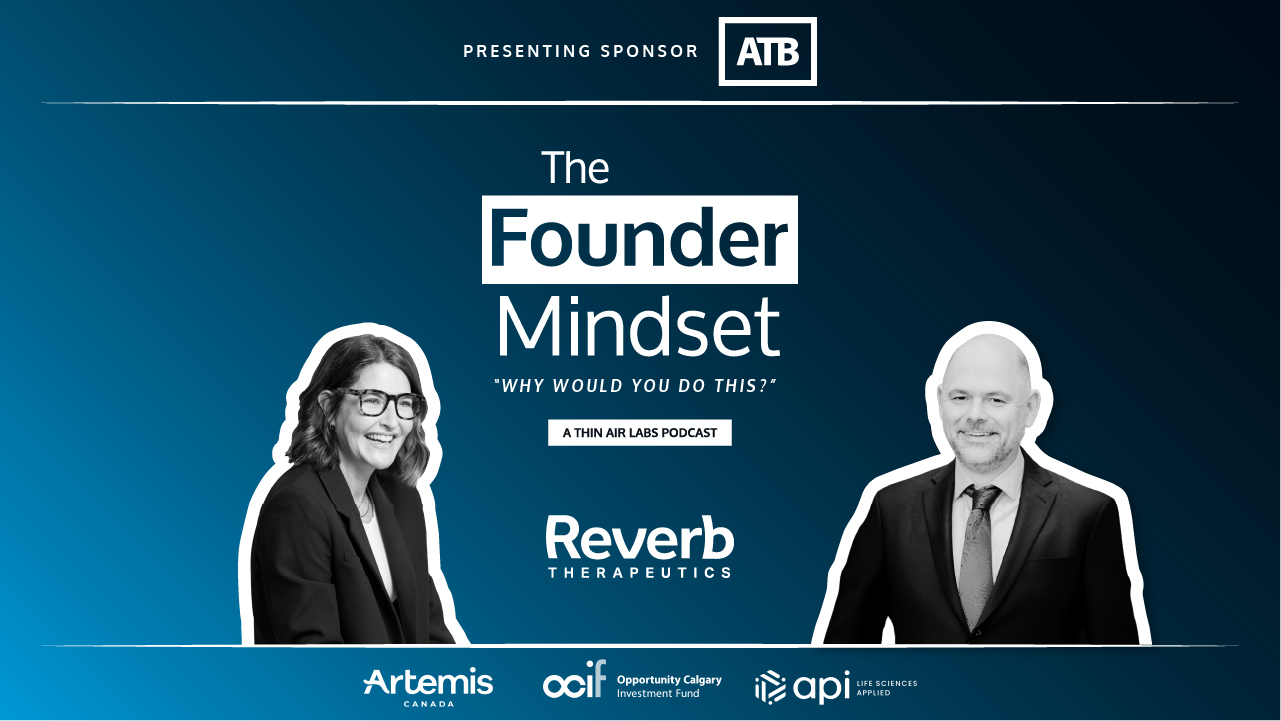
Joining me today is David de Graaf, Co-founder and CEO of Reverb Therapeutics, a biotech company developing precision medicines that harness the therapeutic potential of the body's immune system. David, thank you so much for being here today.
David 01:20
Yeah, thank you for having me.
Leah 01:24
Absolutely so at the beginning of these conversations, I always sort of start with how you even became an entrepreneur in the first place. So we're gonna have to go way back with you. But of course, you're a scientist first. So how did you make that leap from scientist to entrepreneur?
David 01:39
It was completely by accident, unintended, these are the unintended consequences of life, but when you look back, it tends to make sense. When you live forward, everything is a big gamble. Yeah, I'm a geneticist by training, and I thought I'd spent my life in academia, and I started as junior faculty at an institute that's associated with MIT, and then at a certain point, made the decision to go and join the industry, and that was mostly because of the fact that I had kids and I needed to pay bills. So these are not super lofty or big ideas or big visions. It's just the reality of life. But the one thing that I did is I worked for a number of large pharmas and learned a lot about how to make medicines, and I constantly felt like these big pharmas are amazing at what they do, and I always think of them as ocean miners or freight trains. So they've got an engine, they keep on producing, they keep on moving forward, but changing direction is very, very hard, and the reality is that science changes a lot. So at a certain point, I got a little bit frustrated with the pace and the inability to adjust that direction, and I joined a small biotech together with an investor I was interested in bringing me in. Because of my background, I started out as a CSO, very briefly, the CEO quit, four weeks in, I decided I had two options. I could either stay there and wait to see who they would hire, or I could say I'm ready to go and take on the challenge. And so that's what I did, and that's how I became an entrepreneur. So it's a relatively random process that is five companies ago. And one of the things I started to realize that as you go and make that transition, and you are lucky enough to have an opportunity like this, there are things about the entrepreneurial side that are super enjoyable, and one of those is the ability to start with an idea and see it come to fruition in a very short period of time. So that's the reason why I keep on going on this entrepreneurial path. There have been points in my career where I thought, I'll jump back, I'll be the scientist and I'll let somebody else deal with the finances and the fundraising. But every single time, I'm like, no, I like this part as well. So that's how the transition happened.
Leah 03:50
That's a common thing that I hear over and over on this podcast, that it was sort of accidental, or people thought it was just going to be, like, just a blip in my career, like, no big thing, and then all of a sudden, here we are, as you say, like you know, many, many companies later, you keep doing it. So what is it for you that you really love about being an entrepreneur? You mentioned this ability to move quickly and pivot fast.
David 04:10
First of all, doing an early stage company in biotech, and I only do therapeutics, it's a puzzle. You don't know exactly what your market is going to be when you start with your program, you should have a pretty strong idea of where you're going to Well, marketing, but there's a lot of vague stuff that's out there, and it's like putting a giant 1000 piece puzzle together when you're only getting 20 or 30 of the pieces, and you sort of have to envision the rest of this. And as much as you think you know what the picture is going to be, the answer is, no, it's not. And so you constantly have to pivot and adjust in order to get that picture that you want on the box that probably is already there, sort of baked into your financing, baked into the science that you're doing, and baked into the people that you're bringing in. So that's sort of what I enjoy, is this. This, this puzzle of trying to solve things, and the other thing is just thinking ahead, like visioning, imagining what something could be in the future, and then trying to set the straightest, most direct course in order to get there. And actually, puzzles, again, are a great example that we learn to do the outside of the puzzle first, right? That works for most puzzles, but there are puzzles where the outside isn't regular, so now you can't use that trick anymore, or they can have lines on the inside, and suddenly what do you think is on the outside is on the inside. So even here, sometimes you come with surprises if you come in with this idea that there's one recipe or one way of doing things, and I love that challenge.
Leah 05:38
That's so cool. I love it. Let's take a moment to just quickly, sort of talk about biotech in specifically, and what's it like to build companies in this space, in biotech.
David 05:48
There are three things that you need to think about it. It's, I sort of alluded to them. It's science, it's people, and it's finance. The nice thing is that if you're making a product, an electronic product, and you're in high tech or you make a piece of software, your understanding of market dynamics and pricing needs to be exquisite. The nice thing about biotech is that if you're lucky enough to actually make a drug, the numbers come so you can have idiots like me on the financial side actually work in biotech, because now, even if we're wrong a little bit, the exit is going to be great. So I think that's one thing to know about biotech. So fundamentally, biotech is a process that takes an idea to a drug, takes about 15 years. It's a long game, and it's longer than the cycles of money that you have. So if you think about the funds that invest in biotech, almost all of them have 10 year returns. They go raise money from their LPs, and they promise that 10 years later, they're going to write them a check for what they've made on these companies. And that means that you need to start to think about where are the points where you can pay people back that are in the middle of this process. But at the same time, if you don't think through all of those 15 years in order to get to a marketed product, you are not doing your job. So biotech has this very funky thing where you sell a product that you've not made a single dime, you've actually only spent money, right? So there's no validation. And so you need to really deeply understand what potential acquires value somewhere in the middle of that process. Sometimes you're lucky enough, and I always recommend that people think about the companies they build as being established, pharmaceutical companies, from beginning to end, vertically integrated all the way from new ideas all the way to the ability to go and develop drugs. But the reality is that there are very few companies, even successful companies, that make it to be profitable. And again, in biotech, understanding that and understanding what is valued by potential acquirers becomes super important. Just gives you a little bit of a flavor and a difference with how things go in high tech.
Leah 08:01
I love that. Thank you for that. Now, you've done this many times, as you mentioned, but this brings us to Reverb. So tell me a little bit about what Reverb is and why you got on board and you're so excited about it.
David 08:12
I had a break in my career two and a half years ago, and the ability to sort of think about what I wanted to do. So the first thing I did, I spent time with my kids and got on my bike and did a couple of long rides, but then I also started to think about, what have I done? What have I contributed that has been useful for society at large? I think we all want to be people who contribute something to make the world a better place. And I realized that programs I'd been involved with early on… sometimes people say they're my programs. I don't feel that way, because this is always a game where many, many people have an influence on those. But regardless, there's programs where I was intimately involved from the beginning, where maybe the first words or the first idea, the first slide, were mine, or I came in very early and helped all of those have either made it to market or in late stage clinical trials, and so I've had a huge success rate translating ideas into drugs, and that's very rare in an industry where that success rate is less than 5%
Leah 09:11
Wow, incredible.
David 09:13
So either I'm super lucky there, or I figured something out. So I decided to double down on maybe I figured something out. What are the other ideas that I have, and what can I do with us? And I met a group of Canadian investors. So I got in touch with amplitude ventures, because I was consulting for one of their portfolio companies, and at a time where it became clear that starting early stage ideas was getting to be harder and harder, they were willing to invest in early stage ideas. And I said, Look, I have this vague idea about what I want to do, and I'll tell you in a moment what that was with Reverb. But they brought in the other incredibly important point. They introduced me to Surjit Dixit, who's my Co-founder and Surjit, and I had an immediate meeting of the minds, and we ping pong two ideas back and forth between us, and made Reverb out of it. So what are the two ideas? They're actually relatively straightforward in some ways. So Surjit and I have overlapping but distinct backgrounds. Surjit is somebody who designs therapeutic molecules, specifically proteins, and specifically, even more specifically, antibody drugs. I've done antibody drugs. I don't know how to design those. I know how to run the program like this. His knowledge, though, is outstanding, and he has spent time with Zymeworks, which is another Vancouver based company on developing antibodies that can do two things at once. These are called bi specific antibodies. It turns out that's very useful, because in biology, often a single pill, as people know, doesn't do the job. You need to take two things or three things in order to make it happen. And he has ways of building that into a single molecule. I've been playing with a completely different idea, and that was that our immune system does a great job of regulating itself, and there are signals in the immune system that do that. And you can think of these as the alarm bells of the immune system. So if there's, for example, inflammation, the immune system would or if there's an infection, the immune system wants to pull in the immune cells to go and resolve that infection. That pulling in they're doing with an alarm called a cytokine. The cytokine is a small secreted protein. It floats around in your blood and essentially says, Hey, there's a problem here, just like alarm bells, alarm bells should be only specific to a real problem, and they should be local, right? You don't want the alarm to go off in the whole country if there's only a problem in one particular city, and that's exactly what the immune system does. So cytokines tend to be local and very brief. You just turn on the alarm and then turn it back off and you don't need it anymore. And so what we find is that in many autoimmune conditions, as well as in cancer, that ability to regulate and pull in the troops was disrupted. It just wasn't strong enough. You couldn't really do what you wanted to do with it. So I wanted that signal to Reverberate longer, hence the name Reverb. So how can we make that last longer? And so what we decided to do is, other people say—well, we're just going to make that cytokine as a drug, and we're not going to put it in. And the problem with that is that drugs, and as well as cytokines that you turn into drugs tend to act in your whole body for a prolonged period of time. It's like turning on the alarm every year that leads to toxicity. If you are trying to resolve an inflammatory process, you don't want your immune system to react everywhere. So how could we do this locally? So we combined our two ideas. I use antibody drugs to protect these cytokines from being very quickly removed, from having a very short half life, Surjit said, and now we can localize and make sure that the signal only happens in a particular place by making it bispecific, and the other side of the molecule will localize the signal. So now what we're doing is we're using the natural immune system, but you're amplifying the effect of it locally by letting that signal Reverberate longer. So that's the concept behind the company. Then the big question became, well, okay, that's that's great on slides. What are you going to make? Like, what is going to make us money? Like, ideas don't make money. Drugs make money. Yeah, yeah. Way more ideas than I have of drugs on the market. So we said, Okay, what we're going to do is we're looking at successful drugs that already modulate the immune system, and we're going to make them even better. And the interesting thing is, about 2011 the first drugs were approved that helped the immune system recognize tumors. So tumors are super smart. They mask themselves from the immune system. Essentially, what they're doing is they're upregulating molecules on the surface of the cells of the tumor that tell the immune system that everything is hunky dory and that these are normal cells, and the immune system is constantly checking—hey, do you have any of these molecules? Are you normal? Okay, then we'll keep moving. You want the tech? One of those is a signal called PD-1, which is an inhibitory immune checkpoint. It means that the immune system is checking the tumor and it stops, it inhibits immune cells from being activated. So very smart people made a set of drugs that inhibit that interaction. So what now happens is you don't have the inhibition because of the tumor anymore, and the immune system says—hey, hey, you are different, and we should attack you. That set of drugs are so people may have heard of Keytruda. These are immune oncology drugs are now a $40 billion market, and they're used for almost 50% of cancer patients. At some point during their journey, people stop responding to them. People have not great responses all the time, but overall, this has changed the landscape. Over the last 10 years in biotech, people have said that can't be the only way in which tumors evade the immune system. We're going to look at a whole bunch of other things, and to make a long story short, that hasn't really worked out. We've tried to find other signals. Nothing is as good as the blockade of PD-1 with drugs like Keytruda and OPDIVO. So what we decided to do is we decided to say—Well, why doesn't it work more of the time? Well, it's probably because there aren't enough of these immune cells, and maybe immune cells aren't good enough at attacking the tumor. So we found another signal, one of these cytokines called interleukin 15, and we decided to add that to PD-1 blockade. So we're still blocking it, just like these drugs, but now we're adding interleukin 15. And what interleukin 15 does is it says to immune cells, I want more of you, so replicate, and I want you to be better at attacking the tumor. Those two things, and that's exactly what we've shown. So now we have a bispecific antibody that blocks PD-1, and then as a little bit of interleukin 15 floats by, it captures it and activates these immune cells, makes more of them. And so we can see that in model systems, we do better than just blockade of PD-1. We get more immune cells, they're better at attacking the tumor, and that's the program we're moving forward. So that's our AMP01 program, and that's what we're going to be raising money on in Q4.
Leah 16:08
Wow. That's incredible. And if you just think about the impact of that, like, what that could mean for patients globally, it's massive. How do you feel about that impact, like, let's just talk about that for a second. Like, what this could mean.
David 16:24
Honestly, in the end, that's the driver for me. And I'm working on other ideas and other companies where I'm Founder, but I'm not on the management team. I'm a Founder and helping people because I have more ideas than I have companies or ability to raise money and 24 hours in a day. And every time I do this, I want to do something that's really going to transform healthcare for people and help them in meaningful ways. And here, this was the opportunity to say, here's a drug that's used, I think, for 80 different cancer indications. And maybe we can make this 100 or 120 and we can make the people who stopped responding to these drugs now respond for longer and give them a real life back again. Honestly, that's my biggest driver in all of this. Like, I always think, like, the most exciting thing for me is to translate these ideas to impact on patients, and then when it comes to commercialization that you… I always hope that's somebody else's problem. That's another whole big thing. Like, how do you turn a medicine into something with a label on it that's marketed and sold to other people? I hope, in general, that should be a problem for big companies and not for a small biotech like Reverb. Sometimes it becomes the issue for a small biotech like Reverb, and in that case, we'll hire somebody who knows how to do it, right?
Leah 17:37
Fair enough. Okay, cool. You know, I should probably just ask you some of the basic questions about Reverb. So it's based in Vancouver, I understand, please,
David 17:44
Yeah. So we have about 10 people all working in Vancouver. We've got labs in Vancouver, and then there are a couple of idiots like me who decide to live in the US.
Leah 17:53
I love how you just like, casually drop idiots. Like, that's hilarious. This is not the case quite obviously.
David 18:01
No, no, no. It's always true. It's always true. You're all smart about certain things.
Leah 18:07
This is why it's a team effort.
David 18:10
Well, every time I visit Canada, I'm like, why don't I live here? And the answer is, you're right, friends, family, that's the reason why.
Leah 18:18
Anyways, we'd love to have you just for the record.
David 18:21
But Vancouver base in February, we raised our seed round, officially, actually, little pieces, which you never really see on the outside. But we raised $12 million US, so about 17 million Canadian and that will get us to a candidate drug in this class that I just described, our AMP01 program.
Leah 18:41
Oh, that's exciting. Congratulations. And, of course, going after that series A as we discussed, so that's exciting. Wow, incredible. You know, many scientists and you mentioned this just a little bit really like working on the drug discovery and trying to figure all that stuff out, but then you sort of just breezed by this. But commercialization is really where you get not only to the impact on patients, but it's where the money comes in too. Can you talk a little bit about how you think about that process, the commercialization process?
David 19:10
Sure, just to give you the framework, I think you have to think about this whole discovery process stages, and you need different people for all of these particular slices. So I know I have a shelf life, and my shelf life is pretty broad. It's from discovery through phase two. And it doesn't mean I can't be involved later. It just means that my expertise is there, right?
So in the beginning, you discover a molecule, and then very smart people, pre clinically, turn that into a drug, and then it becomes a medicine as you put it into patients. And so those are distinct phases. And once it's in medicine, it needs to be a commercialized entity, and that is the next phase of where you go to and that happens somewhere between phase three and your application for a license and then marketing of that drug. And if you think about value inflection, which is the world I live in. I love all of the pre clinical really getting this molecule right, but actually, that's the cheap part of this. And people look at me and they're like, David, you raised 12 million. We could run three tech companies for that. That is very little money to get a candidate drug. So on average, right now in biotech, it will take about $450 million to get through everything from the beginning for a successful program, from the beginning through phase three. And that's an average. It can be billions. It can be hundreds of millions. If you make a drug like an Alzheimer's drug, it's going to be billions, because your clinical trials need to be so big and take so long that it's going to be very expensive. So in general, it's about $450 million. I just told you, seed stage is about $20 million right now, and A round, it's been bigger for a company where a single asset drives most of the value to get it into the client and show that it works, somewhere between 50 and 70 million. The next to get to through a phase two, phase three is another 150 probably, and then the rest is really towards commercialization. So that gives you an idea of sort of this very steep increase. And so one of the things that I always tell my teams is we need to give the people who raise 150 million, early on, a chance to do it without creating undue risks. It's very easy to cut corners early on, and if you do that, what you're doing is you're endangering a very, very big investment later. So what we want to do is, we want to think through what they might encounter and pre-clinically, we'll do research. We'll figure it out. Clinically, they only should do confirmation of the research that we did. They just make sure that we write about things that they shouldn't be discovering new things that they didn't understand. That's really the goal, in terms of how you set all of this up.
Leah 21:50
Thank you for that. That's very clarifying. You know, when everybody sits in this chair, I ask them this question, there's got to have been a moment when you were building, let's talk about Reverb specifically. There's got to have been a moment when you were like—Ah, this is like, a do or die situation here, or the go or no go moment. And I'm really curious if you can share that story in the building of Reverb with us, and then we can talk a little bit about how you moved through it. So what was the go or no go moment for you with Reverb?
David 22:16
So does moments occur on a continuous basis? If you don't like roller coasters, don't do biotech. So Surjit and I got together in a conference room in Montreal, and then again in a conference room in Vancouver, and we drew something out on a piece of paper, and we had nothing. We had a piece of paper, and so there isn't go, no go. Is this a good enough idea to start to raise capital and start to think that? Do I want to dedicate the next three years of my career to trying to make this work? Because if other ideas, maybe, those other ideas have an easier path to funding? Do I really want to do this? So at that point in time, we got pretty excited. And then you test that idea with other people, and we're like, oh, that's a great idea, but you've got nothing. So this was an idea that was really from us, as opposed to coming from an academic lab. In an academic lab, if you have questions around the idea, you go back to the professor and you say, Let's do one more experiment. We couldn't do that. We had zero. We had nothing in bunch of slides, and, you know, lots of papers that we read why we think we were right. But we have to convince somebody to do that. Talk about a do or die moment. So we got through that with Amplitudes help, and the Myeloma Investment Fund, who came in early, who understood what we wanted to do. And then there were two huge questions. One, early on was, is, we're not the only ones who bring PD-1 biology and IL15 biology together. People do this, but they usually do it by turning il 15 into a drug. And the big question was, you're doing this? Weirdly, you're taking the cytokine that's already there and then one or another, grabbing it with your antibody. Can you even make antibodies like that? So that was question number one, and that was a big one, and we had to flip over that card. The second question was, is there enough of this IL15 around we need in a tumor to even help out? Right then you're just telling me that the immune system is not doing its job, and you think there's still enough to get this effect that you're talking about to be able to present it, and that's something that we know this summer of this year, we started to answer with non human, primate data, and you'd answer before with with mouse data, but those two big questions needed to be resolved, and if either one of those wouldn't have come out the way we wanted them to come out, it would have been a no. And it's it's not because it's a bad idea or you can't make it work. But we already raised $ 12 million. We're now at the point where we're going to need to raise more capital. If we would have said— well, it's worked or it didn't work exactly the way we wanted to, but we think we can fix it. We need to raise another $10 million, and you have to wait another two years for your return, current investors would have said, I can't wait that long. I need to pay back my guys, because I'm in the 10 year fund. So timing has a huge influence on all of this. So sometimes when you flip these cards, you have these no go, go decisions, people are very focused on, does it work or not? It's also about timing your access to capital, or having or not having the talent to go do that particular bit. So I've been in a situation where we did not have a chief medical officer while we're running a clinical trial, and the person was there, left. We needed to get somebody else in. I'm not medic, and so you end up in this situation where you need to make a decision, like, if we can't find somebody who come in to step in and do this right now, we're going to have to stop. And it has nothing to do with the quality of the drug. Doesn't have to do with your access to capital. Has to do with people. So depending on the situations you're in, all of that can kill you.
Leah 26:01
The Founder Mindset is brought to you by ATB financial. In the fast paced world of tech your banking needs evolve as quickly as your industry, whether you're just starting out or aiming to reach new heights, ATB financial is dedicated to supporting tech companies every step of the way. Partner with ATB financial for a banking solution that grows with your business.
Okay, but like, let's just take a moment to reflect on that. Like, what that feels like, even emotionally, like, that's what I get really curious about. Like, what's going through your mind, your body, your brain, when you're getting that moment in front of you?
David 26:37
Yeah, I have to tell you, this is why I was telling people that start this, you better have a great therapist. I think that's I do. Your mental health is important. So especially in the beginning, when I started with this, I had a very hard time separating myself from the ideas or from the company. And especially in North America, you tend to be sort of, you're the spokesperson for the company. You're the guy who has the idea. So this upfront leader with the banner, and everybody follows you. And so you start to associate the failure of the company with your own personal failure, and that hurts. It is really tough, and then you end up being very depressed. And then if you have a very bad short term memory, like me, you start doing it again. But very often, I see people who do this once, and they end up in a situation like this, and they never go back. They're like, I don't want to have that feeling again. Don't want to do this. And so I would have to credit therapy with the ability for me to say—that's an idea that failed, and we need to have failure in order to have success. I just listened to this, and I can recommend it to everybody.
Malcolm Gladwell did an audio book Interviews with Paul Simon. I don't know if you're a Paul Simon fan, but I am. And one of the things that Malcolm Gladwell points out about Paul Simon is he's been successful in his career, not just when he was young, but continuously, and he constantly experiments, like when he did the album with South African musicians, and then Rhythm of the Saints, Brazil musician, he goes out and finds something, and he talked about going. He was very interested in a set of medieval instruments, and he went to Paris to sit down with somebody had a viola da Gama, and he loved the sound, and he wanted to and he said, I sat down, I hired these musicians. We sat in the studio. He said, They don't work out like nothing came of that. And he said, that was great, because, you know, that's what I need to do. I need to do 10 experiments before one works. And I think that's sort of the… I'm not comparing myself to Paul Simon in any way, but in terms of his approach, it's like it's trial and error. And so if you have only one idea and that's what you want to do, then you're going to be the Rolling Stones. You had four great albums, and the rest of your career, you're just playing those albums on different stages around the world, which is nice. It's an awesome way to go and be there. But for me, I need to go back and retry, redo the experiment and see if it works out. And that's what gets me through the ones that didn't work out. Like, let's go and try the next one. See if that works right.
Leah 29:21
There's almost, am I? Am I getting this right? But I'm getting the sense that there's an inherent curiosity that's required. And if, if you've sort of stayed curious, then you're not, you know, too bothered, well, eventually you learn to not be too bothered by the setbacks.
David 29:37
Completely true. And then again, not to only talk about Paul Simon. He talked about, he did a musical in the early 90s about a murderer in New York. It was called The Capeman. I have the soundtrack. You should listen to it. It's fantastic. It was a bomb, a complete moment. He didn't make music for five or six years after, he was so depressed, and then he started to realize that he was just hurting himself. He still had ideas. He still wants to go and take it forward. And so even here, like there are really, really difficult moments, I've been very lucky. I've had to shut down companies, but that was because of financial reasons, and the assets move forward, which is my luck. Like the drugs have been very, very successful. I've been in those moments, and at a certain point, I just have to get up, dust yourself off and decide whether you want to do this again. And to your point, if you're not driven by having impacts on patient lives and helping people, it's going to be very hard to get out of building if your driver is to be the richest guy in the world, good luck. Go be Elon Musk, I don't think that works for the entrepreneurs, the operators, you really need to care about what you're doing. Otherwise, you're not going to come back to this. Yeah, it's too hard, and it can be super, super painful,
Leah 30:52
Absolutely. Let's talk just a little bit about that painful part of being an entrepreneur, because I think there's a very romanticized notion of what it's like to be an entrepreneur or the Founder of a company or, you know, but it's actually really, really challenging work, and I get very curious about what it's like for you as a Founder to do this work, and how that sort of has all the ripple effects in the rest of your life. Like, what does it mean to do this work and have an effect on your family, for example?
David 31:19
You should ask my family. No, I know at least part of the answer. So I have a really interesting experiment going on in the house. My partner, my wife, just took on a leading role for a nonprofit that works on environmental peace building in the Middle East. Not very popular, super difficult time. If I'm complaining about biotech, I'll just see where that happens, and I see her go through a lot of these exact same issues around that. How do you sort of not have that spill over into everything else? And now, honestly, it's super hard, and I made a ton of mistakes, and I owe a deep gratitude to my partner and to my children for letting me deal with those things, and at a certain point, honestly, this is when I just went on vacation this summer at Prince Edward Island, it was awesome, because I didn't have cell reception everywhere, and I was able to put my phone away for pretty decent terms of time. It was the best. You need to go and create those moments where you can be there for them and with them. A lot of that comes from experience. So one of the things you learn if you do this repeated periods of time is the first time you run through it, you're like, oh, do I really need this particular regulatory approval? Did I need it? I needed to do so it means that you're putting out fires almost continuously the first one or two times where you're doing this. I'm now doing this the fifth time, and I'm like, oh, in half a year, we need to go and take care of this. And it means that we've had very few of these types of issues where, you know, we need to call out everybody in order to go and put out a fire. It's been very different. And that allows me to be more present with family and friends. And therefore, I think it also allows me to deal better with setbacks, right? But it came from a lot of experience. So my only recommendation to other people in this situation is, if you're doing this for the first or second time, is surround yourself with people who've done it a ton of times. Listen to them. They don't need to do the work, but listen to them and they say, Hey, you should be taking care of these. A lot of this is patent pathway recognition. If you're lucky, you have that patent pathway recognition from your board, but most of the time, board members don't have the level of detail that's necessary. And so if you're doing this the first or second time, early on, get somebody who you can call up to ask about particular issues. I'm working with a young entrepreneur, actually invested a little bit in his company. Uh, Omar Wagih is in Toronto. He's doing a fantastic company called org therapeutics. You should look it up, we just talked about valuations and 498, which is a way to decide how much options are worth. And it's super important you do that right then. Where else is he going to get that information? And somebody who's actually made the mistake of not doing that right? And here you go, I've made those mistakes.
Leah 34:07
Learn from my wisdom, right? I've been there. I've done that.
David 34:11
Right. And I will say to people like, I know I have a recipe. It's my recipe. May not be yours, and not saying it's the only way to do things right, but I do know that if you do it this way, it's going to work out. And so you should decide what you want to do. More than happy to share what, what I've experienced.
Leah 34:25
You know, I've heard that actually quite a bit on the podcast too. A lot of entrepreneurs will say, You know what, when you're in a really dark place, when you're building your company, it's so helpful to your point, David, to reach out to other Founders and to even Founders that have been down this road before, who can say, you know, think about this process, this this way, and it's okay to be feeling this way. It will pass, and then you'll keep moving forward. So it's helpful to have that guidance.
David 34:54
And be ready to hear somebody say you made a mistake. And that's especially for Founders. It's very, very hard. They just put their whole being into this one great idea, and now you're telling them you should have done that differently. So I just spoke to somebody today, and she made a mistake. She made a fundamental mistake, at least from my perspective. So I shared with her how we deal with it in order to mitigate that particular mistake. But she couldn't hear me. She was so stuck on, again, I'm not running her company. I'm not doing what she's working on, and she probably knows a lot more about the details than I do.
Leah 35:31
In your experience, though, what advice would you give to some of these Founders when they do hear that? And to your point, they've invested so much in that idea, and to hear something like that can be challenging. What would you suggest they do in that case?
David 35:47
So there's a word that one of my board chairs you used; didn't love working with him, but he had some great points and very pithy comments. One of them he said, you need to triangulate every idea. So triangulate. He said, no matter what it is, if there's an important decision, you need to get a second opinion, somebody else who's going to help you to think through whether this is right. And so, and it's your job as a CEO to hear the other side of every single thing, and then you get to decide. And so I often say, for example, you know, and this is a company where I'm on the board, there’s a wonderful CSO, who gives all of the right advice. I said that I think in her case in particular, it would be useful for her to have somebody to triangulate, because when she talks to her board, the board needs to trust that she knows everything. If she can say—Here's somebody else independent of me, go ask them, they have a very similar opinion. Or, you know, I asked these people, this is what came out of it. It's just super helpful for everybody as we go and make decisions.
Leah 36:56
Yeah, that totally makes sense. We talked a little bit about impact, but I want to dig in just a little deeper into that notion, because let's think about Reverb, for example. What you're building specifically here could have extraordinary life saving impact on people globally. So like, that's kind of nuts, really, when you say that out loud. And I'm just curious about how you process that.
David 37:23
That's what I decided I wanted to do with my life, and so now this is my service. So it's something that I tell my kids like I know so many things I really am not good at. I used the word idiots earlier, and I know that as a human being, I'm flawed, and there are things I can and cannot do. I found one way in which I can contribute to the world and make it better, and so the feeling of having that impact is maybe,. this is also part of the problem, and why I keep on doing this. It's almost never enough. I always think like, oh, well, what's the next drug? Or what's the next medicine? Or can I help out these people if they stop responding to this? So it's a process in all of this. So I've been involved in a number of marketed products, and I'll just mention one. It's a drug called SKYRIZI®, which is now marketed by Abbvie, and was discovered when I decided Biotherapeutics at Bergen Engelheim, that's part of my team, and it's a drug that's used for patients with psoriasis and psoriatic arthritis. Um, it's an outstanding drug. It sells a ton of for a ton of money worldwide, but it has changed people's lives. There are people who take a drug one time and their skin completely clears out. And I've met some of those people, and the level of gratification I get from hearing that, I usually don't tell them I was involved in the discovery, the level of gratification is huge. This feeling that now you're something that is, you know, really making a huge difference in people's lives. That's probably sort of what I get back and how I now deal with to your point, to society, there's this mind boggling ability for one person to help effect a huge part of the world.
Leah 39:18
Yeah, wow. That is amazing. It really is about the patients, isn't it? In the end, like that's where this will have the most impact. In the end.
David 39:27
100%. Again, the people I learned from, so one of my mentors also has a Canadian connection, Phil Vickers, Phil, when I worked for Phil, we were working on MS, and he brought in somebody who's willing to talk about the process of being diagnosed with MS and what the disease was like in their daily lives. And we had 400 scientists. I was head of Research at the time, 400 scientists in a room just completely kept about it by understanding what the lives of patients were really like. I've tried to repeat that in other companies, bringing in people who can just tell you what daily life is like with a particular disease. And one of the things you start to notice there is that it's all about the patients. It's not so much about the doctors. And we often make that mistake. Doctors think they know what patients undergo. And I'll give you one great example, when you ask physicians about the class of medicines that we're working in in oncology, about what the issues are that they have with those drugs. So these are drugs that activate the immune system. If you activate the immune system, you can have lots of problems. There's something called cytokine release syndrome, which makes people feel really, really sick. They throw up, they get a fever, it spikes, it goes away. But it's a horrible process, and it's a common side effect of this class of drugs, tends to be on first administration. You can usually manage through it. For doctors, that was the thing to avoid. When we asked patients, they said, can we please have a drug that doesn't give me diarrhea? I know after I get treated, I'm on a toilet for two or three days, and I feel so weak and so horrible. Everything is running through me. I get dehydrated. That never came up with the... patients are at home, right? That happens, right? The doctors don't know, and even if they do know, it's just not a priority. Yeah, right, we've all had diarrhea. What's the big deal?
Leah 41:36
But that's what's meaningful for patients.
David 41:39
So I always try. This is why when you say it's not just patients, in mind, you have to talk to patients and understand what they need in terms of impact. I just had an uncle who died of lung cancer who decided not to get treated when he understood what the potential side effects were, and he was, he was end stage. I miss him a lot. Was a very special man, and again, understanding that decision and how we can provide patients like him with solutions that don't have these issues becomes super important. And when you talk to physicians, it's about efficacy, does it work?
Leah 42:15
Right? Right? There's so much more. Yeah, there's so much more. As we get closer to the end of this conversation, I ask every entrepreneur the same two questions, and so I want to ask them of you. You are the Founder of this company. You're writing the story for Reverb. How do you hope it goes?
David 42:34
I just hope we get to administer this drug to patients and we see the types of responses we want to see. Beyond that, I want to build a great internal culture where people love working on more drugs that use the same concept or idea and really exploit it so that we can help more patients in more ways. That's sort of my tradition. And people always ask, Well, are you thinking about selling the company, or are you thinking about commercializing the product? And honestly, that's not my job. My job is to make sure that at any point in time somebody with better resources or more availability can take over, and then I've done everything to enable them to go and take this over, and if they don't show up, my ability to go and raise the capital to go and make sure that we can go and market it. So that's sort of my vision of what the company is. So don't worry about that. I worry about helping patients and establishing value, and the rest will take care of itself. There you
Leah 43:32
All right. And because it's called The Founder Mindset, of course, I have to ask you, the Founder, how do you want your own story to go as a Founder.
David 43:41
I'd love to just keep doing this for a while. I have more ideas of medicines that help out. I hope at a certain point that I have a little bit more free time in between of my ideas. I'm getting to the point in my life where I'm starting to prioritize that, and that's about it. Once you find a way to help impact the world, and I think I have, I hope I have just turned the crank, see if we can do more of it and help more.
Leah 44:11
Wonderful. David, thank you for this conversation.
David 44:17
Thank you, Leah. It was a pleasure.
Leah 44:22
If you're building a tech company in Canada, you've probably heard of Artemis. They're the recruiters founders trust to find the leaders and key teammates who'll shape the future of their business. I. know them personally. They're thoughtful, genuinely caring and deeply connected in tech. The Artemis Canada team treats every search like the future depends on it because it does.
Ready to accelerate innovation? The Opportunity Calgary Investment fund is driving our economy forward by investing in opportunities that build a diversified and resilient future. Discover how OSIF is shaping Calgary's tomorrow at OpportunityCalgary.com.
API is helping innovators accelerate from idea to impact, whether it's pharmaceuticals, medical devices and diagnostics, health technologies or natural health products, API supports the full journey from early research to clinical and commercial manufacturing. API bridges the gap between academia and industry right here in Canada.

In this episode of The Founder Mindset
David de Graaf never intended to become a biotech Founder, but a confluence of circumstances led him from academia into the startup world. A geneticist by training, David shares how financial needs and a desire for more agility in scientific application prompted his shift into industry. He likens big pharma to freight trains (efficient but hard to steer) and highlights the appeal of startups as nimble, innovation-driven environments.
At Reverb Therapeutics, David and his Co-Founder Surjit Dixit are combining bi-specific antibodies with immune system signals to improve cancer treatment outcomes. Their lead program, AMPA-1, aims to amplify natural immune signals locally, using the immune system's own cytokines to better target tumors. With early data showing promise, Reverb is preparing for a major fundraising round to push the treatment into clinical trials.
David also discusses the emotional resilience needed to be a Founder. He emphasizes the importance of therapy, mentorship, and learning from failure. For David, the ultimate reward isn't financial but the potential to dramatically improve patient lives, a mission that continues to fuel his entrepreneurial journey.
About David de Graaf
David de Graaf is the Co-Founder and CEO of Reverb Therapeutics, a biotech company focused on enhancing immune system signals to improve cancer treatments. A geneticist by training, David previously held roles in academia and at large pharmaceutical companies before founding multiple biotech ventures. His work has contributed to several drugs that are now either marketed or in late-stage trials, reflecting a rare success rate in drug development.
Resources discussed in this episode:
The Founder Mindset is Sponsored By:
Contact Information
Contact Thin Air Labs:
Contact David de Graaf:
David de Graaf, Co-Founder and CEO of Reverb Therapeutics, shares his journey from academic scientist to serial biotech Founder. He discusses the intricacies of biotech startups, the emotional toll of entrepreneurship, and the groundbreaking work Reverb Therapeutics is doing to enhance immune responses in cancer treatments.