.png)
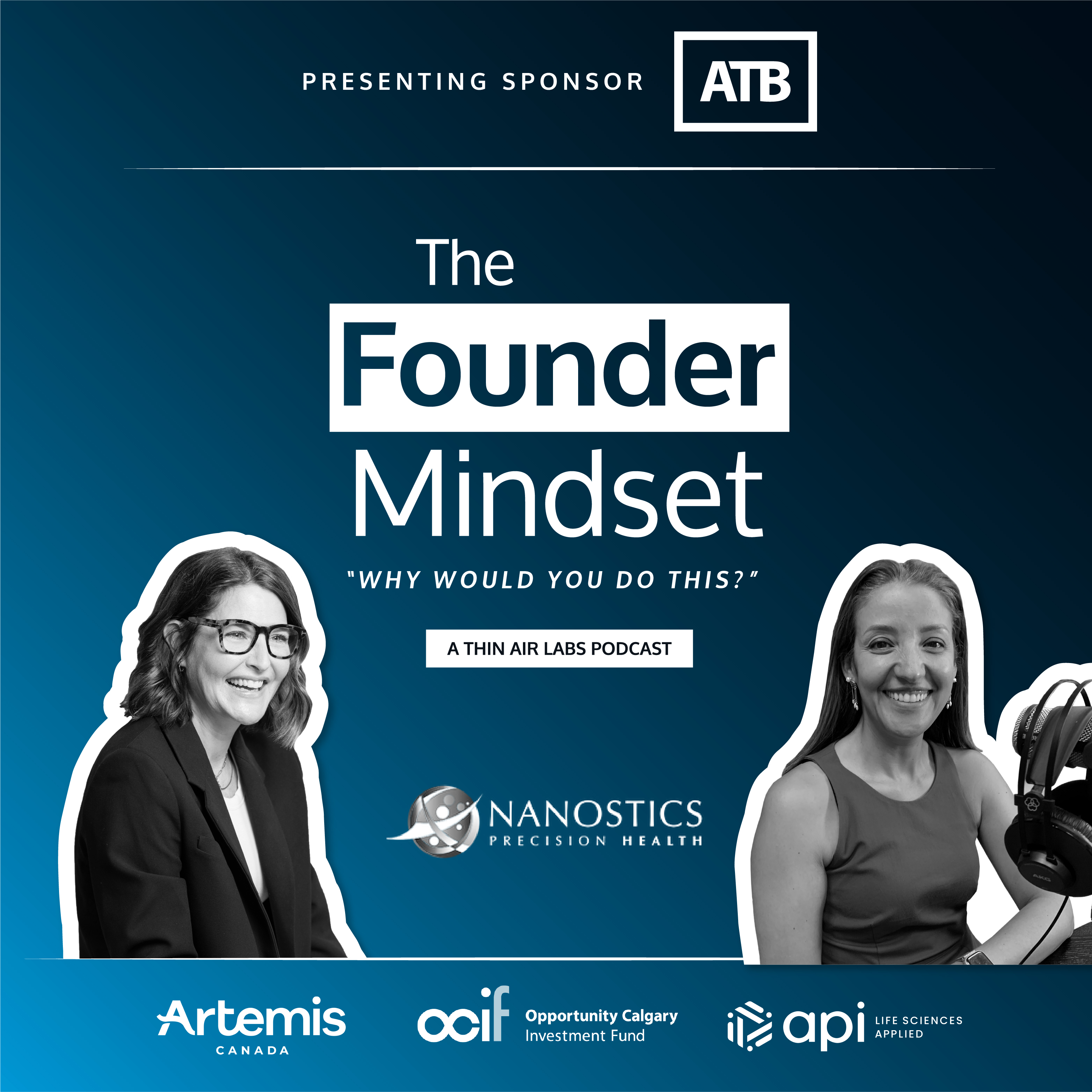

Catalina 00:02
Having this amount of responsibility and pressure is a privilege, because it means we're doing something great for a lot of people. Like this is going to change the lives of so many men and families. So we really… it's, just, it's, yeah, truly a privilege. So when you, when you start seeing things that way, then all the difficulties and challenges that come to you are taken differently.
Leah 00:26
Hello and welcome to Season Three of the Founder Mindset, brought to you by ATB. I'm your host, Leah Sarich, and I'm delighted to be back for another season of talking to Founders about what it's really like to build a company from that first big idea. If you've listened to previous episodes, you know I was a journalist for over 20 years, so I'm more curious about why anyone would ever want to become an entrepreneur, not so much about the business model, product, market fit and so on. I want to understand why entrepreneurs keep going, why they think they're the ones to solve a massive problem, why they want to make a real impact in the world. And if you're here, I bet you want to know why too. Let's find out.
Joining me today in studio is Co-Founder and COO of Nanostics, a biotech company that develops and commercializes diagnostic tests. Its lead product, Clarity Dx Prostate is a test that improves the accuracy of detecting clinically significant prostate cancer. Catalina, thank you so much for being here today.
Catalina 01:27
Well, it was a pleasure to be here and an honour as well. So thank you very much for inviting me.
Leah 01:30
Oh, how fun. Can I call you Cata? I saw that in the email, and I was… we could do that, right?
Catalina 02:00
Yeah, I go by Cata.
Leah 02:04
You do okay, that's tremendous, wonderful. Well, listen, thank you so much for being here. And I always start these conversations with the same question—if I've got this correct, you were a microbiologist by trade. How did you get into entrepreneurship?
Catalina 02:16
Well, I think life took me on this path, and all I have done is say yes to all the opportunities that come my way. Trained microbiologist and clinical laboratorist from Colombia, worked in the clinic there in multiple hospitals for several years, but my husband and I always dreamt of moving to Canada, so the opportunity presented itself. We decided to move in 2007 with our little son, who was one and a half at the time. He's now almost 20, he’s a big boy. How does this happen? Yeah, I don't know, but no, exciting to see them grow too. So, yeah, we came to Canada, and then all the magic started happening from there. So we didn't know English, so the first thing we had to do was to go to English school, right? And then through that English program, I got linked to Dr. John Lewis's lab. At the time that was in London, Ontario, and I did a practicum with him for six weeks, and he gave me a master's project, actually, and so obviously I didn't finish in six weeks, so I wanted to continue the project, so offered to volunteer until I finished the project, to which he answered that he was going to give me a job.
Leah 03:29
Oh, wonderful. You said yes…
Catalina 03:36
And then that was not difficult, because he was going to pay me and I was unemployed, so that was an easy yes, but then he wanted me to do a master's with him, right, to apply to a Master's program in medical biophysics. So I'm… wait a second, my English is not great yet, so I need at least another year to improve it right, to be ready to do a master's, and then medical biophysics—I'm not even that good at physics. I don't understand. So I'm Oh my God. I was freaking out. But thankfully, my husband is extremely supportive. So he's like, no… You're saying yes, you're taking this opportunity. Everything conspired that weekend. So he presented me with the opportunity on a Friday, he asked me to think about it and give him an answer on Monday. And it turned out that I had a shadowing event with a person at the university, and then a friend also called me, who works in biotech in the United States, and they're all saying you must take this opportunity. So I was freaking out, but I said, Okay, I'll take it. It turned out I wasn't ready. So I was right. It was very, hard. So I think those has have been the hardest two years in my entire life.
Leah 04:50
Really… What was so hard about it?
Catalina 04:53
I wasn't ready. My English wasn't there. My self-confidence wasn't there, so I was really hard on myself, so it was, it was very difficult. But anyway, I graduated and then became John's lab manager, because his lab manager had just moved to San Diego. So I took that job for one and a half months, because he was being recruited by the University of Alberta. So I started working with him, and then after that, he moved to Alberta, but we decided to stay in London, and I worked for one and a half years managing investigator initiated clinical trials at the London Regional Cancer Program, all in oncology, but the amazing eye opening… that was another unexpected Yes, because it was an administrative job, and what I wanted to do was patient work. So I said yes because the opportunity was offered, and I had a plan to start doing patient work a year after, once they get to know me. Okay, they're gonna get to know me and trust me, and then they're gonna give me the job I want. But it turned out as really good at doing that administrative job, and I actually liked it, so I did super well. I really, really enjoyed it. I had this wonderful plan, my 5-year, 10-year planning. I'm very goal oriented so… And then John came back and convinced us to move to Alberta to start the Alberta Prostate Cancer Research Initiative. And so, basically, this was an initiative that was born out of this philanthropist called Frank Sojonky, who was diagnosed with prostate cancer, treated for it, ended up developing metastatic prostate cancer and dying from it, sadly. But before he died, he made his life call to help develop better tests for prostate cancer. So he founded a group called the Bird Dogs, and they fundraised money in partnership with the Alberta Cancer Foundation to bring a chair in prostate cancer research to the province. So at the time, there was no chair, and so they brought in John Lewis, and that's how… and then that year and a half that I spent working on that administrative job that I thought that I was going to hate, it gave me a lot of tools to start the Alberta Prostate Cancer Research Initiative, which was a clinical research program developed to create the tools to help develop, validate, and commercialize better tests for early diagnosis of prostate cancer, and we did just that. So we have recruited already 11,000 men in the initiative. We have clinical data available from all of them. We have samples from close to 4000 of them, and have shared those samples and data globally to all investigators who could use it to develop better tests for prostate cancer. But we had our own platform internally at Dr John Lewis's lab, so we used those samples and data to validate our technology and to develop what is now the ClarityDX Prostate test.
So it was developed at the University of Alberta as an academic exercise. But then, when we went and told the Bird Dogs that we did it, we developed the test, now we need to do this large validation study using tons of patients, 1000s and 1000s of patients. And so they're like, Absolutely, you should launch a company. So the Alberta Cancer Foundation and the Bird Dogs supported that we launch Nanostics. And so that was how it was born.
Catalina 08:24
So again, I am not an entrepreneur. I swore to God that I was not going to be in the commercial world because my dad is a business person. He has eight businesses, and we had to work all vacation. Our vacation was in his stores or whatever business he was doing, tending to people and selling whatever he was selling. And I hated it. I'm like, I will never do this. What I wanted to be was a clinician, patient interaction was what really appealed to me, and that's what I started doing in Colombia. And really, loved it. And so here we are launching a company and developing a test. At the beginning, there is no much sales except to investors to sell to get some money, but now we have a commercial product. We're selling in Canada. We're going to start selling in the States. We're looking for partners globally. And so now I'm selling constantly. And I'm like, Wait a second, didn't I say that I didn't want to sell things. Here I am now selling things. But yeah. So the company, yeah, ClarityDX, was born with launching Nanostics in 2017 and we have been working since then to fully validate the test and now make it available to every man who could benefit from it in the world.
Leah 09:43
Which is incredible, because, as we know, the testing for prostate cancer can be somewhat problematic, so we need new tools. So this is so incredible and so exciting, okay, but I need to dig into this a little bit because you said you never wanted to do so many parts of this journey, and here you are saying yes to everything. How did you know to take that leap? How did you even square that with yourself?
Catalina 10:07
Well, okay, so I think meeting John has been very instrumental in my change in my life. Let me recall. John is the CEO, yeah? Dr John Lewis, yeah, the reason behind it is because we are fundamentally opposed, we're so different because I was super structured, organized, goal oriented. So I always had my north, and I always had a plan to get to that North, very good at accomplishing that. So everything I have set to do I have accomplished, and then set the new level and so on. John is very different. He can improvise. He takes all the opportunities, he sees them and seizes them. So it was very difficult at the beginning, because I'm like, Well, dude, we need a structure here. Why don't you do it right? But then what happened is, then I gave up. That's what happened. I just gave up. I'm like, Well, okay, I guess I like his mission. I like his vision. He's a visionary. He's a manifester. So, I admire that. I like his leadership style and I like what he's doing, so I want to continue doing that. Now I need to make a decision, do I keep fighting against his way of doing things or do I find a way around it that we can both grow together and make it happen, right? And so that's what I did. So I'm like, Okay, so the first thing was, the move to Alberta. When, again, I wanted to a set date, so then we can sell our house. I wanted to have the contract signed to sell the house, and have enough time to pack and move and all that. It didn't happen that way. So we ended up starting selling the house without having a contract. But we couldn't sell it right away, so I had to move and leave my husband and my son to finish the sales process, pack, and come and join me after. And then I joined it. And then a week after, I needed to travel to Australia for a conference for something… I had no idea, but anyways, so I just… before starting that process, I said, Listen, I know things are going to be okay. I know that in two months, or in a month, we're going to be fine. The house is going to get sold. We're going to find a house. We're going to move. I have this job, Gabe, my husband is going to find a job, and everything is going to be okay. It's just not going to be as planned or squared out as I would have liked it, right? But everything is going to be okay, so you just surrender and go with the flow, and things are going to be fine.
Leah 12:58
But I would imagine for someone… Now, clearly, you're the operator, you're the COO, right? So, but as an operator brain, that's a big shift to make. To be clear, her eyes are exploding right now, yeah, yeah. I was nuts.
Catalina 13:14
But then it has taken me into this road of learning, self-growth, and so it's been phenomenal,
Leah 13:27
So this is amazing. So you took the leap of faith and you just did it, knowing it was all going to work out. And clearly it did, which is amazing. I still wonder about that, but yes, good for you. I love the idea of being open to possibility. That really resonates with me. But I also love the idea of identifying, which you clearly did with John, different skill sets and how they can work together, right? Like totally different people working in totally different ways, but how that actually is complementary, right? Yeah, amazing. I love this. Okay, so let's do a little 101, on Nanostics. You covered some of it already. You launched in 2017. Is that correct? That's right. Okay. Let's talk a little bit about the core technology itself, the ClarityDX. What exactly is it?
Catalina 14:10
Okay, so this is where it gets tricky. So when Nanostics was born… So it is the integration of nanotechnology for diagnostics, hence the name Nanostics, right? So we have this cool platform detecting extracellular vesicles. And so basically, any given second in your blood or in your body, cells are shedding little pieces of themselves. These pieces can be anything from 20 nanometers, 50 nanometers, to close to a micron. Through science, we have discovered that one of the objectives of doing this is as means of communication. So think of them as little messengers, right? So back in London, Ontario, when we were using intravital microscopy, so basically, what we were doing was using super, super potent microscopes, seeing cancer cells interact in chicken embryo models in real life, we were taking pictures that didn't turn into videos. We were seeing how these cells leave the tumor, the primary tumor, so cancer cells, they get into the blood vessels, and then when they're leaving the blood vessels, the wall of the vessels is so tight that they actually have to shed pieces of the cell to exit the vasculature to find another tumor to cause metastasis. So we thought, okay, it will be super cool to see that, get an instrument that can see those pieces, because then we get, we can get tons of these from cancer cells, and then that could help us diagnose diseases, right, So we actually found this group in the UK, called Apogee. They actually develop and manufacture these instruments for the military to see if soldiers are victims of biological weapons like bacteria and viruses in the field. So they have this super sturdy, small machine that can see viruses and bacteria in the blood of soldiers. Well, that's right at the size that we need to see these little pieces of cells. So we called the guy, Oliver, and say, Hey, Oliver, Would you to partner with us? He said, Yes. So we started taking samples from our patients in Alberta and running them through the instrument. And then these patients have been tremendously generous to provide us with samples and also their clinical data. So we were able to compare if we had some proteins in the membranes of these little particles that can give us information about the organ they come from, and if they're from a deceased organ or a healthy organ. So we ended up developing this test called ClarityDX prostate, where we have five biomarkers. So some tell us it's coming from prostate. Some are telling us, this is just benign inflammation. And some told us, no, this is cancer. And some told us, this is an aggressive cancer. So that's how we developed ClarityDX prostate. It turns out that information that the instrument gave us was super complex. We had millions and millions of data points from in three minutes, so it was super difficult for us to make sense of that data. So that's when machine learning came into play. So Dr Robert Paproski, our Chief Technology Officer ended up developing an algorithm to make sense of that data, but we also had a lot of clinical data from the patient, so he also developed another algorithm to see if that clinical data, like age and if the patient has had previous negative biopsies and other data, if that could also help us add accuracy to the detection of the disease and so we ended up developing ClarityDX, which was two algorithms, one for clinical data, one for the extracellular vesicles, and then a third algorithm to combine both data from both streams into a final risk score. So basically, what we were going to do is tell patients you have high risk or low risk of having cancer that needs treatment. So yeah, so super excited, and that's how we developed nanostics. But then we launched Nanostics. First the Bird Dogs, initially, they obviously wanted to take this to the next level, so they invested in the company. They became partners of the company, gave us $2 million for us to do the clinical validation study. And so we needed to recruit. At the time, it was 2800 patients to do the validation. So we started recruiting in Alberta. That went very, well, and then at 1600 patients, we stopped and did an interim analysis, and it turns out that the extracellular vesicle portion of the test wasn't good for early detection. It was super good for late stage prostate cancer, but that was not the question we wanted to answer. What we wanted to find was a better diagnostic test that could help with early detection of prostate cancer so our men wouldn't develop metastasis. Or a man, because most prostate cancers are curable, if they're detected on time. So what we want to do is to detect all prostate cancers in a timely manner, so all can get cured, so no man will develop metastases, so no men will die from prostate cancer. That's our overall mission, right? So that extracellular vesicle test detecting late stage prostate cancer wasn't good enough for us, but it turns out that with the algorithms that we detected or developed, we could predict using only the algorithm, tests that are part of standard of care and clinical data from the patient, we could detect with high accuracy if the patient is at risk of having clinically significant prostate cancer. So it was super hard. So that was, the do-or-die moment. Up until that time, we were this nanotechnology, molecular, hardware, software, type of company with biomarkers, that was our identity. Dr Desmond Pink did a tremendous amount of work and a remarkably good job at developing the extracellular vesicle test and now we're saying, well, the test, what do we do? So do we continue? Do we recruit more patients to see if the trend changes? So it was, it was super hard. It took us probably one or two months to actually make the decision, and at the end we made the decision, we say, Okay, listen this no, the molecular portion is not what is not is giving us the message is not what it needs to be, but the machine learning is super encouraging. So we went to the FDA and said, Hey, listen, FDA, we met with you to present you with the with the clinical study. This is what we wanted to do, but these are the results we got. So we think we have a software as a medical device here. What do you think? And they were super excited. They say, Okay, this, can be a game changer. Yeah, we really like it. We fully support you. Why don't you go and find us some US patients, because all the patients were from Alberta, find us some US patients, and include some patients who are African American and Latin American, because most of our patients were Caucasian. So they wanted to have a cohort that is more representative of their policies in the United States. So we went out and ended up collaborating with UCLA and Johns Hopkins to get US data. We found this toll Mayor University in Prague to get some European data, and right now, we're partnering with the University of Florida and Chesapeake Urology in Maryland, to get some African American and Latin American patients. So we re-run all the tests, refined the algorithm, and then, after validating with now close to 3500 patients, the test is remarkably accurate.
Catalina 22:34
So we develop four models depending on the data that is available, and when we put all the data that is possibly added to the algorithm, we have the highest, most accurate test in the world to predict the results of the biopsy. And it's an algorithm, so it's a huge impact, because the fact that we do not need an instrument and reagents, then changes the game completely, because now we go from being a test that can only be offered in a lab in Canada and then potentially a lab in the United States, now with the algorithm. Once we have FDA designation, then we can literally offer it in almost every, potentially, in almost any lab in the United States, and potentially globally as well. So that's amazing, because then we don't incur the expenses for instruments, for reagents, to transport samples, etc. We can partner with labs to run the total PSA, which are inputs we use in the algorithm, and then send the results to doctors and patients. So that reduces the cost dramatically, reduces the logistical challenges dramatically, and then help us achieve the goal, which is to bring these tests to as many men as we can in the world.
Leah 23:52
Yeah, okay, so clearly, that's amazing, and we're going to dig into that a bit more, but I do want to go back to that do-or-die moment, because that must have felt really quite devastating to a certain extent, because you just didn't get the results you were hoping for. Tell me a little bit more about how you felt at that moment, that do-or-die moment, what was going on for you.
Catalina 24:13
It was a process, actually, as most things in life, I think, so at the beginning, I think he was denial. So we're like, Well, if we recruit more patients, maybe the signal will change, but it's 1600 patients already into the study. So we consider recruiting more patients to see if the signal will change, and then, and then we consider just continuing, but, what happens with me is I have these, oh, I learned the term last week and I forgot now… regulatory. I have a regulatory mechanism, within me anyway. So what it means is when things are not going the right way, it could be because of me or because of external agents. Then I start having this nagging, a nagging feeling, and then I start waking up at night. And then when I when I just sit and think about it and meditate on it, gives me the answer. So the answer is, you're going to… So it started really, really bugging me. I'm like, Okay, we can't continue with this EV test, the extracellular vesicle test. We need to make a decision. We need to change paths. Yeah, and so and so we had a meeting executives, cost it. And in at the end of the of the meeting, we decided that we were not going to continue exploring the extracellular vesicle portion. At the time, we didn't know what it meant. It was hard, yeah, and there was pushback. So I had to be a little forceful, which is not difficult for me, but… Well, if I really believe in something, I can, oh yeah, get my point across. But, it was very difficult for everyone, because he could have meant the end of Nanostics, right? That was our technology. This was our standard our number one test, right? So we do have other tests in the pipeline, but all the fundraising, everything had been done towards the prostate cancer test. So, we decided to just make a big pivot, yeah, just take a break for couple days. Everyone was devastated, especially for Desmond. It was super hard because it's his baby, you know, and the identity of the company was the extracellular vesicle. So, yeah, so all of us went, I guess, we took a step back as individuals, and then we had a strategy session right after. And then that's when we're like, Well, wait a second, but the algorithm works. Yeah, so I guess we have something here. And then we say, Okay, let's go to the FDA. And well, and it was a whole new beginning, because we have no idea, we're not, we were not a machine learning company. We were an extracellular vesicle company that used machine learning to automate the processes and now we became a diagnostic company that uses machine learning as the core to develop better tests for prostate cancer. So that also had to change, a lot of our identity changed a little bit, and then a huge learning experience again, and it took us a while to actually figure out the strengths and what I just told you about globalization and all that potential. It wasn't that as apparent at the beginning, right? So, but then, we started talking to people, and we have been super lucky to have a lot of people helping us, advisors, mentors, and so in talking to a lot of people, we started refining that concept in our heads, and then that gave us the impetus to keep moving, keep going forward.
Leah 28:09
The Founder Mindset is brought to you by ATB Financial in the fast-paced world of tech your banking needs evolve as quickly as your industry, whether you're just starting out or aiming to reach new heights, ATB Financial is dedicated to supporting tech companies every step of the way. Partner with ATB Financial for a banking solution that grows with your business.
So going through an experience that, this sort of major shift. How does that inform how you continue to build Nanostics? So does it give you confidence to follow other paths, maybe, and things like that? I mean, you must feel we've been through it already.
Catalina 29:02
100%. So, you know what? So we were the recipients of a grant called ASBIRI. So ASBIRI Grant was created with Alberta Health Services, the Alberta Cancer Foundation, Alberta innovates and in our case, Dynalife at the time. So before APL, Dynalife Labs and so and so the strategy around that grant is that the entrepreneur was going to develop a product that there was an end user that could adopt it at the end of the development process. And so that was Dynalife, right? So we started with Dynalife, and they were tremendously helpful at developing that extracellular vesicle test. They helped us a lot with documentation and learning how things are done in the clinic, because we are, researchers, university lab, yeah, doing things the way research researchers do things. But once you are developing a product to come to the clinic, there is a certain level of rigor, quality control. You need more replicates. You need to ensure the results you're getting are real, yes, and then they can be used in all the population. So, the way you run the experiments is way different. So we need a lot of verification, validation, double checking. We have forms, we have checklists, and all those things. Dynalife helped us develop that, but that was a very long way to get to my point. But, so one of the things we talked at Dynalife, and they were always admiring us because of our resilience and because of the way we take challenges. So what happens with the Nanostics… I thought everyone was like that, but then when they tell us this then, apparently, not everyone is that. For us, we don't take roadblocks or roadblocks or challenges or challenges. So the regulatory path is super difficult, is super long, is expensive, it needs a lot of work. The reimbursement path, same thing, fundraising is difficult. all the things are super difficult, but we don't think of them as difficult. We just think of them as steps that we need to take to get to the next level, you know what I mean?
Leah 31:16
Yeah, so got a very clear notion of what the goal is, right? You just have to keep plugging away until you get there.
Catalina 31:22
Exactly. So for us, it's just literally just steps. It’s an uphill battle, but there is the path. We know the path. All we have to do is follow the steps, right? And that's how we take all of these things, right? So say FDA, for instance. It's funny, because when we pitch to investors, they're oh, but you still don't have FDA. And, you have to do all this documentation and, this validation and all these and it's a lot of work, and it is expensive, and you need resources. And I'm like, yeah. And so they're well, we it's most people can't do it, so we will not give you money until you get it, until you demonstrate you can do it. But they're fearful of it. And I'm like, Well, I understand. So we're in the process of, we just submitted a request for breakthrough designation to the FDA. We'll see how it goes. But then the plan is to have a meeting with them and then submit, yeah, and the team is working on that, and they're not wrong. It's a lot of work. Sure, Robert Paproski is leading that process, and it’s a tremendous amount of work, but at the same time, we just know the path, right, So we didn't know the path. So what we do is we find someone who knows it, who tells us what to do, right? And then has been our outcome.
Leah 32:55
I love that. That's so... So how many employees do you have these days? 1515, that's exciting. Do you want to talk a little bit more about how much money you've raised?
Catalina 32:54
Yeah, so we have been very lucky to have a lot of support from the province, both from angel investors, but also from government agencies and the federal government as well. So we have raised $10 million in equity funding and close to $9 million in non-dilutive funding.
Leah 33:13
That's so exciting. Congratulations. All right, so we talked a little bit about, you know, how challenging it can be to be an entrepreneur and build this company, but I'd love to know too, what you love about being an entrepreneur, because that's what you're doing. What do you love about it?
Catalina 33:32
Oh no, it is amazing. It is amazing. So I have been tremendously lucky to have the have had the opportunity to launch the Nanostics. First of all, Nanostics is very mission driven, and I feel that all of our employees are super, super aligned with that mission. We're very proud of it, and we really, want to execute it. So that makes it super easy to lead the team, because as they're fully aligned, they know what to do. They know what the role is, and they do it very well. So it's kind of easy in the sense that I don't have to micromanage. I don't have to… on their breathing on their necks, double checking that they're doing what they need to do. So that's amazing.
We have had the privilege to interact with a lot of patient groups, philanthropy groups, and foundations, and that really gives us a completely different perspective. So we do participate in a lot of fundraising events, awareness events, walks, runs, whatever. We're super active in the community. Yeah, and the motorcycle ride for that is one example. So we have 1000s of riders who are working fundraising to bring awareness about prostate cancer to older men, and so being able to share with them, hear their stories, share their experiences, and also shed a little bit of light that there is something that is being done, in that they can help us also amplify the message and bring it to their men. Yeah, that is tremendously fulfilling. And so sometimes you feel the weight of the responsibility. Sometimes it's so difficult. Sometimes you say, don't have enough money, and is getting super difficult to find investors, or you have a setback, say, regulatory ethics, whatever, and you're feeling down, but then you go to these events and use those men and their stories and how much you have helped them, or you get a patient email you thanking you because they bought the test and that the test helped them prioritize their biopsy, so then he wouldn't have to wait for eight months to get the biopsy, but get it in three weeks. Or men who didn't really know if they needed a biopsy, didn't want to have it, but were scared of not having it, and with the test, they had the clarity that they actually don't need it. And so they went home at ease with the decision of not having the biopsy done. So the wife will write to us, the patients will write to us. And so just hearing those, stories, then it puts everything into perspective, and then humbles you and gives you more and more energy to continue doing it.
Then the glamor of being an entrepreneur, there is certainly more that is true. Travel. I love traveling. So going to conferences, going to meetings. I love meeting people. I love going to conferences. I love networking. So having the opportunity to go to all these events, hear their stories, and then more and more, you know what is happening, too. So at the beginning, I was the recipient of a lot of help, because we had no idea what we were doing right, so we're learning by doing. But at the same time, the province, the city, the country and elsewhere, we have had so many people that has been… Okay. Let me tell you can do this, this way. Or let me connect to this person or there is this grant or this investor wants to hear about you and all these people really helping us selflessly. Now I feel that I am at a stage where I meet a lot of new companies who have no idea what they're doing, and I'm like, listen, okay, so you need to talk to this person. This is what you need to do. I can connect you to this person. You need to register for this conference. You need to go to this place, blah… And it feels great. It feels great because at the beginning, when I was asking for help, I always felt that I had nothing to give them in return, and that I was always asking, so now being able to give in return, to give back. It's amazing, so that I also enjoy very much.
Leah 37:58
Oh, I love that. I love that. I mean, I always ask everybody that sits in this chair, how does being an entrepreneur even affect your personal life and your family life and the people in your relationships and all that kind of stuff?
Catalina 38:09
Well, okay, so in my personal life, tremendous amount of growth I've lost myself in the process, and I am finding myself again in the process. So it depends on personalities, right? Some people can do it without losing themselves. It seems I just throw all of me into it, right? And then, so it was, yeah…
Leah 38:35
What does it look when you lose yourself?
Catalina 38:39
Well, you burn out, yeah, forget why you're doing things, yeah? And then you get so tired that you feel that you cannot continue doing it period, that you have to just, let everything go and run away, far away from here, right?
Leah 38:55
And then, how do you pull yourself out of that?
Catalina 38:56
Asking for help, talking to people. So I found amazing coaches. And then they helped me figure out that there is such thing as burnout, yeah, and how to deal with it. And so, yeah. So I have a number of mechanisms to help me with that. Yeah. And then the other thing that was very difficult for me is, I think I know I maybe put too much mental energy into it, but forgetting about the heart energy. So now it's more, Okay, let's combine both. Let's do mental but also put the heart myself… I forgot who I was. I wasn't expressing myself. I was just being this automatic, yeah, a robot, yeah. So, now I'm just trying to be myself, bring authenticity into the process.
Leah 39:55
I love that, I love that, and that probably feels so much better.
Catalina 39:59
Of course. And then, yeah, you start feeling a privilege. This, having this amount of responsibility and pressure is a privilege, because it means we're doing something great for a lot of people. Like this going to change the lives of so many men and families. So we really… it's, just, it's, yeah, truly a privilege. So when you, when you start seeing things that way, then all the difficulties and challenges that come to you are taken differently.
Leah 40:30
Yeah, for sure, they are. They're put in perspective. I love that, which leads us nicely to talk a little bit about impact. I know for a lot of life science companies and biotech companies, it's so easy to see the through line to impact, but I still want to ask you, what does that mean to you when you're thinking about impact and the impact you'll create with Nanostics?
Catalina 40:49
At the beginning, we were very clear that we wanted to provide clarity, and so all of our brandings, or all of our tests start with clarity. So our first test is ClarityDX Prostate. So we really feel that having that uncertainty—do I have cancer? Do I need a biopsy? Can I really wait eight months to get a biopsy done or to get an MRI, that's, horrible. So having our patients have to wait that long really, takes a toll in their mental well being and virtual being and in their work life and so for us, being able to provide that clarity to patients, to give them that certainty that they need or don't need a biopsy, or at least have more tools to make a better informed decision between the patient and the doctor, right? That's what I think the impact lays, and the fact that we're an algorithm, I think also provides a huge advantage in the sense that we could provide these to a lot of countries in the world affordably. A thing we don't necessarily know this in North America, because we're privileged to have great health care and access to a lot of technologies, but a lot of countries do not have access to these, a lot of men. So for instance, we were doing a clinical study in Colombia, and we discovered that more than 90% of the men who had a biopsy didn't have cancer. In that group that we assessed, 90%? Can you imagine that they didn't need a biopsy, but they so obsessed with prostate health in Colombia that they're willing to go to have an unnecessary biopsy just to have the certainty that they don't have cancer. So, for instance, in North America, men don't want to have the biopsy. No, they want to avoid it at all costs, right? Well, the culture is so different there that they're willing to have it just to know that they don't have it. But imagine you have a blood test. You have a simple test. It's a simple algorithm, way cheaper, with less adverse events, with less physical impact, emotional impact, and then it's easy. Men could pay for it, insurance companies could pay for it… could save so many millions. So we're talking about billions of dollars of savings only in the US per year if we fully implement ClarityDX Prostate Cancer there. So I think that's one of the biggest impacts.
Leah 43:25
For sure. Oh, my goodness, it's amazing. Well, you know, as we come to the end of these conversations, I ask the same two questions. So you are a Co-Founder of Nanostics. You're writing the story for the company. How do you hope that story goes?
Catalina 43:41
Well, okay, so it's been, again, a lot of learning from day one. So what has happened is, at the beginning, for instance, you need to build a business plan and financial projections, and I have no idea, right? And then we do the clinical study. I did have more experience with that, so that was not new. And now we're hitting into commercial. So we're getting, again, uncharted territory. None of us know how to do it, right now, we're talking about how we can take the team we have and retrain, so then we can go to commercial. And also, who do we need to bring in to help us with that? And so ultimately, our goal is to bring the test to any corner that we can right so everywhere in the world, if possible. I know it's massive words, but really that's what we want to do. We want to impact the way men are diagnosed for prostate cancer everywhere in the world, and we understand our limitations as well. So this is not our bread and butter. We don't know how to do this, so we're open to opportunities. So either getting more funding to achieve this, or finding partners who already know how to do it and we can tag along. Maybe I don't know, merge or who knows? So we're open for opportunities. But yeah…
Leah 44:58
I love that there's a theme there of openness. And then finally, you know you are a Co-Founder, and how do you hope your own personal story goes?
Catalina 45:07
Wow. Okay, so I feel that I still have a lot to learn from Nanostics. Also, that I think I'll stay for a while, but at the same time, I've seen a lot of things during these seven years. I've learned a lot of things and so, what I really want to do is… I've seen the impact that incubators have, that accelerators have, that mentors have, right? And I'm from Colombia, so I really want to bring these to Colombia. So I have a lot of ideas, and I still need to do some research to figure out if they're really needed, if there is something similar that I can piggyback on, or whatever. But I really want to have those accelerator programs, those incubator programs in Medellin, in Colombia. So I want to be leading some of that. I really want to be an advisor to a lot of companies. I am doing it already. So I am advising a number of companies in Colombia, in the United States, in Canada, but I want to do it in a more formal manner. And you know what? I have been very lucky and fortunate to have the family I have. So I have a loving husband, loving son. We have made all of our decisions together. So when we moved to Alberta, the three of us voted for it, when I got the job, and then when we launched analysis, we all voted for it. So we take the pros and the cons, we analyze it together as a family, and we know. So I will say, Okay, listen, if we do this, it's gonna, be long hours, tons of events, tons of different things, tons of travel. Are you okay with it? And they said yes, and so I have never had to worry about family. I have never had to worry about me going on a trip, or being on the road for two weeks in a row or going to three conferences a month, or things that, because they have always super supported me, but I’m also seeing how so many women are either single moms or they do not have the support from their families to do these and they have to struggle. They're super smart. They have great ideas. They can totally be super successful at being an entrepreneur or at being at the corporate level or at the director level, but they don't have the support from their families, and so they have to take a step back and take another position that doesn't really reflect their intellect, their ideas, their creativity. And so I really am thinking of either finding something, someone, that is already doing it, or creating something that can provide that support. Maybe, I don't know, group supporting single moms that really, have this impetus to go and do something great and then have the potential in the capacity, but they have three little ones at home that they need help with, but the family are not there, or don't support it, or they don't have the financial means, but many, many things that we, as groups can help support that. So that has been playing in my mind. So I have a few, a few examples at home, that hit home. So I still haven't, fully have, something concrete, but that's something I really want to do, and that is highly needed in Colombia as well. So we'll see. It seems Colombia is pulling me.
Leah 48:30
Come home. Bring your knowledge and wealth... Oh, I love this for you, Catalina, thank you so much for this conversation.
Catalina 48:36
Thank you. I really enjoyed it.
Leah 48:44
If you're building a tech company in Canada, you've probably heard of Artemis. They're the recruiters Founders trust to find the leaders and key teammates who will shape the future of their business. I know them personally. They're thoughtful, genuinely caring, and deeply connected in tech. The Artemis Canada team treats every search like the future depends on it, because it does.
Ready to accelerate innovation? The Opportunity Calgary Investment Fund is driving our economy forward by investing in opportunities that build a diversified and resilient future. Discover how OCIF is shaping Calgary's tomorrow at opportunitycalgary.com.
API is helping innovators accelerate from idea to impact, whether it's pharmaceuticals, medical devices and diagnostics, health technologies or natural health products, API supports the full journey from early research to clinical and commercial manufacturing. API bridges the gap between academia and industry right here in Canada.
In this episode of The Founder Mindset
Host Leah Sarich speaks with Catalina Vasquez, Co-Founder and COO of Nanostics. Catalina opens up about her unexpected journey into entrepreneurship, from working in labs in Colombia to moving to Canada and building a biotech company that is reshaping prostate cancer diagnosis.
She discusses the origin and evolution of Nanostics’ flagship product, ClarityDX Prostate, including the critical pivot from nanotechnology to machine learning. Catalina highlights the global impact of making accurate, affordable prostate cancer diagnostics widely accessible, the resilience needed to push through scientific setbacks, and how her team is building toward FDA approval and international partnerships.
Listeners will gain insight into the challenges of biotech entrepreneurship, the power of collaboration, and the profound personal growth that comes with leading a mission-driven company.
About Catalina Vasquez
Catalina Vasquez is the Co-Founder and Chief Operating Officer of Nanostics, a Canadian biotech company transforming how prostate cancer is diagnosed. Originally trained as a microbiologist in Colombia, Catalina moved to Canada in 2007 and quickly built a career at the intersection of science and innovation. From her early work in Dr. John Lewis’s lab to leading clinical trials, she embraced challenges that eventually led her into entrepreneurship, a path she once thought she’d never pursue.
As COO of Nanostics, Catalina has been central to the development of ClarityDX Prostate, a diagnostic tool that uses machine learning to improve early detection of prostate cancer. She has helped guide the company through pivotal scientific and business decisions, international collaborations, and progress toward FDA approval. Passionate about mission-driven innovation, Catalina is committed to making life-saving diagnostics accessible worldwide while also mentoring and supporting the next generation of entrepreneurs and innovators.
Resources mentioned in this episode:
The Founder Mindset is Sponsored By:
Contact Information
Contact Thin Air Labs:
Contact Catalina Vasquez:
In this episode of The Founder Mindset, host Leah Sarich speaks with Catalina Vasquez, Co-Founder and COO of Nanostics. Catalina opens up about her unexpected journey into entrepreneurship, from working in labs in Colombia to moving to Canada and building a biotech company that is reshaping prostate cancer diagnosis.