.png)
John 00:03
Anything worthwhile is difficult. And I would say that… I have a joke—running a company is the hardest thing I've ever done. And I'm a brain surgeon.
Leah 00:12
Hello and welcome to Season Three of The Founder Mindset, brought to you by ATB. I'm your host, Leah Sarich, and I'm delighted to be back for another season of talking to Founders about what it's really like to build a company from that first big idea. If you've listened to previous episodes, you know I was a journalist for over 20 years, so I'm more curious about why anyone would ever want to become an entrepreneur, not so much about the business model, product-market fit and so on. I want to understand why entrepreneurs keep going, why they think they're the ones to solve a massive problem, why they want to make a real impact in the world. And if you're here, I bet you want to know why, too. Let's find out.
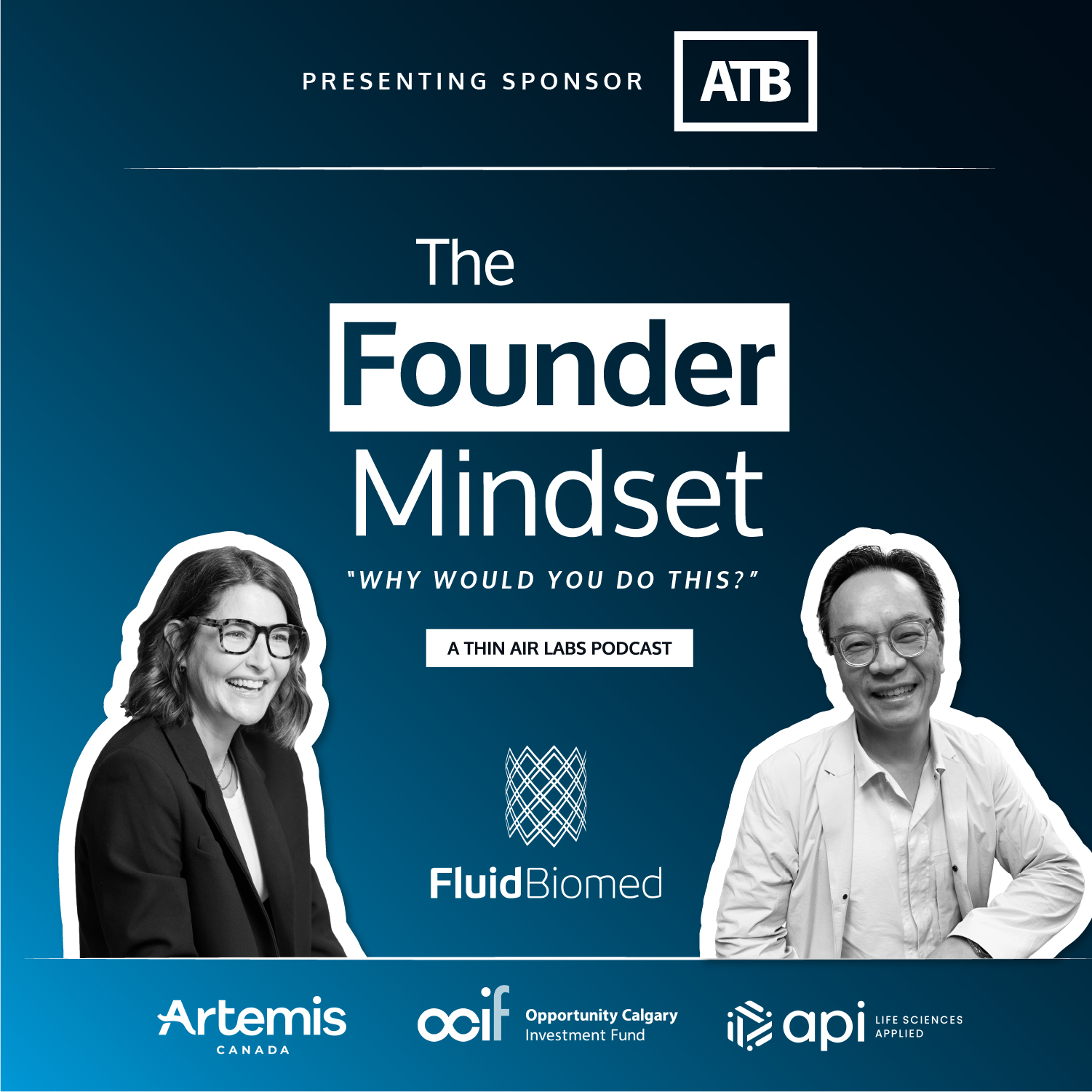
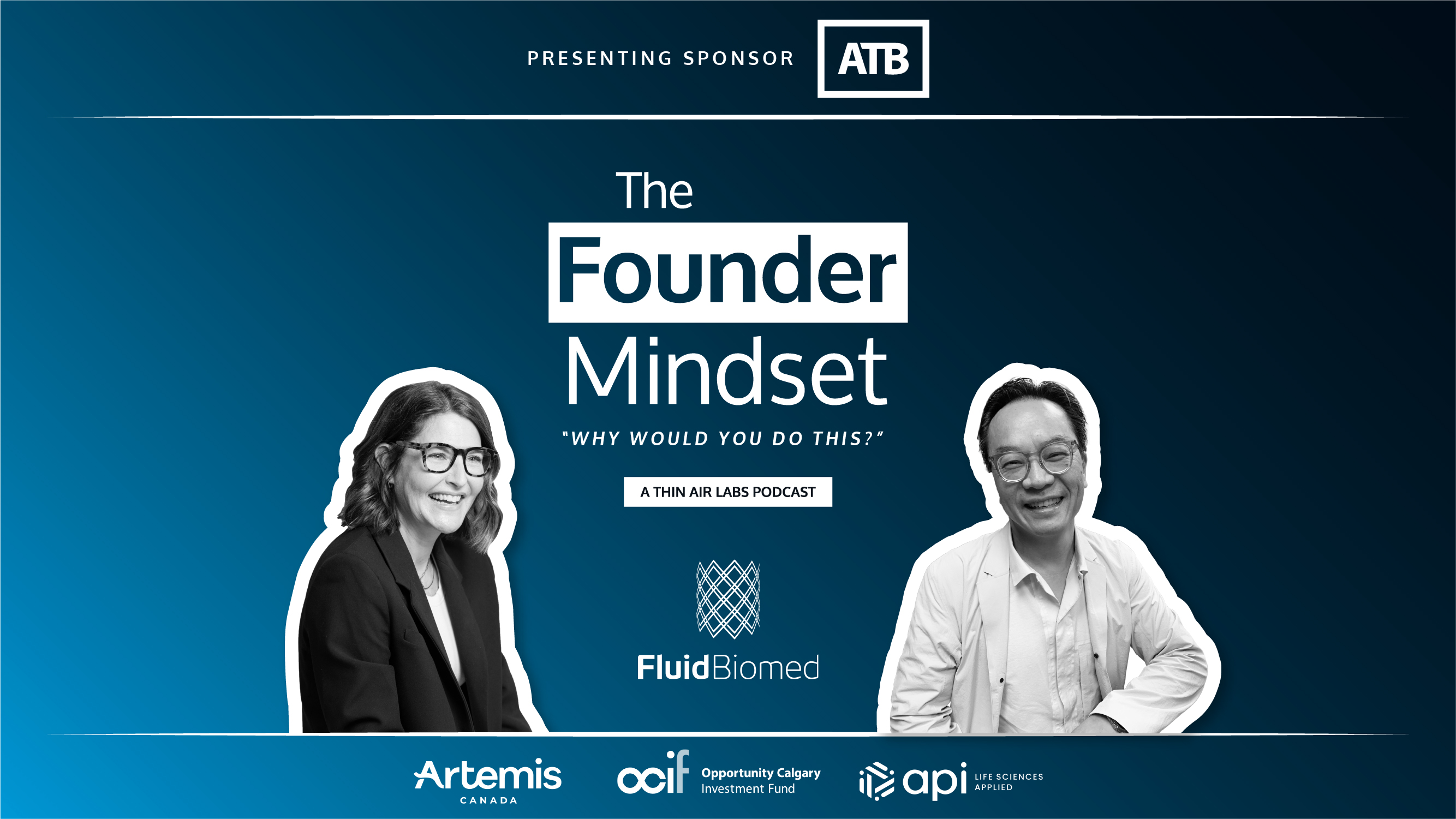
Joining me today in studio is Dr John Wong, neurosurgeon and Co-Founder and CEO of Fluid Biomed, a medical device company developing the next generation of stents to cure brain aneurysms without invasive surgery. John, thank you so much for being here.
John 01:11
Thank you. It's my pleasure. I love talking to you about this because you're a neurosurgeon. So let's start there. How do you go from being a neurosurgeon to founding a company?
John 01:24
It's been a very interesting journey, I would say. I graduated from Edmonton at the University of Alberta from medical school, and did my neurosurgery residency there. That was many, many moons ago and along the way, did the usual things that doctors do, develop a clinic, develop a patient practice. I became very sub-specialized in patients with brain aneurysms. And, you know, a brain aneurysm, for those who are unaware, can be described as a bubble on a blood vessel that's weak. It's typically silent. You wouldn't know you had a brain aneurysm, unless it bursts, and if it bursts, then the horse is out of the barn. Unfortunately, people will then develop severe symptoms, headache, terrible problems such as even paralysis, and for a good proportion of people, they don't survive. The people who make it into the hospital are then treated, and we can get a little bit into the product and technology, but essentially, along the way, I did neurosurgery. Learned neurosurgery, but I also learned this new technique. I learned from one of the pioneers in New York City, where we can treat conditions of the brain without opening up the skull by going through the blood vessels of the body using tiny wires and catheters. In this manner, you can seal off an aneurysm again without opening up the skull. So doctors have been using these different technologies. One of them is called a stent, a mesh tube. I don't want to give away the ending here, but we developed a new kind of stent, a very special kind of stent that became the genesis of the company, but backtracking a bit… So that was my career as a neurosurgeon, and along the way, I met many interesting people, including my Co-Founder, Dr Alim Mitha, an incredibly talented and special human being.
Leah 03:19
And so the two of you are hanging out, you're talking, and you come up with this stent, is that right? And then you realized, Hey, this is something that we could commercialize. Would that be fair to say?
John 03:30
Yeah, it's interesting. Yeah, I first met Alim when I started here in Calgary, and Alim, at that point, was a trainee; he was a resident. He was in the process of becoming a neurosurgeon, and even then, you could… anyone who's met Alim knows that he's an incredibly talented and special person. And yeah, along the way, when we were in the fortunate position of recruiting him back to Calgary, I knew that Alim had this special talent. Not only did Alim complete neurosurgery, but in the middle of his neurosurgical training, when he asked me what I would do for my research stint, I said, Well, back then, I had always had a profound respect for people who could develop new ideas or take them to reality. And so Alim then pauses neurosurgery, goes to Harvard, learns the fundamentals of engineering and becomes a biomedical engineer, and then comes back to finish neurosurgery. So you can tell the tenacity, the perseverance, the intelligence behind him. So eventually, when he had his credentials, again, we were fortunate enough to recruit him back to Calgary. I knew that to make the most of his abilities, we needed to set him up in a laboratory. So Alim then started a Biomedical Engineering Laboratory at the University of Calgary, based Hotchkiss Brain Institute and the Libin Cardiovascular Institute, and that's where things got started for his scientific career. But again, very early on, we knew that we wanted to work on something, we wanted to work on something together, and that was the genesis of Fluid at that point… sort of the vehicle for us to work together towards something that we were going to make a reality. So it did not just exist in medical journals, but could actually go and become something tangible to help heal patients.
Leah 05:35
Wow. Okay, so you knew you wanted to have that impact on a patient, for sure, but I'm really curious about this idea of going, Okay, we're neurosurgeons. We're still practicing. You're still practicing as a neurosurgeon. How did you decide then to go, Okay, well, let's actually make this a company. Like, let's actually build a company around this scientific idea that we have that we're working on, and I'm going to be the CEO. Like, how did that even happen? You're laughing…
John 06:04
Yeah. Well, I guess if we had sought advice very early on, we probably wouldn't have embarked on this.
Leah 06:11
And why is that?
John 06:13
The journey is so uncertain. To be honest, it's incredibly difficult. I was at a conference, and a young trainee from ophthalmology at Stanford approached me, and this was a couple of years ago. Hey, Dr Wong, I just wanted to chat with you a little bit. You know, I'm in the middle of this design course at Stanford. Got some great ideas about doing a startup with technologies for ophthalmology? What's your recommendation to me? Well, what would you say? I said, Go back to medicine. It is so difficult, but you know, that's the highs and lows. Maybe he caught me at a low point. Because, yeah, the journey is incredibly rewarding. But again, anything worthwhile is difficult. And I would say that… I have a joke—running a company is the hardest thing I've ever done. And I'm a brain surgeon.
Leah 07:19
Okay, that's a great joke, yeah, and I'm a brain surgeon. Oh, my goodness, that is so good. That actually cracks me up. And you are grinning ear to ear. But I would love to know how you think about being an entrepreneur. Like, do you think entrepreneur first, or do you think neurosurgeon first, with a product that we need to get into patients? How does your mind work around that?
John 07:34
Yeah, so I alluded to this. My history with entrepreneurship, or what I've seen, is probably reflected in my own childhood; my father's a small to medium-sized business person and immigrated to Canada, sort of like a rags to semi-riches story, or semi-success story, in that regard. But he has a factory that started from very humble beginnings, based in Edmonton, and he's still working. He's in his mid-80s now, so really, really has dedicated himself towards that, that career, and so I always had this fundamental respect for entrepreneurs and for business, and then with, you know, with Alim then joining us at the University and his skill set, I did think that at some point we would be doing something and I think that was also a key point here. You know, it's a tough journey, and it can be lonely if you're doing it by yourself, or maybe even impossible. Sole Founders who take things to a critical point in evolution are few and far between, or perhaps they don't recognize the people who actually help lift them up to that point. So again, with myself and Alim, we started the project together that evolved from a scientific standpoint towards a real product. But again, the funny thing is that we started the company within the first month of his setting foot into Calgary. So we knew we had that idea that we wanted to develop something, and develop something together. What it was took a couple of years to figure out.
Leah 09:22
Amazing. Okay, well, that leads us nicely to Fluid Biomed specifically. So we'll do a little one-on-one on the company. So when did you actually form the company?
John 09:29
Yeah, the company was formed in 2012 when he joined, literally was when he joined us in Calgary.
Leah 09:36
Yeah, amazing. Yeah. And so, where are you at now? How many employees do you have these days, roughly give or take?
John 09:40
Just in terms of that evolution of the company. So in 2012, the company started on paper, and then the technology which we were developing as a research project, started to come along over the next, say, three or four years. It was probably not until 2017/18 that we felt that, based on all the progress he was making in the lab with some phenomenal people he had under his supervision, you know, the vision was coming together. The product was coming together. It was, you know, the stent, which is, of course, our flagship product. But this is again… a stent is a mesh tube that you implant into a blood vessel. And these stents typically will divert blood flow away from a weakness. So it's a very flexible mesh tube. And as opposed to the current stents out in the marketplace, which are made out of tiny wires and metal that are permanent, ours are mostly made out of polymer, so essentially a plastic that's bioabsorbable. So after you implant this stent, it will then divert blood flow away from the bubble, away from the weakness, heal the aneurysm, and then gradually dissolve over time. So that was a project that was developing. And then when we thought it had legs, we thought, hey, this company, which we already had in place, all of the basics of corporate hygiene were looked after, then we could sort of accelerate. And there's been some fantastic people in our sphere here in Calgary that really helped us further launch based out of Creative Destruction Lab, other entrepreneurs, other business people who really provided us with very sound advice. And then, of course, supporters like Thin Air Labs in Calgary that have been instrumental in either propping us up or helping uplift us along the way.
Leah 11:45
That's amazing. And so you still have a relatively small team, though, yeah?
John 11:49
Yeah, I would say that it's grown quite a bit over time. So it's funny, like as a CEO, when before you know, we would obviously know everyone in the company extremely well because you were all together. But yeah, we've grown substantially. We now have 25 full-time employees.
Leah 12:08
Yeah, that's incredible. Yeah, that's amazing. Of course, recently, you've been very successful in raising money. Do you want to talk a little bit about that?
John 12:16
Yeah, I can talk about money now that I'm on the other side.
Leah 12:31
We should, okay, yeah, let's get the number, and then we'll talk about how you got there, because I know it was a journey.
John 12:25
Yes, it was a journey. So this is something they didn't teach you in medical school… maybe in business school, but the process of developing a product, at least for academic people with an academic background, isn't just science, and it's not grant writing. It really means raising capital, and that's part of the burden that Founders will share. And it's difficult, I would say; it's a process where you have to approach people, people you know, people you may not know, tell them the story in a very specific manner, hopefully get another conversation going, and eventually it leads to, ideally, investment. But getting back to the history here. So as a young company, we were making do with grants and such, but to really accelerate, we needed to raise capital. So we're fortunate to do a pre-seed, a friends and family round. You know, part of the benefit, I guess, of being embedded in the community now, as a physician, surgeon, we have great colleagues. We have great people in our network who, I think, to be honest, didn't necessarily invest in a stent, they invested in Alim and John, and really trusted us with their funds, which we were, and remain very, very grateful for, even the earliest investors, right? We think about them. And so we were fortunate to raise about a million dollars when we were finishing the Creative Destruction Lab sessions. And then we fast forward to that was 2019/20/21, I received some advice from a very, very seasoned physician-entrepreneur that you and I know. And when I had sought his advice, he said, John, you need to look beyond you know… and what do you mean by that? And he goes, Well, you have to look beyond Calgary. You have to go to the East Coast, you have to go to the West Coast, you have to go south of the border. You have to go where the capital is. And so at around that time, it was perhaps easy to say you should travel. But if you recall, there was such a thing as I call the pandemic, fading into our memory, so we did a lot of Zoom calls and spoke with a lot of early venture capital firms. And something resonated, I think, with the VC, what we call med tech, or medical devices, typically conveyed as med tech, a med tech VC based in Florida, they invested in us. As we were closing a round, another very, very well-respected fund from Palo Alto and Silicon Valley contacted us, which was unusual. We didn't contact them. They contacted us. And I thought that was amazing. It was amazing. I guess they had seen our deck somewhere. But anyway, we got to discuss, discussing things. And so we then raised the $4.7 million at that point. So that gave us, again, sufficient capital to continue to build the team. I think we're, at some point, we're up to, you know, probably less than 10 people. And then you know, there's a term that you're very familiar with, the valley of death. It seems like every fundraising cycle has a valley of death, but…
Leah 15:47
We should tell our listeners, just in case they don't know, what the valley of death is?
John 15:51
Well, it's basically many things, but one of the aspects is that to get to your next inflection point, you need resources. Part of those resources is capital, and so you'll need to have your companies in a position to attract that capital to get to that next step in your evolution as a firm. And if you don't, then you're likely going to disappear, much like dinosaurs, I guess they faded away. Yeah, the valley of death was in the horizon there, but it just meant that we needed to work even harder at it and and that fast forward from 2021 to 2024 we’re very proud to say that we then were able to physically meet with with investors and potential partners, and then we raised a total of 27 million USD that we closed in 2024. Our lead Investors were Amplitude Venture Capital, a great firm as well, great partners, as well as an undisclosed, major, strategic, one of the largest medical device companies in the world, put a bet on us. So we're really proud of that. And of course, all the other investors, whether national, international, and even local.
Leah 17:24
Okay, so what I love to do on this podcast is force Founders to take a breath and a moment to reflect on how that feels to finally get that Series A done, and know, like we did this because I know the journey was hard. How did that feel for you?
John 17:41
Oh, incredible, incredible. It's almost unbelievable for us. Yeah, Alim and I were super happy because then we were at least guaranteed the resources to take the company to the next stage, so that we could map things out and do all the other good things that we're planning to do. So yeah, we were super happy about that. And I think a couple of bottles of champagne…
Leah 18:10
At least I would hope. The Founder Mindset is brought to you by ATB Financial. In the fast-paced world of tech, your banking needs evolve as quickly as your industry. Whether you're just starting out or aiming to reach new heights, ATB Financial is dedicated to supporting tech companies every step of the way. Partner with ATB Financial for a banking solution that grows with your business.
As we know on this journey, there's always like one moment when you're like, oh, this may not work. This could be the do-or-die moment, and maybe it was the valley of death for you, but I mean, or at least seeing it on the horizon. But is there a moment that you can reflect on when you were like, Okay, this is the do-or-die moment right now?
John 18:57
Yeah, I would say this wasn't necessarily discrete. I mean, it always seems with a startup, there are many challenges that you need to navigate, and this was one of them. It's, it's probably one of the most formidable. But Alim and I, because we're physicians and surgeons and treat patients and also can view the other technologies that are out there for patients. We knew that what we had in our lab was something extremely special that had a place somewhere in the armamentarium for physicians around the world to treat their patients as well. Yeah, so we had that North Star where we want to head towards, you know, so in terms of a specific do-or-die, I would say that again, in this fundraising journey, when I was sort of surveying the landscape of other companies that were having challenges, one of the things I recognized, and this is also based on conversations with other entrepreneurs, which is, again, this other network outside of medicine that is super valuable, my friends and colleagues that exist outside of the hospital, who run companies, and one of the pieces of advice I remembered very specifically was that you need to take your product to the next level, which is for us, not necessarily testing it out in the laboratory, in a research lab, but taking it to what we call the clinic, to patients, right? And so we were able to, very efficiently, and this is based on the hard work of our TMR employees, in 2022 launch a human trial, so a small study where we were able to demonstrate in human patients, this is an international study where we were able to demonstrate that our product worked and was able to cure aneurysms in people. And I think this really validated our technology. Gave credibility to our company, ourselves, as management and Founders, which then helped us get into the Series A and do that successfully, so I think that was definitely a critical milestone that we needed to achieve to get to a Series A.
Leah 21:15
But what was it like to get there? I mean, that seems like kind of a big leap to go from the lab all of a sudden to, you know, humans walking around with your stent.
John 21:24
Yeah, it is. It's a huge leap. And I think many companies don't make that leap. And when you don't, and we have to remember that the final product here, after you commercialize, is to use it in patients. So it's a necessary leap, and very, very critical. And that's what we knew in our minds that we need to get towards achieving that, to demonstrate, again, the real value of our product, besides scientific papers.
Leah 21:54
Besides the scientific. Yep. I mean, even as a storyteller, I can see, once you have humans walking around, even if you can't even understand the science, that makes sense, that's easy to get your head around. And I could see how that would resonate with investors, too, right? They're just like, oh yeah. Okay, so humans have this all right, that sounds good. But I also do want to take a moment, like you have human beings now walking around with the stent that the two of you created. What's that like?
John 22:24
Incredibly humbling. Incredibly humbling. I mean, when you look back on it and think where we started as an idea, and then the laboratory and that vision that we were able to make into a reality, it's incredibly humbling, and we're very, very grateful to the people in our community that supported us, incredibly grateful to the patients who participated in this study. Yeah, it almost seems surreal at times.
Leah 22:56
I bet, I bet, it's incredible. It's incredible. Okay, so we have to talk a little bit now about what life is like as an entrepreneur for you, but I think for you, quite obviously, you're not just an entrepreneur, you're also a neurosurgeon. So just tell me what your life looks like when you have these two massive jobs happening at the same time.
John 23:17
Yeah, we talked about challenges already, didn't we? I still haven't figured it out completely, but along the way, we thought that we would be successful in this project, in this venture, because we are doctors, not even though we're doctors, because I think a lot of potential people looking at our company might say, well, how can you balance both? How can you do both? They're both full-time jobs. Yeah, I don't dispute that, right, but it's because we are physicians, neurosurgeons, who look after patients. Again, we can see the impact that we can have with our product, right? You can see the deficiencies of the tools we use as surgeons now that we want to fill the gap in with our product overall, and Alim and I, I don't think we slack off too much, but we are able to balance things, and because we also… Alim is also practicing medicine, right? Neurosurgeon. He's my surgical partner at the university. And again, anyone who knows Alim knows how dedicated he is to patient care and his craft and his lab and the company, and we're able to then balance things. So if there's a clinical need, an imperative that we need to address at the hospital, of course, we will. We definitely look after that. We have a great team at our hospital. We've built a practice that many people are envious of across the country because of the people around us. So we can lean on them. But the other thing is that we then, of course, lean on one another. So if I have to go to a meeting, Alim will be in the hospital, sometimes operating vice versa, and it's very synergistic. Remember where we started as neurosurgeons. We're also academic professors at our university, so we have the research background and the clinical trial exposure experience as well to run human studies. It's very synergistic. The research laboratory is right next to the hospital. So we can balance that and the company, which had its beginnings, actually physically at the university, at the Life Sciences Innovation Hub, which was an incredible resource for young companies. So again, I smile because I think about our team now, and there's like three or four people sitting in cubicles next to one another, but that was our start at the Life Science Innovation Hub, which is a stone's throw away from, well more than… but a short, you know, two minute drive away from the hospital that was on university grounds. So again, grateful for all the synergistic coincidences that have happened or we've helped create, that really helped make our company viable and successful.
Leah 26:17
So you can do all of the things at the same time.
John 26:21
I think so. I mean, we would never reduce our commitment to patient care, but at the same time, we are also very respectful of the people who supported us along the way, including the investors. And the investors are looking for a return. Very clearly, they are also indirectly helping patients who want to see a return on their investment. Alim and I recognize that, and that's why we work so hard to take the company and take it to the next level, so that we can then eventually be successful and return their capital at multiples. So that's our goal, too.
Leah 27:02
Of course, it is, but I still want to know, what do you do for fun? Is that even an option?
John 27:07
I don't know.
Leah 27:12
He's still laughing, just for those listening.
John 27:15
Fun is a neat concept.
Leah 27:17
A foreign concept?
John 27:20
You know, I do like to slow down and reflect a little bit, you know, at times, and that could be a few minutes, it could be maybe a couple hours, but I will say, I don't really have hobbies. I have this, I have a golf membership that I've had for the last 20 years. I think I've golfed maybe four times in my life. So it's a worthwhile goal to get onto the golf course, but what I do like, yeah, maybe on the weekends you'll see me on my front lawn, weeding the grass in my little garden out front. So that's what I do, and at the same time, it gives me some downtime to think about the upcoming week and all the things that I need to do.
Leah 28:03
That's hilarious. Okay, so we've talked about the challenges, but I would like to take a moment to reflect on the high parts too, right? Like, what do you really love about adding being an entrepreneur to your already busy life? Like, what do you love about it?
John 28:17
I think again, it comes down to the people, like anything worthwhile, takes effort, takes time, and you can't do this solo. Very few things are done by yourself, in isolation. What I'm most proud of is right now the company has found a solid footing with its fundraising. We've been able to attract people from across the country to join Fluid. We have a very robust internship program that we're able to pay it forward and bring on young engineers and scientists into the fold, so they can learn for a year or longer in our place. We just recently moved into a new headquarters that looks phenomenal. And in Calgary, it looks like the prototypical, very clean modern space. We have a nice private cafeteria as well. Yeah, that's one of the things I'm proud of, to see the evolution of the company come to this point, but also this realization that we need to continue to evolve, not just as a company, but as Founders, as management. We need to grow because we left one valley of death behind us, but there will be another. And whether that's some other challenge that we didn't see around the corner, my job as CEO is to sort of look around that corner and predict, but yeah, we need to continue to make advances so that we can get to the next stage.
Leah 29:56
Yeah. You know, it's funny. You just mentioned, you know, you as CEO, and it does occur to me, how did you and Alim decide that you were going to be the CEO? I'm curious about that thought process.
John 30:08
Yeah, Alim… so we just had to look at our individual skill sets. I think overall, you know, I from from a physician background, we're equally talented in what we do. We both specialize in aneurysms and stroke. We have a joint practice here. Alim has the additional benefit of having a of having a biomedical engineering background. So it's his lab that he was supervising with all of his students, so clearly he would take the technical lead, the scientific lead there. I also, maybe had a little bit of a different pathway. I was chief of neurosurgery for my time here in Calgary, and so came to understand how to deal with people and teams and management. So I think I had that kind of background along the way. I don't think I mentioned this, but around 2018, we're talking about, you know, challenges, I felt at that point the company was just coming out of stealth, in a way, and that we were seeing the product generating really great data in the laboratory, but I felt I really wanted to expand my horizons. And it wasn't necessarily even for Fluid at that point, it was for myself. And so I decided to do an MBA.
Leah 31:31
Yeah, you know, just add that to the list. Just gonna go get an MBA here.
John 31:36
You should have seen Alim's reaction when I told him that. But yeah, and I had done courses here at the University here in Calgary—phenomenal Business School and professors and such, and I'd taken some courses there. The difficulty, though, as a neurosurgeon in practice, is that, you know, I don't know if, for some of our younger listeners out there, they may not have ever seen a pager, but in the hospital, we still are tethered to this device, you know, size of a pack of playing cards that you wear on your belt. And basically, people can reach you, 24/7 through radio waves. So there's no cell loss. You can't say that your cell phone didn't receive it. So I remember going to these courses locally here, and I was just paged incessantly, and so you couldn't really focus and pay attention. And, you know, I didn't just not feel bad for myself, but also for the professors who have also devoted all their time to these classes. So I decided I really want to take things to the next level. So I want to do an MBA, and I just made the conscious decision I need to be out of town, out of pager range. So I then looked at the schools out there, and what really resonated with me was the Wharton School of Business at UPenn. They have a satellite campus, not only in Philadelphia, but also in San Francisco. So it was doable. So I did an executive MBA there, where every two weeks I was flying down to San Francisco or Philadelphia, typically on a Friday, which was when they'd have classes, and you do about 8 to 10 hours of class a day, and then Saturday night, I would jump back on a plane, and then get back to Calgary. And then on the flight, you try to get your homework done, and then you do your smallest group sessions. But you know, it was a phenomenal experience from my standpoint, not only in terms of the content and learning the basics of business and finance, working with Excel spreadsheets, which were foreign to me at that point, but also learning about myself. I learned many, many things: how I communicate, how I should listen, how I'm perceived, and how I wish to be perceived. I would say, like 30 to 40% of the MBA for me was in the soft skills and a diverse, very talented group of classmates that I had there and that I still keep in touch with. It's been five years now, so I graduated from there with an MBA. During that time, Alim held down the fort every two weeks, but we were able to make that happen. So, then it naturally became, yeah, after that, I would become the CEO.
John 34:30
The CEO, yeah, that makes sense, yeah.
John 34:33
So we decided to sort of split the rules that way.
Leah 34:35
That's incredible. I just can't believe you just threw an MBA in there. You know, that's just outrageous to me, amazing.
John 34:41
But I will say, although I am the CEO and title, Alim and I make decisions jointly as President and CTO. He leads the engineering team, but all major decisions we make jointly, and we've never had a crossword or disagreed about anything. It's been phenomenal.
Leah 34:59
That's incredible. You talk about that synergy. Sounds like it's essential. Yeah, yeah. You briefly touched on this, but I would like to dig into this a little bit more, this notion of creating meaningful human impact. As you know, that's important to us at Thin Air Labs, but I know… I mean, first of all, even as a physician, that must be very important to you. But I would love to explore what that means to you in terms of the company as well. What does it mean for you to create this impact in the world?
John 35:25
Well, it's probably the end goal of Fluid Biomed. Our goal is to provide physicians around the world, not just John and Alim, but physicians around the world with a technology that can really make a meaningful impact on their patients, not just here in Calgary, Alberta, Canada, but around the world, around the globe. And to do that, there's many steps along the way—the scientific research, the testing, the initial human clinical trials, the larger clinical trials that are forthcoming, as well, the regulatory aspect, all the things as a company, the manufacturing, the quality, all of these are domains that we need to succeed. Recognizing all that work, and if we can get to that North Star, I think for me, that's the eventual pride that I will have that Alim, and I will have at the end of that journey, if we get to it, where we can say, hey, we did something. We created something from nothing, and that something is extremely powerful. It will change lives. It will prevent stroke. It might rescue someone from a terrible fate. We see a lot of sad things in neurosurgery. We see a lot despite all the advances; we do see people who are stricken with, we use a euphemism in neurological deficits, but it means, you know, essentially paralysis or the inability to speak, or people who are vibrant and now dependent on others for their care. We want to alter that course, change that trajectory for people around the world.
Leah 37:12
It's incredible. It's incredible. As we wrap up these conversations, I always ask the same two questions, you are the Co-Founder of Fluid Biomed. You're writing the story for your company. How do you hope that story goes?
John 37:25
Depends on the perspective. You're one of my major investors. You want me to make a great return, just on an official we will make a great return for you.
Leah 37:35
Just for the record, there, yes, noted.
John 37:38
But if you also, and don't get me wrong, they're, they're not just capitalists, but they are… you know, it's funny, investors can invest in anything they want. It’s fungible. It's totally, it's, you know, there are no borders for capital, relatively. And so they could have taken their funds and invested in any other country, in any other company and in any other domain. So it didn't have to be medicine. You and I know they could put their funds anywhere, like Thin Air Labs, right and so the fact that they were able to entrust those monies with us again, is humbling. And so we want to respect that overall. And they, in their way, they're not necessarily physicians. A few venture capitalists are physicians. But the ones that aren't, I think this, in a way, is their indirect method of making that impact through us. We're the vehicle to make that happen. So that's one perspective.
The other perspective is that we also have supporters who are doctors, who also believe in that mission, and then you have the other team members in our company. So where we end up at again, if we're successful, is to change lives around the world, and whether they're a student, a co op student with us, whether they're a scientist with us right now, helping develop the experiments and the scientific papers to help push that forward. Whether they're the technicians right now developing our stent and all the packaging, or the engineers, this is their way of contributing to that impact. Super grateful to them. We can't do it without them.
Leah 39:17
Yeah, I love that. And then finally, you know you are the Co-Founder of this company. How do you hope your own personal story goes?
John 39:27
It's a story. A story is a book. There are chapters in that book. I think I would not have predicted where I'm sitting now with you as a CEO, maybe 10 years ago. And who knows what the story will lead to 10 years from now? This is a very important chapter in the book. We want to see it to its conclusion. But I think, you know, for all of us, it's a matter of evolution, as personally, professionally, with myself, it seems like everything's mixed in together, tied in together, whether it's an entrepreneur or physician, husband, father, son, all those things, it's part of the evolution of John Wong, but I do hope the book comes to a happy ending.
Leah 40:13
I think we all do. Thank you, John. Thank you so much for this conversation.
John 40:17
Thank you, Leah.
Leah 40:28
If you're building a tech company in Canada, you've probably heard of Artemis. They're the recruiters Founders trust to find the leaders and key teammates who will shape the future of their business. I know them personally. They're thoughtful, genuinely caring, and deeply connected in tech. The Artemis Canada team treats every search like the future depends on it because it does.
Hey, innovators, Calgary is buzzing with groundbreaking ideas and talent. The Opportunity Calgary Investment Fund is fueling our future by investing in innovation to build a diverse and resilient economy. Dive into the details at opportunitycalgary.com.
API is helping innovators accelerate from idea to impact, whether it's pharmaceuticals, medical devices and diagnostics, health technologies or natural health products. API supports the full journey from early research to clinical and commercial manufacturing. API bridges the gap between academia and industry right here in Canada.


In this episode of The Founder Mindset
Leah Sarich sits down with Dr. John Wong, neurosurgeon and CEO of Fluid Biomed, to explore this remarkable journey. What does it take to move from treating brain aneurysms in the operating room to founding a medtech company that could transform how these conditions are treated worldwide?
John shares how his partnership with Co-Founder Dr. Alim Mitha led to the development of a next-generation stent, one that diverts blood flow, heals aneurysms, and then dissolves safely over time. He opens up about the challenges of fundraising, navigating the infamous “valley of death,” and the eventual triumph of closing a $27M Series A with global investors. As John likes to say, “running a company is the hardest thing I've ever done. And I'm a brain surgeon."
About John Wong
Dr. John Wong is a practicing neurosurgeon and the Co-Founder & CEO of Fluid Biomed, a Calgary-based medical device company developing bioabsorbable stents to treat brain aneurysms without invasive surgery. Trained at the University of Alberta, Dr. Wong specialized in aneurysm treatment and learned innovative methods for treating the brain through blood vessels rather than traditional open-skull surgery.
Alongside his clinical career, he has grown Fluid Biomed from a research idea into a venture-backed startup with 25 employees, international clinical trials, and $27M USD in Series A funding. John also holds an MBA from the Wharton School of Business, giving him a unique perspective at the intersection of medicine, leadership, and entrepreneurship.
Resources discussed in this episode:
- Creative Destruction Labs - Calgary
- Creative Destruction Labs - Rockies
- Life Sciences Innovation Hub (University of Calgary)
- Hotchkiss Brain Institute
- Libin Cardiovascular Institute
- Wharton School of Business (University of Pennsylvania)
The Founder Mindset is Sponsored By:
Contact Information
Contact Thin Air Labs:
Contact John Wong:
What does it take to move from treating brain aneurysms in the operating room to founding a medtech company that could transform how these conditions are treated worldwide? In this episode of The Founder Mindset, Leah Sarich sits down with Dr. John Wong, neurosurgeon and CEO of Fluid Biomed, to explore this remarkable journey. John shares how his partnership with Co-Founder Dr. Alim Mitha led to the development of a next-generation stent, one that diverts blood flow, heals aneurysms, and then dissolves safely over time. He opens up about the challenges of fundraising, navigating the infamous “valley of death,” and the eventual triumph of closing a $27M Series A with global investors. As John likes to say, “running a company is the hardest thing I've ever done. And I'm a brain surgeon."