.png)
Sabina 00:01
That's where the serial entrepreneur helps to know that you've been there before. Things got sticky and messy, and then you figured it out, and you cycled through it. So that helps to know that you don't have to ride the waves. You just stick right in the middle. You let the waves kind of lap over you. You don't go too high. You don't go too low, right? Don't get too excited. You just try to stay even. It's not a roller coaster that'll kill you.
Leah 00:27
Hello and welcome to Season Three of The Founder Mindset, brought to you by ATB. I'm your host, Leah Sarich, and I'm delighted to be back for another season of talking to Founders about what it's really like to build a company from that first big idea. If you've listened to previous episodes, you know I was a journalist for over 20 years, so I'm more curious about why anyone would ever want to become an entrepreneur, not so much about the business model, product market fit, and so on. I want to understand why entrepreneurs keep going, why they think they're the ones to solve a massive problem, and why they want to make a real impact in the world. And if you're here, I bet you want to know why, too. Let's find out.
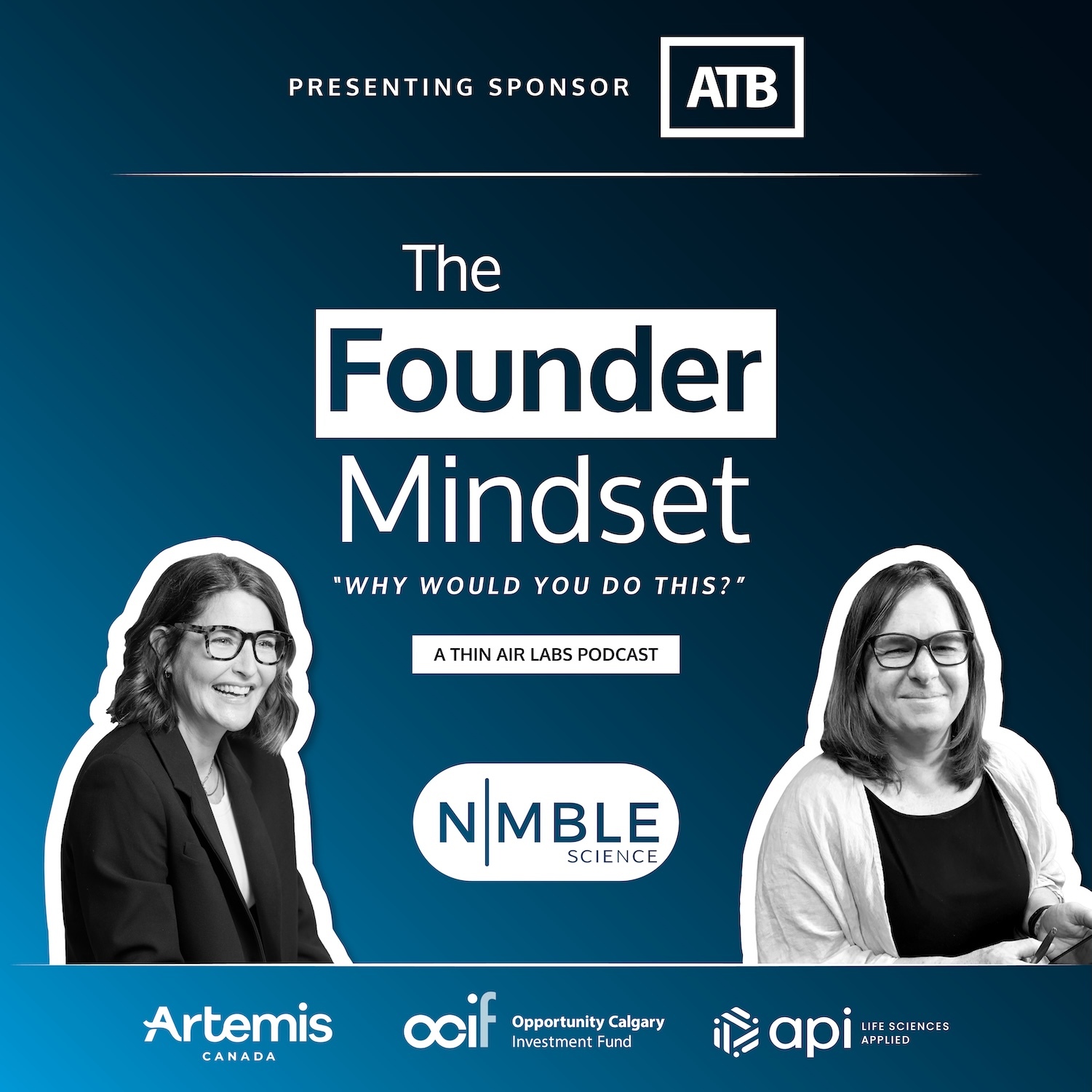
Joining me today in studio is Sabina Bruehlmann, Co-Founder and CEO of Nimble Science, a precision medicine company revolutionizing the understanding of the gastrointestinal tract thanks to their SIMBA capsule, a medical device that collects data from the GI tract, including unparalleled access to the small intestine. Sabina, thank you so much for being here. I'm so excited to have this chat with you.
Sabina 01:32
Me too. I was excited to hear that company intro. I thought that's cool.
Leah 01:35
Did you like that? I wrote that myself. I'm so glad you liked it. You know, at the beginning of this conversation, we always take the little time capsule back in time, and we go way back. It's like, how did you even get into entrepreneurship? I know a little bit… I know you're a biomechanical engineer by trade, and you're a serial entrepreneur. You've done this three times, but I want to know, how did you first get into entrepreneurship? Do I have this right, that it had something to do with a critical hallway collision during your PhD?
Sabina 02:04
It did. But the truth is, I'm really stubborn, and I don't like things to not make sense. It so when there's like a problem, then you just start solving it because it has to be done, and then you find yourself alone, and then you call yourself an entrepreneur.
Leah 02:18
I love that.
Sabina 02:20
Because no one's bothering to do it with you. So that's the mindset. I was in my PhD just finishing, and I was really punchy, which is kind of a mood that I'm in right now. So just beware. I had won this award, which was kind of cool. It was an international Spine Research Award, and I'd gotten the email, and I thought, “Oh my God, we won.” And I went out into the hall to find my supervisors who would obviously co-won with me to celebrate, and I ran into this guy, like I collided him… radically ran into him because I was not paying attention, and apologized and asked him what he was… you know, and he was looking for the bathroom, and I said… I don't know why, but I said, “You're not really looking for the bathroom. What are you really here for?”
Leah 03:04
That's ballsy.
Sabina 03:06
I know I was just sort of in that mood. And then he said, “Well, I'm, you know…” Then he explained what he was doing, which was to find out the truth about this technology. He was associated with a venture capitalist in Palo Alto, and he wanted to engage with different researchers to figure it out. And I was like, “You know, it doesn't really work that way, like they just hire grad students to do that work, like they don't have time to, you know, they have the expertise, but they don't actually do the work.” And so I said, “You should really just have a company do it that engages them.” And he said, “Well, why don't you come to dinner tonight and we'll figure that out.” And I was like, “Okay.” And so we started a company to do that. So I hired all these grad students, and I had all these researchers on contract and I got their expertise, and they designed studies, and the grad students did it, and I just sort of brokered this. And then we figured out that the technology was terrible and it shouldn't have a life, and so they paid me to shelve it.
Leah 04:01
And that happens, yeah, that's good. That's a good way to start, right? Not everything deserves to go forward. Okay, so that's the first one, but I do actually just want to take a moment to reflect on the fact that you did just like, pitch this guy in the hallway. And was just like, well, I can figure that out for you. You go to dinner that night, and then ta da, it's done.
Sabina 04:23
So I didn't really think about it. I was just like, “Well, obviously you need to know this information, so obviously we need to do this.
Leah 04:32
So it was that obvious to you?
Sabina 04:34
Yeah. So I followed my gut, which is what most entrepreneurs do, I think. When… calculated is ridiculous, because there's no calculation that says you should do this. So everybody's following their gut. So I just followed my gut, which is funny that I'm now following everyone's health. Okay, it's also tidy,
Leah 04:55
So that's the first one, and then the second one was Zephyr Sleep Technologies. Is that right?
Sabina 05:00
Okay, so first, when I was doing that company, they kept talking about IP, right? And I thought they meant Internet Protocol. It was the late… the early 2000s, and internet protocols were a big thing, so they were more than what they are today. But anyway, I realized I had to actually learn something about where I was going to do this. So I went to the university and worked at the university tech transfer back when it was called University Technologies International, or UTI, okay, which is very funny, and all the women and all the medical faculty know, right? Funny, about the UTI. So I learned some things there, and then I spun out with a company that was spun out of the university, so it sort of hopped onto one of my portfolio.
Leah 05:48
Oh, yeah. Okay, that's exciting. And to be clear, IP is intellectual property, yeah. Just to be clear. That’s very fun. So how did you make that leap into just jumping aboard a company that you wanted to be a part of.
Sabina 06:02
I really loved the Founder, the now late Dr Remmers. He passed away just a few weeks ago, which is tragic, but I thought he was brilliant, and wanted to work with him. And again, it was a problem that needed to be solved, and so I threw myself into that as sort of a junior Co-Founder, you know, learned a lot, was able to work with a lot of people that knew different things and gained… so that's where I really cut my teeth, and was able to sort of watch from the sidelines as to how this all goes down. Yeah, and then took that experience and founded Nimble.
Leah 06:36
That's so exciting. Okay, so let's talk a little bit about Nimble itself. First of all, what is nimble?
Sabina 06:42
Well, what was Nimble, or what is Nimble?
Leah 06:44
Well, why don't we do both? Yeah, so how did it start? And then where is it today?
Sabina 06:46
So full props to my Co-Founder, who went to his basement to figure this out. So he was the one that heard it from the skies, that this technology was needed… that we needed better access to the gastrointestinal tract, and he figured out the capsule that would do it. And that's what… that's Dr Joseph Wong, who's my Co-Founder in Nimble. And he brought me this capsule, and he said, “Look, here it is. And I heard you're looking for a new company.” And I thought, oh my god, this thing is so simple, like it's a piece of plastic, and it does this awesome thing. So I thought I could just do this with my eyes closed. The Zephyr technology was so complex, had so many complexities to it… AI and data and bio… all these other things. And I thought, “Oh, my God, a piece of plastic. I love it. I'll just do this for a quick hot second.” We're gonna get this wrapped up and parked, and then we'll just move on right. And then, you know, as Joseph and I started, and we started talking to customers, and then we realized the value of the data and the interest of the data, and the role that Nimble had to play to not only deliver access, but to deliver the information context in which… because nobody knew what small intestinal… nobody really knows what the small intestine looks like on a day to day…. it's a sort of the black box of the human body, right? It's the control center, and it's the black box, which is very, very important.
So then we had to create a data company so that we could understand what was in the small intestine and how to relate those to different applications. So now Nimble is a data platform that works with B2B companies that are developing consumer products and drugs and different types of solutions for GI health, we give them access and give them better data to develop those products, and then we also take those data and insights with them and develop diagnostic tools to translate to clinicians, so clinicians can have a better view of the small intestine and then better products to serve it. So it's kind of like a full loop, so now we're more of a data platform than…
Leah 08:43
Okay, yeah, amazing. So not simply the medical device. It's much bigger than that. Yeah, that's exciting. Okay, so then, if we're talking today, and let's keep in mind that this content is evergreen. So how many employees do you have right about now?
Sabina 09:01
23-25 ish. Yeah.
Leah 09:02
And then you launched when?
Sabina 09:04
What does launched mean?
Leah 09:06
That's a good question, isn't it, that we all really need to answer.
Sabina 09:11
Joseph started in 2018, we joined up in 2019. In 2023, we were ready to really offer commercial products in partnership with companies around the world. And then the data platform launched this year.
Leah 09:27
So exciting. Stages of launch. Got it. And do you want to talk about how much money you've raised?
Sabina 09:33
Well, we've been, I don't know… no, because it's like, five something like that. We're in the middle of a raise. So we're always… this is evergreen, because you're always in the middle, we are in the middle of a raise right now. Yeah, we have a phenomenal group of investors that really span the world and all of the different fields that we work in. So food and nutrition, pharma, data, devices, everywhere from New Zealand to France to Japan to the US, and so it really is a global company, and a very much a global cap table, which is really exciting. We could always use more from Canada, though. So if you're listening… Evergreen, here we go Canadian folks, pay attention.
Leah 10:14
Here it is. Do I have this right, that you're now integrated? The symbol capsule, anyway, is now integrated into over 19 global clinical studies. Is that right?
Sabina 10:25
Yeah, there are 26 partnership agreements, about six of them are maybe bench top studies in 1920 clinical studies. And it's… every like, name a disease, like everything from… I just got off the phone this morning with a researcher in Austria who's done liver cirrhosis and she's just waiting for the data to come back now, partnered with Dr Valerie Taylor here with an OCD project. Chronic fatigue, RTI, Parkinson's, multiple sclerosis, Alzheimer's, everything…
Leah 11:00
That's outrageous, like that is incredible when you start thinking about the impact of these studies, and we'll get to that in a minute. But what I do want to dig into just a little bit is, you know, we're sitting here kind of saying how amazing this is, and you've got these incredible global partnerships. But as we know, with every entrepreneur, there are always crazy moments when you're building the company, when you're like, “I have no idea if this is going to work or not,” and you know, maybe the first one you had to shelve that… it just didn't work. But in this case, can you think of a story that really sort of outlines that high rate, high stakes moment for you, like, do or die moment?
Sabina 11:36
No, it's um, it's every day. So this technology will solve problems, and it's our job to figure out where the problems are ready to be solved and it won't be all of them. And so there are technical challenges or technical things to be aware of all the time. And that's so every day I worry about the technical risk every day, because that's my job, which is… okay, I thought this was going to be about me and my mindset… because it's you have to be like a cheerleader and have ultimate belief, which I do, on a global sense, but on every problem you think is this gonna give us… because nobody needs more noise like the medical community, especially in GI health, right? We don't need more storytelling that isn't data-driven. So the technical challenge, like, just this morning, well, you asked me the question there offline, we were talking about, like, what was on my mind, and repeatability, right? We're really diving into the weeds of what signal is repeatable, and where and how much, and what's the clinical significance of that, and what can we say? And so it's not like we made a widget and we tested the widget and then we're like, “Oh, great. How many people want this widget?” It's like, “What problems can this data solve?” And so every day there's a technical, oh no, go.
Leah 12:56
So here's where we get into the mindset. So how do you, as a human being, deal with that kind of stress of trying to figure out it—Does this thing… Is this useful? Is this helpful? Is this working every single day, you're saying.
Sabina 13:11
Yeah, well, I'm stubborn. Yeah, you know, my PhD supervisor left me with many, many words of wisdom. But one of the ones, he's like, “Wow, you're super stubborn,” and then he was more gracious and said, “tenacious.” And it's like, yes, you just, I just know that this is valuable information, because it's not just what's happening in our microbial environment, in the small intestine, which is linked to all of these different gut pathway type things. It's actually a way of measuring what's happening in real time. So we can look at it like you ate this, this happened. So we can start to understand the body's reaction to certain types of impacts and stuff. So there's answers in there. And so you just have to do two things. One, you have to be stubborn. Three things. Two, you have to have a team that can solve these problems with you. The team is huge, especially because of its multidisciplinary nature. And then you have to create a business model that allows for many of these things to be done together. So we've created a business model where these 19 studies, and I think, 14 different conditions. So we've got a systematic way of the needle in the haystack to look for what is… where the answers are, and then combining that stuff to form bigger solutions. So it's a business model and a stubbornness.
Leah 14:32
I love it. So stubbornness… but I actually liked how your supervisor said, but it's also the tenacity, it's a nicer word, it's a kinder word. But don't you think that's absolutely essential an entrepreneur.
Sabina 14:46
Have you ever met an entrepreneur, that's anything but? Absolutely… you start to do this enough, you can see some pattern recognition going on, and tenacity and stubbornness, I guess, tenacity and resilience, I would suggest, also comes up a lot, that ability to keep going and be resilient and move it forward.
Sabina 15:07
Yeah, and you don't want to go, you know… everything, like my first story, not everything has a life and needs to be right. So there has to be a tenacious… but tenacity includes, you know, knowing when you're solving a problem and when you're not right, whereas stubbornness is just kind of like going for it. That's where the serial entrepreneur helps, to know that you've been there before. Things got sticky and messy, and then you figured it out, and you cycled through it. So that helps to know that you know you don't have to ride the waves. You just… you stick right in the middle, you let the waves kind of lap over you. You don't go too high, you don't go too low. Don't get too excited. You just try to stay even, because it's not a roller coaster that'll kill you,
Leah 15:49
Right, right? So, how? So, how do you deal with that roller coaster? Because that also comes up in these conversations every single time that the roller coaster, huge highs, huge lows—exciting.
Sabina 15:58
Yeah, I think, well, some people are naturally like that. So you're looking for an even keel, yeah, just know that that's the way that time will solve it. Good sleep will solve half of it. Yeah, time will solve the rest of it. You've got to keep moving forward. So… you might keep telling the team like we're building roads, even though we're still figuring out the car, but the car will drive on these roads, and so we understand what the roads are going to look like, and so you don't have to wait. So you're kind of building the infrastructure around you to scale as you're scaling the technical solution, right?
Leah 16:32
Yeah, that makes sense. I think those analogies are helpful, because I don't think people totally get what it is to be an entrepreneur until they're in it. Yeah, there's a lot of naivety at play.
Sabina 16:42
There's a lot of naivete, yeah, for sure. And there's a lot of versions of what entrepreneurship means, right? Like, I think it's different for every kind of journey. I think for a very heavy technical… like Nimble is a very, you know, we're doing something very technically difficult, versus commercially difficult. Or, you know, well, we've got that too, yes…. But then we also have some commercial pros, right? It's very cool… easy to get meetings. People love to talk about it. It's easy to understand—oh, I don't have this now. I want this…
Leah 17:13
Yeah, and solving some really cool problems. We can talk a little bit more about impact in a minute, but I'm also really curious about how being an entrepreneur affects your relationships, your family, your friends, that kind of stuff. What does it look like for you?
Sabina 17:29
Yeah, you end up being surrounded by people that get you, but, you know, hopefully everybody is like that? I think it definitely puts relationships to the test. I mean, I'm a married woman of over 50. You know, I'm in that sandwich, parents, kids, very understanding husband, and all of that is a reality of what… I'm thankful that I'm doing it at this stage of my life, because I have the wisdom of what I've learned. And I, you know, learned that even keel piece. So it definitely tests relationships, less with your family, because they kind of, you know, you can help them understand. You can kind of bring them… they're not surprised. But friendships are difficult, more difficult to understand the sort of mental stress that you're under versus, you know, the mental stress that, I mean, everybody's under some sort of mental stress, but just a different type, right? Yeah, yeah, yeah. So it's difficult. It's nice to be friends with other Founders. That helps, for sure. Yeah, the community that we have is really helpful.
Leah 18:30
Yeah, no kidding. Let's talk just a little bit about that mental stress. How do you cope with your mental stress? whereas maybe we're not right,
Sabina 18:40
Why do we think that we're coping?
Leah 18:42
And maybe we’re not… sometimes it's things that people try to achieve right. They're still striving for the wellness.
Sabina 18:49
It’s… improvement. It's like quality management systems. It's a difficult one. Sometimes I'm coping and sometimes I'm not, and the people around you will tell you, you know how you're relating to the team, and things like that are telling you how you're… and then you need to adjust. So it's mostly just giving yourself time. And I know I'm supposed to say that exercise, you're supposed to exercise. And that would be great…
Leah 19:15
That would be great, “would be” being the operative part.
Sabina 19:19
If I were coping, I would be exercising. That piece has not been achieved very well. I don't know if you cope. You just sort of let it become part of yourself and realize, actually, you know what… I have a strategy. I learned this at Zephyr from a colleague that I valued a lot, and he came in from the outside world, meaning he hadn't always been in this kind of crazy environment, and we were in a room and doing things that we… and he was like, “Oh my God, just look behind you. Nobody's trying to eat you… There are no tigers chasing you,” and the physical act of actually turning your head and looking behind you and telling your brain that you're not going to get eaten, actually brings the stress level down. So I do that all the time. I tell my team, “Stop. Turn your head. If you see a tiger eating, you proceed. Otherwise, calm down,” and your stress will adjust. Yeah, do it. You have to turn around. No tiger, you're fine. Your body really is tuned to like—I'm going to be eaten. And you're like, “Yes, I'm actually not going to be eaten.” Something's… not today, you know, something's not gonna be exactly the way I want it, or whatever, right? And that's okay. You're not getting eaten. So that's that is a major coping…
Leah 20:36
That sounds very useful.
Sabina 20:38
It is, yeah, it has served me well.
Leah 20:40
And I would imagine, too, and you sort of alluded to this, but you know, as we get into our 50s, there's a bit of wisdom, and there's a bit of, like, I've kind of been through this before. I know what this can look like, and I'm gonna survive. Like, it's gonna be okay, it's gonna be a gong show getting there, but I can do this.
Sabina 20:59
Yeah, there is, there's also the other stuff, though, like menopause.
Leah 21:03
Yeah, tell me about it.
Sabina 21:07
Can we say it right? You're like, you think you're in this Founder craziness, right. And you're dealing, you're like, why am I doing all the things, and you're like, struggling, and everyone's giving you company advice, and really… you just need… your body, it's freaking out. And then when you realize that and you give your body what it needs, then you're like, oh, oh, the Founder thing is not actually responsible for all the stress in my life, right? It's not everything. There's, you know, you have kids stress and body stress and, yeah, inherent stress, and so sometimes I think we, it's really just one part of our, of our lives, and that has to be kept in mind. But yeah, the menopause at the same time is a bit of an interesting… it offered a lot of creativity and yeah…
Leah 22:01
Sure, yeah, that's a good spin. But I'm actually really glad you brought that up. I mean, I'm being… in the same age
Sabina 22:04
Right. Put it in the title, like—Founder Talks About Menopause. Why not? Yeah, let's not.
Leah 22:09
But why not? I love that. Why not? I absolutely love it. Because, I mean, as you know, on the morning show, I would talk about this stuff all the time, and nobody was talking about this stuff. And I'm saying this kind of like… menopause is incredibly impactful on a woman and her team and everybody around her and her husband, and her husband, bless them, because it impacts everything right from the brain fog to the physical symptoms to just the inability to assess some of that stress that you're talking about, absolutely…
Sabina 22:38
And even actually… the husband. So you know, I remember the conversation I had with my husband, Peter, who was like, you know, this is killing you. Like you've got, like, what are you doing? You have to, like, you know, where does this take place in your life? And then once we realize that it's actually, like this other thing that is also influencing, then it almost allowed, like it relaxed him that it wasn't something I was taking on, on my own, right? And so it's actually really important that people understand, because it's tough when you're stressed and you think you've done this to yourself, right? Yes, yeah. Like, what am I doing? Why am I working this hard? Whatever your job is, right? Why am I doing this? Why am I, you know, you're trying to think, like, for what? For how you're always reasoning, “No, it's it's good, it's exciting, it's neat, you know, I love it. The world needs it.” This is going to be, yeah, you know, a good company. But when you realize, no, this is actually something else that's working alongside of it, it de-stresses, the… what you need the company to answer for?
Leah 23:38
So I just need to explore that one phrase. This is killing you, because is he talking about the company and the building of the company?
Sabina 22:44
Well, it's certain moments.
Leah 23:46
I'm sure, yeah, because that's a huge statement to come from a partner, right? That's someone who's saying, “I'm really worried about you.”
Sabina 23:53
Right? Yeah, no, there's parts where you like, you know, you work, and I mean different Founders and different people do it in a different way, but I really love it, yeah, really love it. And I really love the other parts of my life too. But you can get addicted. And so your body starts to, you know, assume the position, and you like, it's like, laptop size, your body goes into laptop size, like, you get right? And then you're like, okay, my mobility, like, I can't, I'm not hiking the same way that I could before, right? My health. And so he's like, “Look, this is crazy, right?” But then you realize, no, it's because my ligaments are tightening because I'm in menopause and I don't have enough estrogen. It's not … so all of that, right? It's like, I think his statement of—it's killing you is in the same context of any husband looking at a wife going—What's happening? I don't understand, right? Yeah, we were putting it all on, on the, on my involvement in this, in this company, in this, this thing that I wanted to do, and so, yeah, so it's nice to be like, “No, it's not all…”
Leah 24:54
Yeah, okay, that makes sense. I like that little bit of perspective. Is helpful. The Founder Mindset is brought to you by ATB Financial. In the fast-paced world of tech, your banking needs evolve as quickly as your industry, whether you're just starting out or aiming to reach new heights, ATB Financial is dedicated to supporting tech companies every step of the way. Partner with ATB Financial for a banking solution that grows with your business.
Okay, so clearly, there are a lot of challenges when it comes to being an entrepreneur, but you've mentioned this a couple of times—how much you love this work. What do you love about it?
Sabina 25:36
I love that you get to invent, not just the technology, but the way that you work as a team, the way that the… I love all the inventing in terms of how to do things faster, more efficiently. You're inventing business models. You're inventing ways. So I love that. I love the creative process across the board. And I don't think there's another type of job where you can do that as freely. So I love that part of it. I love the fact that every… you see people transform… you transform, you know, one quarter to the next. You're a new person. But your team, you know, you give these people these 15 hats, and they learn to juggle them, and they evolve as these people… They only start as one type of person, and they end up being like… they just completely evolve who they are, which is so wonderful and cool to see, and then so Nimble to borrow a word. So lesson in Zephyr. Zephyr did a deal with Align Technologies, which is the people that did Invisalign braces, and they were just kind of like, you know, they were not a startup anymore. They were past, sort of scale up, but they still sort of had that Founder early mindset, right? They were this big company pumping Invisalign braces around the world, and we partnered with them, and we were all in awe, like, Oh, they've got all this stuff, beautiful building, project manager sitting there taking notes in the meeting, and all this stuff. And yet we recognize that, Oh, my God, we can move so much faster than they can. We can be so much more effective, so much more efficient. And so startup companies bring something wonderful to the world, right? Whether we're like… I mean, the intent is to become successful business, because that's ultimately the way your technology gets out there, right? So that's a needed piece of it, but you're really creating something that no one else can do… like, it's this unique, you know, no one else can take that type of risk, can make those types of advances. And so I just love that.
Leah 27:24
Yeah, you did say, though, that you evolve every quarter as a human being. So…
Sabina 27:30
…let's just maybe your baseline, maybe my baseline is something went, okay… No, yeah, it might be the baseline that you know, the lower you are, the more you… but you do… like you evolve your way of thinking, your way of interacting. You know, you're building processes like—how do we talk to each other? How do we meet? How do we… and so it's constantly evolving your understanding the business more, the business is growing. Like, it's just so dynamic, right? So you look back one quarter and you're like, Wow, that was the one I put… that's how you know, you can see your materials from a quarter ago, and you're like, That's crazy. How? So it's cool.
Leah 28:08
How much we've changed in that short amount of time. Yeah, wow. That is cool. It's very exciting. Yeah, we've got a few minutes left here. So I want to talk about impact. We think a lot about impact at Thin Air Labs, and I know you do too. So I really want to talk about—how do you think about creating impact in the world?
Sabina 28:22
If things are different, you know, you've left things differently. So Zephyr was not a commercial success. We, you know, for many reasons, a whole other podcast, but we really changed the minds of how people viewed an alternative to CPAP therapy. CPAP therapy, for… this was in sleep apnea. So we just changed the mind of how the clinical community understood alternative approaches to sleep apnea therapy, which is amazing, and you could see it, right? And you're like, and then the world is different now. I see the technologies coming out, and I think, yeah, the world is different because we showed that you could do this, you could create these bars. And so that's wonderful to me, but Nimble is a special one, because Nimble is a success, impact wise, already, because we have countless researchers and companies around the world that are looking at their products differently, asking different types of questions, expecting more valid answers to their products, everything from protein shakes to drugs to, you know, Parkinson's medication, and so that… it's shifted, it's changed. And so that's huge. Yeah, it's massive the world, and I don't mean you me and my mother, although my mother does think differently, but I mean, like the people that are the ones creating these solutions in GI health, across clinical consumer, you know, the entire spectrum, they think differently about what level of knowledge is expected from them, and they know that there's a bar that's shifted, and that's massive.
Leah 29:55
That's massive. Yeah, I do want to take a moment to reflect on that. Even. Further. If you take it even farther down the line, you've got the capsule, and it's informing these research studies that you're talking about. But then, okay, let's take Parkinson's for example. If that means there's a new therapy for people suffering from Parkinson's disease that impact is massive.
Sabina 30:16
Or better yet, if the existing therapies can be applied with more precision, right? Because then it's a tomorrow solution. Like, you don't have to, it's not like you have to develop a new drug. It's just like, if you could understand what you know, in this case, Levodopa is doing and how it should be tuned for you as an individual because of your microbial content, like, that's massive, and that's just like, there isn’t a lot of steps between there and now, right? So if you could just… Yeah, it's not necessarily always about new or better. It's just like, let's do what we have and understand what we have, right? You're taking GLP-1. Let's understand what that means to your body, right? And before we just… Yeah, or, if you're, you know, having a protein shake, how are you digesting those proteins? Or what’s happening in your lipids, and what's just, it's actually just informing actual decisions we make today.
Leah 31:09
Wow, because that really is the future of medicine, isn't it? Really, it's about being more precise. It's precision health care.
Sabina 31:13
Yeah. It's not treating everything, it's not treating everybody the same. In GI health. It's not treating the GI tract like a tube, measuring the poop on the end. It's a finely tuned instrument. It's got things going on, and we can't just, we can't over… It's about getting the right information out. Wonderful to do podcasts, to get a chance to… I mean, really I feel about, you know, these bills have to get paid… It's like, the other 14 hats get, we don't get to sit back and but, yeah, it does feel good, and it's motivating. It's in those times where things are sticky, that you're like, I don't know how you would be an entrepreneur without impact.
Leah 31:55
Yeah, absolutely.
Sabina 31:56
Because you have to build a business and the business you want to be profitable and everybody wants the exit for sure, but that doesn't come. The road… cannot be built on the desire for an exit. Right? Right. It's too long.
Leah: 32:07
It's too long.
Sabina 32:08
And crazy and too hard. And so if you don't have impact to guide you, I don't know what that… that would feel horrible like, it's very helpful. On Tuesday morning at 10:00, you're like, okay, this is good. This is a good thing, right? Yeah.
Leah 32:22
Awesome. We want to go to our last two questions. So you're the Co-founder of Nimble. You're writing the story for the company. How do you hope it goes?
Sabina 00:32:32
I hope we replace GI health with I want to say something more accessible, but how often do you think about your GI health? Well, probably a lot.
Leah 00:32:39
I do. Often.
Sabina 32:40
The right answer is a lot.
Leah 32:41 The right is. And that's exactly what I do.
Sabina 32:42
Even whether it's like, oh my God, I'm pooping like a, like a machine today or…
Leah 32:45
We're talking about the water and…
Sabina: 32:48
All the time, all thinking about our GI health. But we don't think… it doesn't feel very connected to us. It's this in right? We don't feel like our blood. We… right? Like we're kind of it's like this hidden thing that just sort of we think about it a lot, but we don't really associate. We don't even look at our poop.
Leah 33:05
Right, right, right.
Sabina 33:06
Nobody wants to look at their poop, right? The Japanese look at their poop and they're better for it.
Leah: [00:33:10] Oh.
Sabina: [00:33:11] So I hope that Nimble changes the language around how informative the GI tract is so that we start to think of it like a blood sample.
Leah 33:22
Oh.
Sabina 33:22
Like, of course it holds the information to my health, right? Whereas you think of your blood. You look at your blood and you think that has information in it.
Leah 33:31
Absolutely. Right. Whenever you're unwell, you think, I gotta go get some blood work done.
Sabina 33:34
And you think, gross, I don't want to be bleeding everywhere, right? Of course. And that's fair. But we think of it as a source of information, right? And it's valued. It's like a valued part of our body. Right? You're giving it to somebody.
Leah 33:45
Yes.
Sabina 33:46
And it's treated that way. And I think the GI health, GI tract, our intestinal fluid and our poop need to be treated in the same thing as blood.
Leah 33:56
Wow, that's really cool. All right. And then you are a Founder. How do you hope your own personal story goes?
Sabina 34:06
No one ever asks you that.
Leah 34:07
I know. That's why I like to.
Sabina 34:11
I mean, I'd love a successful exit, right?
Sabina 34:14
Let's be clear.
Leah 34:15
Let’s be very clear about that.
Sabina 34:16
Let's be very clear. My family would love a successful exit to balance what? It's taken from the journey so far, for sure. I hope that Nimble ends at a point where I have lots left to give. You know, because I'm always still in the… My husband was like, we should talk about retirement. I'm like, retirement. What are you on? We've already revealed the menopause thing. So obviously I'm, you know, at the age where retirement is a reasonable conversation to have. But I was like, I'm in the 101 course of this. I hope Nimble exits and the technology lives on, and the answers are there for others to to partake in and build off of. And I hope that I'm left with a, like that I can take all this and do something else.
Leah 35:02
So you're not stopping here?
Sabina 35:04
Yeah, I may have to do it from like a she-shed in southern Alberta while my husband's, like chopping wood in the mountains. We may need, like, internet to be better. So I can just sit in a shed somewhere.
Leah 35:15
Sit in a shed. Life goals right there. That's right. Sabina, thank you so much for this conversation.
Sabina 35:21
Thanks, Leah. It was awesome.
Leah 35:32
If you're building a tech company in Canada, you've probably heard of Artemis. They're the recruiters founders trust to find the leaders and key teammates who will shape the future of their business. I know them personally. They're thoughtful, genuinely caring, and deeply connected in tech. The Artemis Candida team treats every search like the future depends on it, because it does.
Life sciences. Aerospace. Agribusiness. Tech. The Opportunity Calgary Investment Fund is fueling Calgary's future through smart investment in innovative sectors and world class talent. It's how we grow a resilient, diversified economy. Explore more at OpportunityCalgary.com.
API is helping innovators accelerate from idea to impact. Whether it's pharmaceuticals, medical devices and diagnostics, health technologies or natural health products, APU supports the full journey from early research to clinical and commercial manufacturing. API bridges the gap between academia and industry right here in Canada.




In this episode of The Founder Mindset
We talk with Sabina Bruehlmann, Co-Founder and CEO of Nimble Science. Sabina takes us through her entrepreneurial journey, from an unexpected hallway collision during her PhD to launching companies in spine research, sleep technology, and now precision medicine. With candor and humor, she shares how stubbornness (or tenacity, as her supervisor put it) has been essential to navigating the highs and lows of entrepreneurship.
We also dive into Nimble’s groundbreaking SIMBA capsule, a medical device that provides unprecedented access to the small intestine and is now integrated into global clinical studies across diseases like Parkinson’s, Alzheimer’s, and chronic fatigue. Sabina reflects on the importance of impact-driven entrepreneurship, the realities of coping with stress while building a company, and why creating dynamic, adaptable teams is key to startup success.
Listeners will come away with a deeper appreciation for the mindset required to ride the entrepreneurial waves while keeping a steady keel, as well as insights into how data and precision medicine are transforming the future of healthcare.
About Sabina Bruehlmann
Sabina Bruehlmann is the Co-Founder and CEO of Nimble Science, a precision medicine company pioneering access to the gastrointestinal tract with its SIMBA capsule. A biomechanical engineer by training and a serial entrepreneur, she has founded and led multiple ventures, including Zephyr Sleep Technologies. Known for her resilience, creativity, and ability to bring multidisciplinary teams together, Sabina is passionate about advancing human health through innovative technology and data-driven solutions.
The Founder Mindset is Sponsored By:
Contact Information
Contact Thin Air Labs:
Contact Sabina Bruehlmann:
- Website: Nimble Science
- LinkedIn: Sabina Bruehlmann
Serial entrepreneur Sabina Bruehlmann, Co-Founder and CEO of Nimble Science, joins us to discuss her journey from accidental entrepreneurship to leading a company revolutionizing gastrointestinal research. She shares insights on resilience, coping with founder stress, and the impact of Nimble’s SIMBA capsule on precision health care.